Society of Jesus
The LeopardThe Society of Jesus is represented chiefly through its members’ work and choices rather than through a formal account of the order. Father Pirrone, chaplain to Don Fabrizio Corbera, Prince of Salina, links the order to household prayer, spiritual counsel, and the practical vulnerabilities of clergy during Sicily’s political upheaval. The Society’s response to danger is concrete: its older members leave for Naples carrying its archives, while a personal political connection helps Father Pirrone remain.
Household Ministry and Spiritual Authority
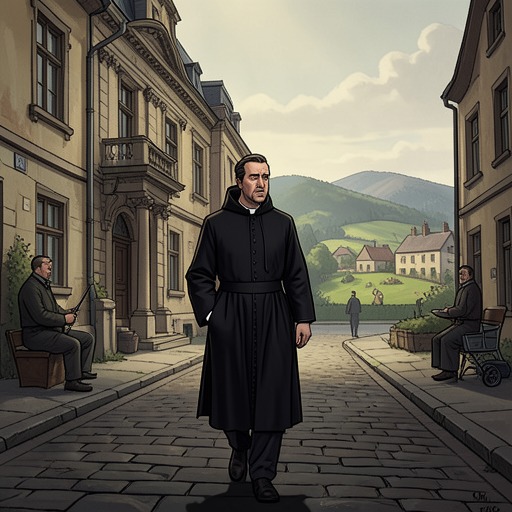
Father Pirrone’s position as the Salina family chaplain brings the Society of Jesus into the rhythms of private aristocratic life. In the opening household prayer, the Rosary concludes and the family and other participants disperse, while Father Pirrone remains absorbed in further prayer. His presence places the order within the family’s domestic religious practice, though the scene also shows how prayer takes place amid the elaborate, worldly setting of the Salina home.
The chaplain’s relationship with Don Fabrizio is not simply ceremonial. After accompanying the Prince on a night journey to Palermo, Father Pirrone later asks whether he is coming to confession. Don Fabrizio treats the priest’s knowledge of his conduct as if it made confession unnecessary. Father Pirrone rejects that assumption: knowing a person’s sins does not substitute for that person’s sorrow or repentance. The exchange defines a limit to the Prince’s social authority. Father Pirrone may be his dependent and companion, but he insists that spiritual judgment cannot be reduced to familiarity or private access.
Political Danger and the Order’s Response
During the 1860 crisis, Father Pirrone reports that his colleagues consider the situation more dangerous than it appears from the relative calm of Villa Salina. They fear a Piedmontese landing near Sciacca and a breakdown of control that could expose the city to looting and violence. Their concern is not merely political speculation: three of the oldest members leave for Naples on the afternoon packet boat, taking the Society’s archives with them. The episode presents institutional survival as both movement of people and protection of records.
The order’s vulnerability is also evident in the decree expelling Jesuits. A military general who has taken a liking to Father Pirrone agrees to seek an exemption by appealing to his supposed age and illness. He speaks with political acquaintances and uses his influence, and Father Pirrone is allowed to stay. The outcome depends on personal favor and political mediation rather than on any security the Society can command for itself. For Don Fabrizio, the exemption confirms his expectation that the new authorities will make room for old arrangements when useful.
A Cleric Between Private Service and Public Change
Father Pirrone’s journey with Don Fabrizio exposes an uneasy overlap between his clerical role and the Prince’s private life. The priest is offended by being made a companion on a visit that he understands as a love-adventure, yet he acquiesces. His position brings him close to the household’s conduct without giving him control over it; later, in the observatory, he reasserts the distinction between knowing about sin and granting spiritual absolution. The two episodes together show both the compromised proximity and the continuing moral claims of his office.
The Society’s members also remain visible in the Salina family’s later religious world. At the May 1910 meeting concerning an inspection of the family chapel, two members of the order are present among the clergy gathered at Villa Salina, including Father Corti. The inspection itself is organized by the Archdiocese of Palermo, and the evidence does not assign the Jesuits a particular role in its proceedings. Their presence nonetheless extends the order’s association with the family beyond Father Pirrone’s service, into the later scrutiny of private worship and the authenticity of the family’s religious objects.