Stars and Astronomy as a Spiritual Refuge
The LeopardFor Don Fabrizio Corbera, Prince of Salina, astronomy is both a serious intellectual pursuit and a refuge from the disorder of Sicilian life. Mathematics and observation give him genuine pleasure, official recognition, and a sense of contact with a stable cosmic order. They also allow him to withdraw, for a time, from political change and the decline of his class. Yet the stars do not resolve those earthly problems: their serenity offers temporary relief, while his reliance on it exposes the distance between understanding change and acting upon it.
Intellectual Practice and Personal Pride
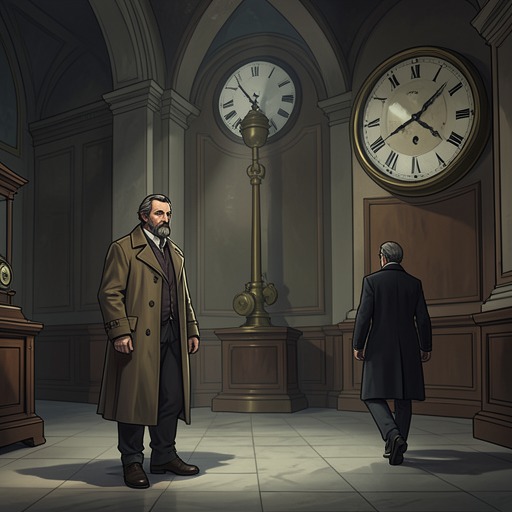
In a family long unable to keep accurate accounts, Don Fabrizio is distinguished by a genuine talent for mathematics. He applies that aptitude to astronomy, finding both professional recognition and private satisfaction in the work. His observatory, high in Villa Salina, is a space where scientific instruments receive the same careful attention that his powerful hands can give them at their most delicate. The contrast matters: a man who can bend a coin and has been known to twist table forks in anger handles telescopic fittings with precision.
His astronomical achievements also become entangled with family pride. He has discovered two small planets and named them Salina and Speedy, after his main estate and a favored shooting dog. He imagines their names carrying the Salina family’s reputation into the space between Mars and Jupiter, and takes the discoveries as a kind of vindication of the family’s grandeur. The aspiration is at once scientific and dynastic: the heavens appear to offer a durable stage for a house whose earthly inheritance is already in decline. His confidence that the stars obey his calculations further joins intellectual discipline to personal vanity, making astronomy a source of real knowledge and an imagined guarantee of family memory.
Withdrawal from Political Uncertainty
Astronomy becomes especially valuable when political events intrude on Don Fabrizio’s ordinary routines. In his office, the papers requiring decisions remind him of the administrative burdens he would rather avoid. He compares this burden with the late King’s reliance on a phantom administration and recognizes astronomy as his own more refined means of consolation. He pushes aside worries about precarious estates and turns to the latest issue of the Journal des Savants. Reading about observations from Greenwich allows him to enter a field governed, in his view, by calculation rather than political confusion.
His conversations with local dependants make clear what this withdrawal screens out. Don Pietro Russo speaks confidently of liberty, security, and prosperity after political change, even as he is secretly seeking to buy Argivocale and has previously hidden the Prince’s lemons. Don Fabrizio recognizes the self-interest beneath the assurances and understands that the rising class wants opportunities to make money. He also sees that promises of a new Sicily have accompanied successive invasions without delivering a different social reality. His response is not to organize against the changes but to find reassurance in the prospect that the old order may be altered in form while much remains familiar. Against this unsettled political world, astronomy offers a different kind of continuity: trajectories that can be calculated and celestial appearances expected in advance.
A Shared Language and a Temporary Calm
Astronomy also provides a point of contact between Don Fabrizio and Father Pirrone, despite their disagreements about politics and religion. After their exchange about confession and the future of the Church, the two discuss a report they are preparing for an observatory at Arcetri. The comets’ punctual appearances represent, for Don Fabrizio, not warnings of catastrophe but evidence of the mind’s capacity to anticipate and participate in the order of the skies. He contrasts this elevated attention with Bendicò’s pursuit of prey and the household’s ordinary work, viewing the observatory as a place from which disparate activity can be considered in a larger pattern.
This absorption brings a temporary composure that religious absolution has not supplied in the same way. For a period, his attention to the universe quiets the imaginative figures painted on the ceilings and the monkeys decorating the walls. The effect is not a conversion or a lasting cure: it is a brief suspension of the pressures he carries. When the household’s bell calls the two men back to luncheon, they return to domestic life, where even a small mishap involving Carolina’s hair becomes part of the day’s conversation. The movement between observatory and dining room makes the refuge’s limits visible. Cosmic attention can momentarily set earthly concerns aside, but it does not remove them.
The Stars as an Imagined Ideal
On another night, Don Fabrizio pauses on the balcony of his dressing room and tries to imagine himself in the cold regions of space as a pure intellect occupied with calculations. He regards the stars as disinterested and trustworthy, unlike human beings whose concerns involve dowries, political careers, and marriage. The comparison reveals how his attraction to astronomy exceeds technical work: the heavens stand for a realm free of the social claims that make his terrestrial life burdensome.
But the night also shows that this distance is incomplete. Don Fabrizio recognizes that it has been a bad day and that his mind keeps arranging the stars into the outline of a face. The pattern gathers together his unease about Don Calogero Sedàra’s appearance in Salina society, Concetta’s feelings, Tancredi’s attraction to Angelica, and his own conduct. The sky has not changed; his disturbed attention has altered what he sees in it. Astronomy can offer an ideal of impersonal order, but the observer carries human anxieties into the act of looking. Even Bendicò becomes, in this moment, a consoling comparison to the stars: a familiar presence that does not provoke the same troubling interpretations.
Consolation Without Escape
The Prince’s brief calm on the morning of May 13 extends from astronomy to his perception of the political landscape. He sees the countryside, Palermo, and foreign warships without the alarm they had seemed to promise during the night, and credits the sun with keeping Sicily in a state of immobility. He observes that even Victor Emmanuel II cannot easily change this condition. The scene places celestial observation beside a political insight: both register forces larger than individual will, but only the first seems to promise a precisely ordered routine.
That contrast defines the refuge’s ambiguity. Don Fabrizio can calculate celestial motions and take satisfaction in their predictability, while recognizing that his class is not promised the permanence the Church claims for itself. His astronomy sharpens his awareness of time and transience even as it consoles him. It gives him a genuine life of the mind, a private source of pleasure, and moments of release; it also helps him set aside the political and familial realities he understands but does not try to save. The stars are therefore neither a simple escape nor a solution. They provide order to contemplate, while the earthly world remains beyond the reach of his calculations.