Tancredi Falconeri
The LeopardTancredi Falconeri is the nephew and ward of Don Fabrizio Corbera, Prince of Salina, and one of the novel’s most consequential figures in the passage from Bourbon rule to a new political order. Charming, ambitious, and adept at reading the interests of his moment, he joins the revolutionary movement, marries Angelica Sedàra, and advances into public life. His rise turns political change into a personal strategy: he helps preserve an aristocratic name by allying it with money and influence from outside the old nobility.
Identity and Family Background
Tancredi is the son of Don Fabrizio’s sister and a spendthrift father whose ruin consumed the family fortune. After his mother’s death, the King entrusted his guardianship to Don Fabrizio when the boy was fourteen. By the time he is twenty-one, the family villa is a half-ruined remnant of the Falconeri estate, and Tancredi depends on his uncle’s generosity, including money from Don Fabrizio’s own pocket. The Prince’s attachment is unusually strong: although he does not admit it, he would prefer Tancredi as his heir to his own son, Paolo, Duke of Querceta.
The Prince sees in his nephew a restless appetite for life and an easy charm complicated by abrupt moments of seriousness. Tancredi can joke and disarm, but he is also perceptive about power. His manner allows him to move between contradictory positions without seeming trapped by either. To Don Fabrizio, this combination makes him both endearing and difficult to take at face value; the uncle’s affection does not prevent him from recognizing the younger man’s tact and self-interest.
Revolutionary Service and Political Adaptability
Tancredi’s early political sympathies put him in danger under the Bourbon government. After the April disturbances, Don Fabrizio works to keep him from serious trouble, despite the young man’s association with gamblers, fashionable women, and the secret National Committee. When Tancredi announces that he is leaving for the hills near Ficuzza to join the insurgents, the Prince fears for his safety and objects that a Falconeri ought to support the King. Tancredi answers by questioning which King he means. He argues that unless people like themselves take action, a republic may be imposed, and that change is necessary if existing arrangements are to endure. Before leaving, he embraces his uncle and promises to return with the tricolour.
Don Fabrizio’s response reveals the material support beneath their political disagreement. He runs after Tancredi and presses gold pieces into his pocket. The young man jokes that his uncle is subsidizing the Revolution, then departs. The gesture is affectionate, but it also shows how Tancredi’s rebellion remains connected to the resources of the family he appears to challenge.
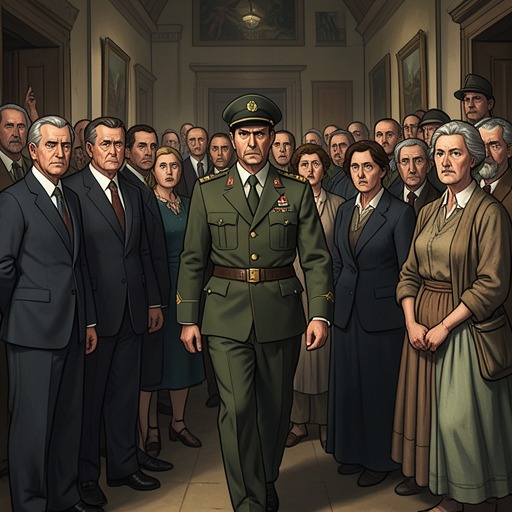
His revolutionary position soon becomes a practical route into the emerging order. By about 20 June, Tancredi has returned with a newly acquired captain’s rank and appears with the victorious officers who visit the Salina household. He is at ease with the mainland officers, exchanging familiar forms of address with them; Don Fabrizio notices that his nephew’s manner retains a faintly ironic edge. The Prince is reassured by the visit and by the cordial dinners that follow. The old household accommodates the new authorities, while Tancredi moves comfortably between them. The general’s intervention also secures an exemption from the expulsion order for Father Pirrone, a result that confirms Don Fabrizio’s sense that personal connections can soften political change.
Marriage and the Joining of Families
Tancredi’s marriage plans first unsettle the Salina household because Concetta Salina believes his attentions may signal a proposal to her. Father Pirrone reports her expectation, but Don Fabrizio doubts her interpretation and privately considers the practical and social conditions of a match. Concetta’s dowry would be limited by the division of the Salina fortune, while Tancredi needs substantial resources. The Prince concludes that the apparent courtship may be one of her romantic illusions. Tancredi’s actual choice soon makes clear that his future lies elsewhere.
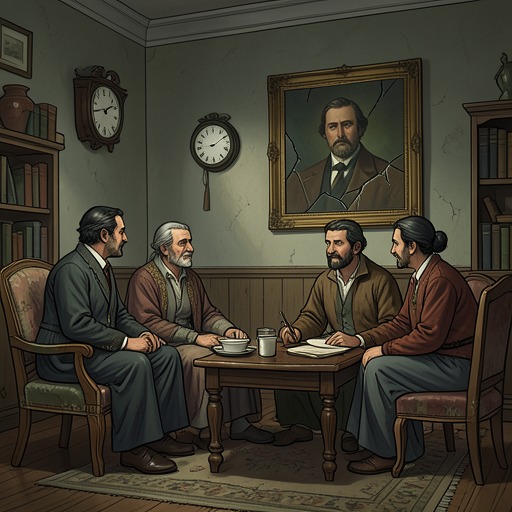
In a carefully composed letter, Tancredi asks Don Fabrizio to request Angelica’s hand from her father, Don Calogero Sedàra. He presents the match as a union between old and new families, one that could bring new resources into an aristocratic house and reduce class divisions. Don Fabrizio recognizes both the political argument and the familiar, ironic voice behind the formal style. The letter’s practical tact impresses him: its discussion of social change can be removed before the rest is shown to others. The Prince welcomes the match as a source of financial security for Tancredi, though he is uncomfortable at having to negotiate such an intimate matter with Don Calogero.
The engagement makes the economic exchange explicit. Tancredi’s inheritance has been largely lost: estates around Mazzara, pistachio woods at Ravanusa, mulberry plantations at Oliveri, and the Palermo palace have all gone. Don Fabrizio saved a villa during his guardianship, but it is in poor repair. In contrast, Don Calogero offers Angelica substantial property: the Settesoli estate, described as 644 salmi or 1,010 hectares of arable land, olive groves and vineyards at Gibildolce, and twenty linen sacks, each containing 10,000 ounces of gold. The figures expose the scale of the new wealth that will support Tancredi’s name and ambitions. Don Calogero also says that documents are in order for Angelica to bear a baronial title, though one link remains to be completed.
When Tancredi and Angelica become engaged, his confidence and attention to detail are evident in the ring he has selected: its size is exact because he has already measured her finger. At her arrival, he welcomes her and places it on her hand, while acknowledging Don Fabrizio’s role in providing it. The family’s return to Palermo is postponed, and the couple spend two weeks together at Donnafugata. Their courtship is marked by attraction and restraint; a church bell interrupts a moment when they are close to abandoning that restraint, and Tancredi has to leave the next day. The narrator later presents these days as a brief, cherished preparation for a marriage that would not prove erotically successful.
Public Advancement and Social Performance
Tancredi’s political and social ascent continues alongside his engagement. When he arrives at a gathering at Palazzo Ponteleone with Angelica and Don Calogero, he moves immediately to meet them. Angelica wears the Neapolitan sapphire ring, and Don Calogero’s newly awarded Cross of the Order of the Crown of Italy is discreetly removed from view by Tancredi. The small adjustment captures his fluency in managing appearances: he helps Angelica perform the composure expected of a future princess while keeping her father’s conspicuous distinction from disrupting the occasion.
That composure does not erase the force of the alliance. Angelica asks Don Fabrizio to dance, teasing him that Tancredi had been jealous of the request. Tancredi joins in the light exchange, and the three share a moment of warmth, though the Prince cannot tell whether the young couple intend to please him or gently mock him. Their affection for him persists alongside their confident movement into a changed social world.
By the time Don Fabrizio is dying, Tancredi is a Deputy and has been promised the Legation in Lisbon. He sits beside his uncle, holds his hand, and talks cheerfully about political developments, his projects, and the stories he knows. The Prince is grateful for his presence but is absorbed in reviewing his life. In that reckoning, Tancredi occupies an important place: Don Fabrizio remembers his nephew’s sympathy, especially because it carried an ironic quality, and the pleasure of watching him maneuver through the dangers of life. The uncle’s final recollection confirms that Tancredi’s significance is not only political or financial. He is also one of the relationships through which Don Fabrizio measures the genuine happiness of his own past.
Character and Significance
Tancredi’s career depends on his ability to combine conviction with calculation. He joins the insurgents while speaking of political change as a means of preventing deeper disruption; he accepts his uncle’s money even as he jokes about revolutionary subsidy; and he pursues a marriage that links his depleted aristocratic inheritance to Don Calogero’s immense resources. These are not separate sides of his life so much as a consistent method of adaptation.
Through Tancredi, political transformation enters the family as courtship, inheritance, military service, and social performance. His marriage does not simply unite two young people: it gives the Falconeri name fresh material support and brings the Sedàras into the orbit of the old aristocracy. His advancement also helps explain why Don Fabrizio can recognize the new order without imagining that it will wholly displace the old. Tancredi changes allegiance and circumstance with unusual ease, while retaining the family connections that make his progress possible. For his uncle, that same flexibility is a source of pride, affectionate amusement, and unease.