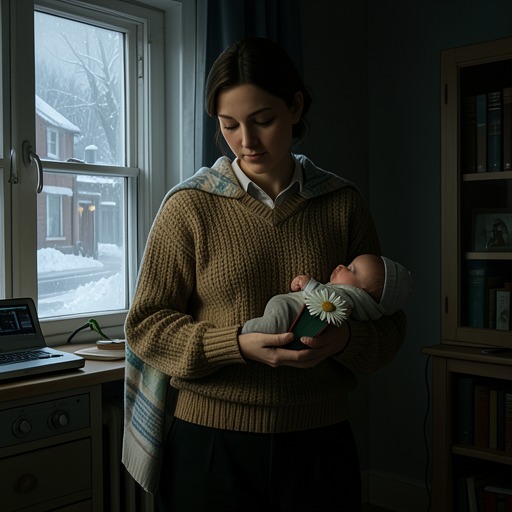
Austin’s adoption by Brett
The Life ListAustin Elizabeth’s adoption by Brett Bohlinger grows out of Sanquita Bell’s dying wish and Brett’s commitment to raise her child. Its decisive turn comes in court, where a notarized statement signed weeks before Sanquita’s death gives legal form to a request Brett had said was made to her alone. The ruling grants Brett temporary custody pending adoption procedures, while later scenes show the two living in a mother-and-child relationship without establishing the adoption’s final legal status.
From Sanquita’s Wish to a Custody Dispute
Brett’s claim rests first on her relationship with Sanquita: she was Sanquita’s best friend and homebound teacher, and Sanquita had asked her to keep the baby. At a meeting with social worker Kirsten Schertzing, Brett explains that Sanquita woke after delivering the child and told her she wanted Brett to raise the baby. The medical chart, however, records that Sanquita lapsed into a coma after her C-section and that nobody reported her conscious during the thirteen hours before her death except Brett. The gap between Brett’s account and the chart makes the request difficult to establish through testimony alone.
Kirsten neither confirms nor dismisses Brett’s account. She says that people sometimes regain consciousness briefly to say goodbye or express a last wish, but stresses that her own belief is not what matters: the court must decide. She also tells Brett that Tia Robinson came to see her that morning, describing her as coherent and extremely well behaved, and warns that custody courts almost always rule in favor of family. That warning frames the hearing as more than a test of Brett’s devotion: her promise must withstand a process in which her account competes with both medical documentation and the possibility of a family claim.
The Evidence at the Hearing
Under questioning, Brett acknowledges that nobody else was present when Sanquita spoke to her. She adds that Sanquita had told Jean Anderson from the Joshua House about her intention earlier. The opposing lawyer presses the point, asking whether anyone witnessed the moment Brett describes as Sanquita emerging from her coma long enough to entrust her baby to her. The question reduces a deeply personal exchange to the problem of corroboration.
The turning point comes when Judge Garcia holds up a notarized statement dated March fifth, several weeks before Sanquita’s death. Signed by Sanquita, it records her intention for her unborn child should the child outlive her: she wanted Brett, identified as her best friend and homebound teacher, to receive sole custody. The document supplies independent, written evidence of the same wish Brett has described. The court therefore does not have to rely only on Brett’s recollection of Sanquita’s final hours.
Temporary Custody and Its Meaning
On the strength of the notarized request, Judge Garcia grants Brett temporary custody until adoption procedures are finalized. The distinction matters: the ruling authorizes Brett to care for Austin while the legal process continues; it is not itself confirmation that the adoption has been completed. Brett breaks down in court, then declines to celebrate with Brad and Jean Anderson. She goes straight to the hospital, eager to see the child she now calls her baby.
The emotional force of the decision lies in the way Sanquita’s wishes move across forms of evidence and care. Her spoken request is intimate but contested; her signed statement makes that intention legible to the court. Brett’s relationship to Austin, meanwhile, is not expressed only as a legal claim. She has been chosen by Sanquita, has accepted responsibility, and now acts on that responsibility by going directly to the hospital after the ruling.
Life with Austin
A later scene places Austin in Brett’s arms. Brett has just spoken with Catherine Humphries-Bohlinger, whose call stirs a memory of a trip she took with her mother; as she walks to the door, she is holding the child. The scene presents Austin as part of Brett’s everyday life and makes tangible the caregiving relationship that began with her promise to Sanquita. Together with Brett’s exclamation at the hospital, this later image shows the movement from a contested custody request toward lived motherhood, while leaving the final legal outcome of the adoption unspecified.