Brett Bohlinger—John Manson
The Life ListBrett Bohlinger’s relationship with John Manson is the answer to a lifelong uncertainty about her parentage, but it is not settled by biology alone. Her mother’s journal leads Brett to identify John as her biological father; her first phone call brings both recognition and fresh disappointment, and their eventual reunion begins the work of becoming family in person. The relationship moves from a name left among painful clues to a reciprocal bond marked by welcome, physical affection, and Brett’s connection to John’s daughter Zoë.
Identity and the Hidden Connection
For most of Brett’s life, Charles Bohlinger occupied the place of her father, although Brett had struggled with their relationship and felt that he did not love her. The possibility that her parentage was different emerges through her mother Elizabeth Bohlinger’s journal. When Brett’s brother Joad Bohlinger urges caution, pointing out that the journal does not prove anything and that Charles may well have been her father, Brett insists that her mother left the journal and a new goal on her list so that she would find her real father and have a relationship with him. Her certainty is emotionally forceful, but at this point the identity remains to be verified.
Brett’s search turns the name Johnny Manns into a person rooted in her mother’s past. When she asks David Newsome and Mary Newsome about him, they remember that he played guitar at Justine’s and that women in the neighborhood had admired him. Their recollection places him in the neighborhood in the spring of 1978, giving Brett a concrete lead rather than a conclusion. The decisive confirmation comes later, after Brett watches a video four times: she recognizes John as the man in it and tells David and Mary that he was her father.
The name itself becomes clearer as Brett acts on what she has learned. When she speaks with Brad Midar, she corrects the earlier identification: her father is John Manson, not Manns, and he is living somewhere out west. She asks Brad to tell Steve Pohlonski, the investigator, and describes John as beautiful after seeing him on the video. The correction marks a shift from interpreting a journal and other people’s memories to pursuing a specific living person.
First Contact and Its Uneasy Welcome
Brett reaches John by phone at Christmas. The connection is hesitant at first: after a silence, he identifies himself as John Manson. Brett learns that he lives in Seattle, owns Manson Music, and still gets occasional guitar work. The music in his life gives shape to the memories of the guitarist David and Mary described, while the conversation makes the long-absent father an immediate voice with a present-day life.
Brett wants to know everything about him and asks whether he might come to Chicago. John says that he is happy to know her and looks forward to meeting, but not at that time. Brett accepts his answer politely and sends her love to Zoë, hoping she feels better. Once the call ends, however, the contradiction is plain: Brett has found her father and learned she has a half sister, yet feels more rejected than ever. The relationship therefore does not leap from discovery to ease. John’s acknowledgement is real, but his inability to meet then leaves Brett with a new, personal form of waiting.
That first call also establishes that Brett’s connection with John cannot be separated from Zoë. Brett is introduced to her as John’s other daughter before she has met either of them in person. On a later call, Brett asks John how Zoë is; he reports that she is coming home for good after repeated hospital stays. Brett celebrates the news and understands that it brings relief to the family. Her concern is no longer only a route toward John: she is already responding to Zoë as someone whose well-being matters to her.
Reunion and Recognition
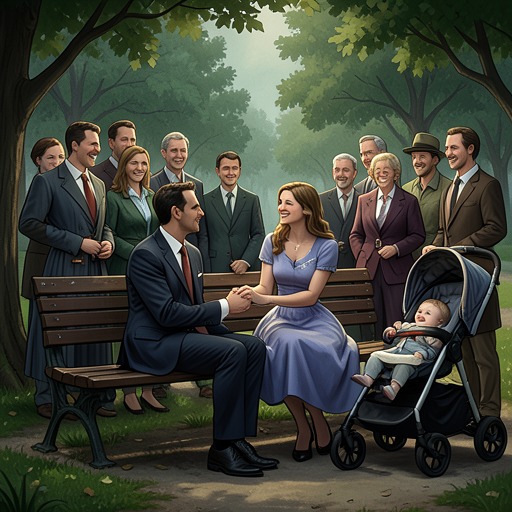
When Brett finally meets John, the visual resemblance joins the evidence that had accumulated through names and a video. She recognizes the man from the recording in the tall, silver-haired figure before her. John opens his arms, and Brett steps forward, rests her head against his leather coat, and lets him rock her. She understands the embrace as her first experience of being held by her father. What the journal and search could establish as a fact, this encounter gives a bodily and emotional form.
John tells Brett that she is beautiful and looks like her mother. When she jokes that she must have inherited her height from him, he points to her eyes as another resemblance and says he is glad she found him. His response matters because it answers the rejection she felt after their first call: this time, John expresses gladness directly, and Brett feels joy. He carries her bag and puts an arm around her shoulder as they set out to collect Zoë from school, moving from reunion between two adults into an act of shared family life.
Zoë’s welcome completes the encounter without making the relationships interchangeable. She tells Brett that Brett is her sister; Brett confirms that they are sisters and immediately feels love for her. John takes one of Brett’s hands and Zoë the other as they walk together. The scene makes kinship tangible through recognition, affection, and their shared movement through Zoë’s school, while preserving the distinct new bond Brett is forming with each of them.
Parentage, Silence, and the Meaning of Family
Elizabeth’s final account explains why Brett’s biological relationship to John remained hidden. Thirty-four years earlier, Elizabeth promised Charles Bohlinger that she would never disclose the secret of Brett’s conception, in return for his promise to raise Brett as his own. Elizabeth says that she wanted to tell Brett, but Charles was adamant; she also feared that, without knowing where Brett’s biological father was, disclosure would only deepen Brett’s sense of paternal rejection. The account places John’s absence inside a history of choices and silence, rather than treating the discovery as a simple reunion with an available father.
The letter identifies John as the man Elizabeth loved and connects Brett’s conception to that past relationship. It does not erase the years in which Brett understood Charles to be her father, nor does it make the pain of those years inconsequential. Instead, Brett’s relationship with John develops alongside a more complicated understanding of the family she already had: Charles raised her, Elizabeth withheld the truth, and John is the biological father she eventually finds. Their reunion matters not because blood alone settles every question, but because John’s welcome and Brett’s willingness to meet him begin a relationship the concealed history had made impossible earlier.