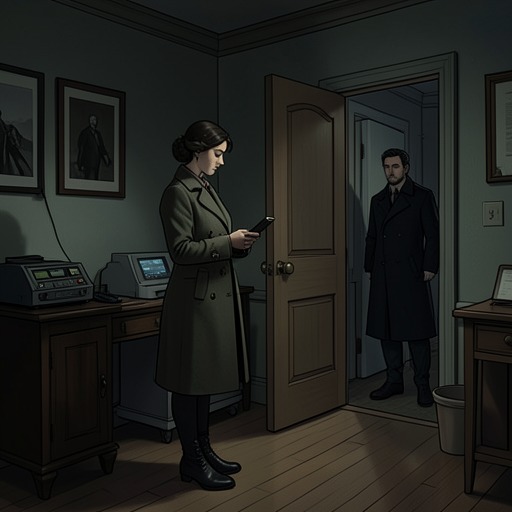
Brett discovers her father’s identity
The Life ListBrett Bohlinger discovers that the man she has sought as Johnny Manns is John Manson, the father whose identity was obscured by a stage name. The discovery begins with uncertainty over her mother’s journal and ends with a name precise enough to pursue: a clue carried through an old friendship, a family video, and a bartender’s memory. It gives Brett an answer, but not immediate closeness; finding her father and being welcomed by him prove to be separate events.
From the Journal to the Search
The discovery grows out of Brett’s reading of her mother’s journal after her death. When Brett confronts her brother Joad Bohlinger, he urges caution: the journal does not prove that Charles Bohlinger was not her father. Brett rejects that possibility, connecting the journal to the final goal her mother left her—to find her real father and have a relationship with him. For Brett, the journal is not merely a record of her mother’s past; it is an instruction to pursue her own.
Joad’s response reveals another layer of the family’s silence. He had found the journal years earlier while helping their mother move into the Astor Street house, but kept what he had seen to himself. It resurfaced for him at the funeral. His reluctance to accept Brett’s conclusion contrasts with her determination to treat the journal as a deliberate clue, though neither the journal nor Joad’s earlier discovery yet supplies the name she needs.
A Friend’s Memory and a Face on Film
The trail advances through Brett’s renewed contact with Carrie Newsome. At a family gathering, Carrie, Brett, and other relatives watch old home movies that David Newsome has transferred from VHS to DVD. The footage first brings Brett face to face with her mother as a young woman, visibly pregnant and pulling two boys on a sled. The family archive makes the past tangible, but the decisive identification comes from the people who remember it.
David and Mary Newsome say they were among Brett’s mother’s first customers and recall meeting her in spring 1978. When Brett asks about Johnny Manns, they recognize him: he played guitar at Justine’s, where Mary remembers him as talented and striking. Their recollections place him in the life of Brett’s mother at a specific time and place. David then offers something more direct than memory: he filmed the musician while bartending at Justine’s and preserved the performance on DVD.
On the recording, a young man with shaggy dark hair and a beard sits on a stool in a crowded, dim bar. When the camera closes in, Brett recognizes his brown eyes as the same ones she sees in the mirror. David’s footage therefore does more than establish that Johnny existed or that he performed at the bar. It gives Brett a visual likeness through which she recognizes a family relationship before she knows the man’s legal name.
The song in the recording deepens that recognition. Johnny introduces the Beatles’ Blackbird and sings of a bird longing to fly and to be free. Brett thinks of her mother’s constrained life with two young children and a husband she did not love, then of her own long wait to look at her father. She watches the recording again and again, listening to his voice and reaching toward his image. The footage cannot answer whether he will welcome her, but it changes the search from an abstract hunt for a name into an encounter with a recognizable person.
The Name Behind Johnny Manns
Brett has already hired a detective, who has spent months looking for Johnny Manns among the many people with that name. David’s recollection supplies the missing distinction: Johnny Manns was a stage name. The musician’s surname was Manson, adopted for performance because the name carried a terrible stigma in the 1970s. David knew the legal surname because, as the bartender that summer, he handled payroll.
That explanation turns an apparently specific search into a misdirected one. Brett had been looking under the name the musician used onstage, while the person who could connect him to official records knew the name behind it. She realizes that without seeing Carrie again, she might have searched indefinitely. Her mother’s ninth goal had led her back to Carrie, and Carrie’s family history had led to David, the man who could identify Johnny as John Manson. In Brett’s account, the route joins the recovery of an old friendship to the discovery of her father.
Recognition, Contact, and What Follows
Knowing the name allows Brett to make contact, but does not immediately resolve the relationship. When she finally speaks with John Manson, he tells her that he is glad to know her and hopes to meet, but not at that time. Brett responds graciously and asks him to give her love to Zoë. After ending the call, she recognizes the distance between having found her father and feeling accepted by him: she has also learned that she has a half sister, yet feels more rejected than ever. The discovery is thus both a breakthrough and a fresh emotional setback.
The relationship develops beyond that first postponement. When Brett meets Zoë, she affirms that they are sisters and comes to love her. The later meeting gives the identity discovery a consequence that the first phone call could not guarantee: the search opens onto a living family relationship, not merely a name or a resemblance. The mother’s letter, read later by Brett and her father together, further explains why the truth had been withheld. Elizabeth Bohlinger writes that she promised Charles Bohlinger she would not reveal the secret of Brett’s conception in exchange for his promise to raise Brett as his own. The letter does not erase the years of silence, but makes clear that Brett’s search has uncovered a family history shaped by a promise as well as by biological kinship.
The event’s significance lies in the chain of evidence through which Brett reaches the truth. Her mother’s journal gives her a goal, Carrie reconnects her to the people who remember the past, and David’s video and payroll knowledge join face to name. Yet the sequence refuses to make discovery a simple resolution: John’s identity can be established before trust or belonging is secured. Brett’s search begins as a demand to know where she comes from and becomes the first step toward choosing and building family ties.