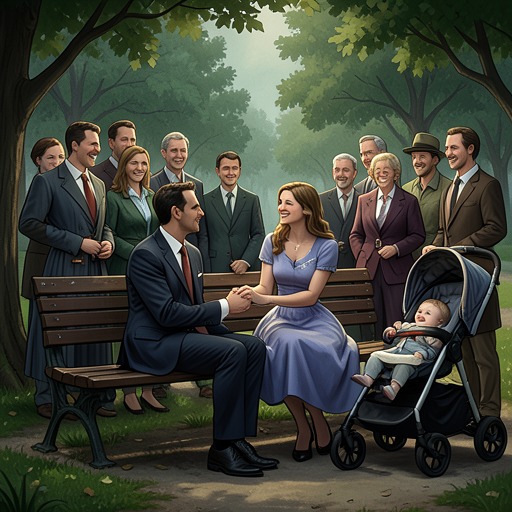
Brett reunites with her biological father, John
The Life ListBrett Bohlinger’s reunion with her biological father, John, transforms a goal on her mother’s life list into a relationship grounded in shared stories, painful family history, and new kinship. Their two-hour conversation fills in parts of a thirty-four-year family puzzle, while John’s account of his love for Elizabeth and the threat that drove him away changes Brett’s understanding of the past. By the time Brett leaves, she no longer experiences John and her half-sister Zoë as strangers; she treats them as family and entrusts John with Elizabeth’s journal.
A Goal Under a Deadline
The meeting belongs to a larger reckoning set in motion by Elizabeth Bohlinger’s life list. John tells Brett that she must complete at least one goal by the end of the current month and finish the entire list by September 13 of the following year. The deadline gives the family encounter practical urgency: establishing a relationship with her father is one of the goals she is trying to fulfill, not simply a possibility she can leave indefinitely open.
At thirty-four, Brett is also confronting how much of her life has been shaped by fear of losing what she already has. She recognizes that she has been afraid to leave Andrew because beginning again could mean ending up with nothing. After they decide to pursue a different lifestyle, Andrew is cold toward her, and Brett sends him out to the office rather than give him time to change his mind. The strain makes the effort to form a new family connection part of a broader period of uncertainty, rather than a detached search for information about her origins.
By late winter, the deadline feels increasingly close. Brett has completed five of ten goals and is hopeful about establishing a relationship with her father, even as other ambitions—including falling in love, having a baby, buying a horse, and getting a beautiful house—seem beyond her control. The contrast matters: this particular goal depends on another person’s willingness to meet her, but the visit gives her a direct opportunity to act on it.
Two Hours of Stories
Brett and John spend two hours exchanging questions, stories, and anecdotes, trying to supply the missing pieces in the family history. The conversation is reciprocal rather than a simple revelation delivered by John: both ask and answer, and the time they spend together begins to turn an abstract relationship into an acquaintance built from personal memories. John tells Brett that she reminds him of Elizabeth, a comparison Brett receives as a compliment and meets with an expression of how much she misses her mother.
The question of whether John tried to stay in touch with Elizabeth brings the history into sharper focus. He says that he wanted to marry her and loved her as he had never loved another woman. His account directly challenges the idea that he left because he did not love her or was unwilling to commit. Brett refers to Elizabeth’s journal and says that it made clear her mother would have left Charles and followed John, while also confronting John with the fact that his departure broke Elizabeth’s heart.
John explains that Charles Bohlinger discovered their love and demanded that Elizabeth choose between the two men. Elizabeth openly chose John and left the kitchen. Before John could follow, Charles stopped him and threatened that, if Elizabeth left, she would never see her sons again. John says Charles planned to portray Elizabeth as an unfit mother and him as a drug-using boyfriend, a liability in a custody fight. The revelation recasts John’s departure as a response to the threatened separation of Elizabeth from her boys, rather than as a lack of love.
A Farewell That Makes Them Family
The visit’s emotional change becomes clearest at the airport. By Saturday, Brett feels she is leaving family rather than the two strangers she met upon arrival. She crouches beside Zoë in the lobby and hugs her; Zoë clings to Brett’s sweater, then holds out her thumb. The two press their thumbs together as a new ritual, and Brett tells her sister that she loves her and will call that night. The gesture gives their newly recognized kinship a small, repeatable form that can continue after the visit.
Brett also invites John to come to Chicago so everyone can meet him and Zoë. Before she leaves, she gives John Elizabeth’s leather journal. He holds it carefully in both hands, and Brett tells him that its pages contain Elizabeth’s feelings for him. The gift makes the reunion more than an exchange of explanations: Brett places her mother’s written testimony in John’s keeping, linking the relationship they are beginning to the love that preceded it.
Consequences and Significance
The reunion does not erase the years of separation or resolve every unanswered question. Instead, it changes what Brett can know and how she understands the people involved. John’s account supplies a motive for leaving that is bound to the threat against Elizabeth’s sons; Elizabeth’s journal, which Brett has read, and John’s recollection become complementary records of a relationship whose consequences shaped the family for decades.
The encounter also gives the life-list goal a concrete outcome. Brett leaves with a father she intends to keep in contact with and a sister with whom she has made a promise to speak. In the broader arc of the list, this is a relationship she cannot complete through willpower alone: it requires time, another person’s participation, and a willingness to receive a complicated history. The airport farewell, the thumb-press, and the journal passed into John’s hands mark the shift from searching for family to beginning a life within it.