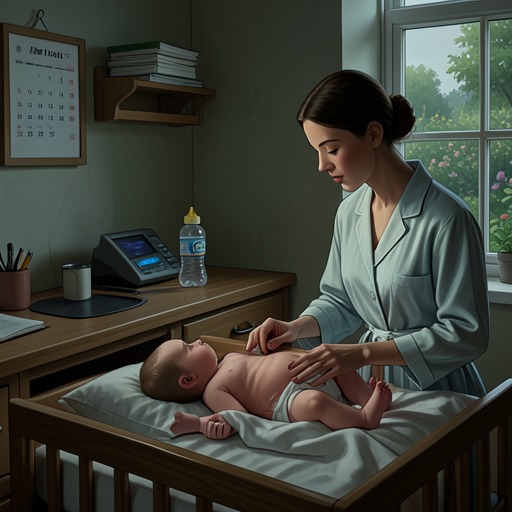
Jay Bohlinger—Shelley
The Life ListJay Bohlinger and Shelley’s marriage is shaped by a negotiation over work, parenting, and the identities each partner can sustain. When Shelley gives up her career to stay home with their children, the arrangement she and Jay thought would suit the family instead leaves her feeling diminished and isolated. Their recovery begins not with a demand that Shelley adapt, but with Jay’s support for her return to work and his willingness to take on more of the caregiving himself.
Identity and Shared History
Shelley is Jay Bohlinger’s wife and Brett Bohlinger’s sister-in-law, but her connection to Brett predates the marriage: the two were friends and college roommates. They preserve that earlier bond by getting a silly pleasure from calling each other sister. That easy intimacy gives Shelley a confidante outside her marriage when the household arrangement becomes difficult, while Jay and Shelley’s decisions remain the central partnership under strain.
The couple’s initial choice is presented as a joint decision rather than one imposed by Jay. Shelley tells Brett that she and Jay agreed it would be best for the children if one parent stayed home. In the wake of Elizabeth Bohlinger’s inheritance, they also believe they no longer need the additional income from Shelley’s job. The choice appears practical and family-minded: they have a reason for changing their division of labor, and Shelley is able to leave her position without an immediate financial need to replace its pay.
Shelley Leaves Her Career
Before becoming a full-time caregiver, Shelley works as a speech pathologist in the rehabilitation unit at Saint Francis Hospital. Her work involves helping adults with traumatic brain injuries recover not only speech but also reasoning, negotiation, and social skills. She had described the work as a calling, so leaving it means relinquishing more than a job title. The loss is visible in the gap between her former professional identity and the diminished way she later describes herself.
The departure happens quickly. Shelley’s maternity-leave replacement is still available, is interviewed the previous day, and starts immediately, so Shelley does not even have to train her successor. She presents the smooth handover as having worked out perfectly, but Brett hears a catch in her voice and recognizes that the ease of replacing her at work does not mean the choice feels easy. Shelley’s apparent readiness therefore carries a contradiction: the practical transition is settled, while the personal cost is only beginning to surface.
At first, Shelley imagines that staying home will connect her and her children to the neighborhood’s routines. She points to the other stay-at-home mothers, their park gatherings, playdates, and toddler yoga, and worries that the children missed social opportunities while in day care. But her son Trevor’s difficulty speaking touches the professional knowledge she has left behind. She jokes that perhaps a speech pathologist can finally teach her own child to talk, then stops herself mid-thought. The joke cannot quite conceal how closely her new role is bound to the expertise and expectations she used to carry into work.
Strain Within the Marriage
After a couple of months at home, Shelley tells Brett that she is struggling with motherhood and regrets how sharply she has just spoken to Trevor. She feels she ought to be grateful for time with her children, yet dreads another playdate and describes herself as exhausted, boring, and inadequate. The change has narrowed her sense of self: she no longer has the meaningful professional work she valued, and she does not experience domestic life as a satisfying substitute.
Shelley also fears that Jay is losing interest in her. She says she has nothing to share with him anymore, connecting the state of the marriage to her loss of a life beyond the children. This is Shelley’s anxious assessment, not confirmation that Jay has withdrawn from her. The distinction matters: the scene shows a marriage under pressure as she experiences it, while leaving Jay’s feelings to be revealed through his later response. Brett suggests that the couple spend time away from the children, first imagining a tropical break and then proposing a city trip with shows, shopping, and uninterrupted time together. Shelley resists the fantasy that a holiday alone will instantly repair how she feels about her changed body and daily life.
Repair and a New Division of Care
The later account of a weekend in New Orleans marks a change. Shelley says that she and Jay felt like an actual couple again rather than only a mother and father. As they packed to go home, she cried and admitted that she was unhappy in the stay-at-home role. She confided this to Jay and Brett, and Jay’s answer, as Shelley reports it, carried neither judgment nor a guilt trip: he told her to return to work. His response addresses the problem she has named instead of treating her discontent as a failure of gratitude or devotion.
Jay then acts on that support. He meets with his department chair and receives a leave of absence; he will finish the semester and then take a year off. The arrangement reverses the division they first chose: Shelley plans to return to her former profession, while Jay will try being the stay-at-home parent. Shelley believes he may be good at it because, in her view, he has more patience than she does, although neither the outcome of his trial nor a permanent division of labor is established. The important change is that caregiving is no longer treated as Shelley’s role by default. Jay is prepared to take responsibility for the same domestic work she found overwhelming, while she can recover a valued professional identity.
Their marriage thus moves from a well-intentioned family arrangement into strain and then toward a more flexible partnership. Shelley’s distress is not resolved simply by the couple spending time together; the weekend gives them room to reconnect and speak honestly, while the practical change in work and childcare makes that honesty consequential. Jay’s willingness to support Shelley’s return to work, and to test a different role himself, turns marital care into a shared adjustment rather than an expectation that she endure an ill-fitting identity. The relationship’s developing strength lies in that capacity to revise the plan when its costs become clear.