John Manson
The Life ListJohn Manson is Brett Bohlinger’s biological father and Elizabeth Bohlinger’s former love. A guitarist who performed in Chicago under the name Johnny Manns, he was bound by a decades-old promise not to disclose the secret of Brett’s conception. The delayed revelation turns him from a name hidden in Elizabeth’s journal into a living relative: Brett recognizes his face and eyes in old footage, reaches him by telephone, and eventually meets him in person.
Identity and Background
John’s connection to Brett begins with a relationship he had with Elizabeth before she married Charles Bohlinger. Elizabeth’s final letter explains that, thirty-four years earlier, she promised Charles she would not reveal the secret of Brett’s conception; in return, Charles promised to raise Brett as his own. Elizabeth says she had wanted to tell Brett the truth, but Charles opposed it, and she feared that revealing the identity of an absent father would deepen Brett’s sense of rejection. The secrecy therefore shaped both Brett’s upbringing and John’s place in the family story: he was her biological father, but not the father who raised her.
The letter also makes clear that John was not an incidental figure in Elizabeth’s past. She describes him as the man she loved and says that, in Brett, a piece of him had returned to her. Her account places their relationship at the center of Brett’s conception while also showing how Elizabeth’s loyalty to her promise kept that history from her daughter. John’s absence is thus connected not to a lack of significance, but to an agreement made between adults that Brett could not know about.
Musician and Stage Name
In the summer of 1978, John played guitar at Justine’s, a bar where David Newsome worked as a bartender. David remembers him as a major talent and recalls that women in the neighborhood were taken with him. He had also filmed John performing there. When Brett asks about the name Johnny Manns, David identifies the performer as John Manson: Manns was a stage name adopted because the Manson name carried a terrible stigma in the 1970s, associated with the notorious mass murderer.
The old recording gives Brett evidence more immediate than a remembered name. As the camera closes in on the young musician, she recognizes his brown eyes as the same eyes she sees in her own reflection. John’s appearance in the footage makes a distant family resemblance visible before she has met him. The recording also preserves him speaking about a Beatles song from The White Album, including its origins and the racial tensions in the United States that prompted it. For Brett, the footage is at once a record of a musician’s performance and a first encounter with the face of her father.
John had spent time in San Francisco, after which David and Mary Newsome lost track of him. Brett had already hired a detective to search for someone she knew as Johnny Manns, but the discrepancy between the stage name and John’s real surname helps explain why the search had been difficult. Correcting the name changes the search from a frustrating hunt for one of many Johnny Mannses into a pursuit of John Manson.
The Secret and First Contact
Brett’s discovery begins with Elizabeth’s red leather journal, left with a note asking Brett to save it for a day when she felt stronger. When the journal later reveals the name Johnny Manns, Brett interprets the clue alongside the new goal Elizabeth left for her: to find her real father and build a relationship with him. Her brother Joad urges caution, pointing out that the journal alone does not prove John was her father and that Charles may have been. Brett rejects that uncertainty, convinced that Elizabeth intended the journal and the goal to lead her to the truth.
The eventual telephone call gives Brett confirmation of John’s identity, but not the immediate reunion she hopes for. When he finally speaks, he identifies himself as John Manson. He tells Brett he is happy to know her and looks forward to meeting, but says that he cannot do so yet. Brett accepts his response and sends her love to Zoë, whom she understands to be his daughter and her half-sister. After the call, she tells those around her that she has found her father, yet feels more rejected than before. The contrast between confirmation and postponement makes their first contact a beginning rather than a resolution.
Reunion with Brett and Zoë
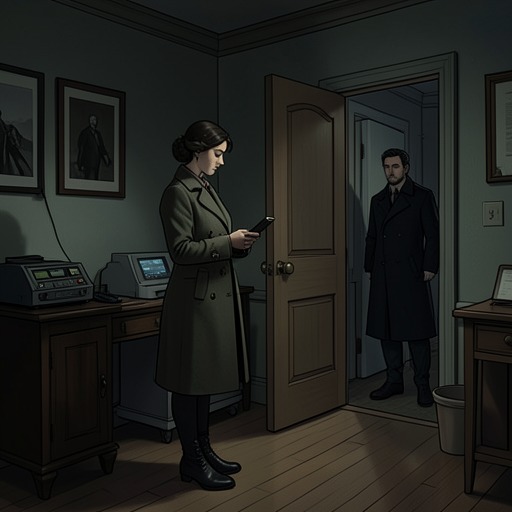
When Brett arrives expecting to meet John and Zoë, she worries that they may have forgotten the appointment or that Zoë has fallen ill again. John then calls her name. The man before her is tall, silver-haired, clean-shaven, and markedly different in appearance from the young musician in David’s video, but his eyes and smile connect the two images. Brett nods through her trembling, and John opens his arms. She steps into his embrace; he rocks her back and forth, and she experiences being held by her father for the first time.
John tells Brett that she is beautiful and looks just like her mother. The recognition is reciprocal: the daughter who had searched for him is not merely meeting a stranger, but finding a resemblance that links her to both parents. The embrace does not undo the years of secrecy or replace the father who raised her, but it gives physical form to the relationship that had existed only as a hidden history and a face on a screen.
Brett also meets Zoë, who has Down syndrome. Zoë declares Brett to be her sister, and Brett answers that they are sisters. Brett’s immediate affection marks a change from her earlier resentment toward the half-sister she had not yet met. Holding one of John’s hands and one of Brett’s, Zoë leads them down the hall toward her classroom. John points out the school’s facilities, including a hallway designed as a city street, with storefronts, traffic lights, and crossing signals. The scene places their new kinship within Zoë’s everyday world and makes the meeting a family introduction, not only a private reunion between father and daughter.
Significance
John’s story is structured around the difference between biological truth and lived parenthood. Charles raised Brett, while John, because of his promise to Elizabeth and the concealment surrounding her conception, remained unknown to her. The revelation does not erase that history; it allows Brett to name the relationship that had been withheld and to begin another one. Her journey from a coded name in a journal, through a recording and a difficult first call, to an embrace gives the delayed disclosure its emotional shape.
The objects and names that carry the search are consequential. Elizabeth’s journal preserves the clue; David’s video supplies a face and voice; the stage name initially obscures the surname; and David’s correction makes John traceable. Together, they show how a family history can survive in fragments even when the person at its center is absent. John’s reunion with Brett and her acceptance of Zoë expand her family, while leaving intact the distinction between the father she has newly found and the man who raised her.