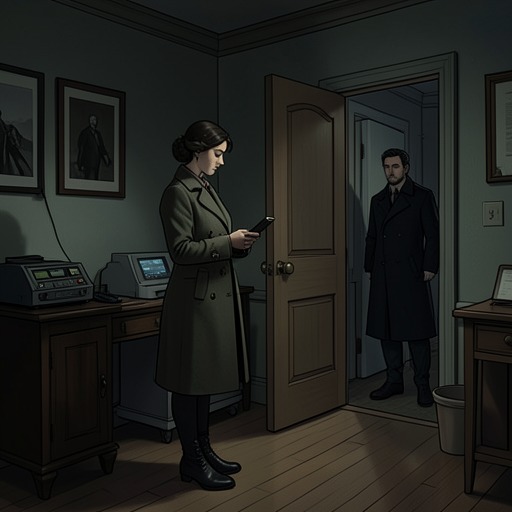
John leaves Elizabeth to protect her sons
The Life ListJohn Manson’s departure from Elizabeth Bohlinger was not a loss of love but a separation he chose under pressure from Charles Bohlinger, who threatened to make Elizabeth’s custody of her sons contingent on ending the relationship. John left after telling Elizabeth he did not want permanence, a lie meant to protect her from having to choose between him and Joad and Jay. The scene is recalled by John and later illuminated by Elizabeth’s letter, which confirms both his motive and the cost of the decision.
Causes and Stakes
John recounts the ultimatum to Brett Bohlinger after she challenges the idea that Charles was her father. When Charles learned that Elizabeth and John had fallen in love, John says, Charles was furious and forced her to choose between them. Elizabeth answered that she loved John and walked out of the kitchen. Before John could follow, Charles took him by the arm and threatened that if Elizabeth left, she would never see her boys again.
The threat drew its force from the unequal circumstances John describes. He places the episode in the 1970s, when, in his account, Charles could present himself as the respectable parent and John as an unfit partner. John says he had smoked marijuana, giving Charles material to portray him as a “pothead boyfriend.” Charles also threatened to testify that Elizabeth was a “slut, an unfit mother.” John believed it would not be difficult to guess which side a court would favor. The threatened loss was therefore not simply the end of a romance: Elizabeth risked losing daily life with Joad and Jay, whom John believed she could not bear to lose.
The Separation
John says he lied to Elizabeth, telling her he did not want a permanent relationship. He describes the decision as an effort to prevent her from having to choose between him and her sons: if she lost Joad and Jay, he believed, she would never recover. His account makes the deception painful precisely because it was meant as protection. He did not describe himself as indifferent or unwilling to love her; he says the lie “nearly did me in.”
The goodbye took place on the front porch on a sweltering afternoon. The house’s windows were open, and John was sure Charles could hear them. Even so, John told Elizabeth that he loved her and would always love her, while insisting that he was not the staying kind. He remembers believing that she saw through the claim. Elizabeth kissed him goodbye for the last time and whispered, “You know where to find me.” Her parting words left open the possibility of his return, even as the separation took effect.
What the Separation Meant to Each of Them
John’s recollection preserves the contrast between the explanation he gave and the feeling he says he concealed. To Elizabeth, his insistence that he was not suited to permanence could sound like a rejection; in his account, it was a means of keeping her sons from being taken from her. He remembers her as steadfast in her belief in him, and Brett recognizes the cost of that belief when she imagines Elizabeth later pulling her sons in a wagon, still expecting John to come back. The scene’s grief lies in the gap between the message John delivered and the motive he could not safely make its basis.
Elizabeth’s account, written later, independently confirms the sacrifice as she understood it. She says her world went silent after John left and that she loved him so desperately she would have done anything to stay with him, even at the cost of her own well-being. Only years afterward, she writes, did she understand the selfless purpose of his departure. She remained grateful that he had spared her from a choice that could have meant losing her sons. Her letter thus reframes the separation not as proof that John did not love her, but as an act that made their love impossible to live openly.
Aftermath and Narrative Significance
The separation did not resolve into reunion during Elizabeth’s life. After divorcing Charles, she hired someone to search for John, but the search failed. In her letter, she expresses certainty that Brett will find him one day and urges her daughter to celebrate when she does. She also acknowledges the affair’s selfish and cowardly circumstances while insisting that what she felt for John was real and powerful. Her account keeps both the moral complication and the emotional truth in view.
The event reaches the reader through two retrospective voices: John’s spoken explanation to Brett and Elizabeth’s written account. Their agreement revises the apparent meaning of an old abandonment. John’s explanation supplies the coercion behind his departure; Elizabeth’s letter reveals that she eventually recognized the sacrifice, though not in time to undo the years apart. For Brett, discovering this history connects her own search for her biological father to the choices her mother made under pressure. John’s departure protects Elizabeth’s relationship with her sons, but it also leaves a love that both remembered as enduring and a family history shaped by silence.