Joshua House
The Life ListJoshua House is a shelter for homeless women on Carroll Avenue, and a place where Brett Bohlinger’s teaching assignment grows into an enduring commitment to its residents. First encountered as an unexpected address during her home-teaching work, it becomes a setting for shared meals, practical care, and collective grief. The shelter’s significance lies not only in providing a place to stay, but in the relationships Brett forms there and the responsibilities she accepts as those relationships deepen.
Setting and Purpose
Brett reaches Joshua House after driving through Englewood to visit a student. A large green house on Carroll Avenue looks safe to her, but the sign outside makes her wonder whether she has come to the wrong address. The contrast between her expectation and the place’s actual purpose is immediate: it is a shelter for homeless women. The location is introduced through Brett’s uncertain perspective, as a home-teaching visit brings her into a social world she did not expect to find at the end of her route.
The shelter’s residents are called guests, and its limited space is apparent when Jean Anderson explains that it is at full capacity. The house also has a defined daily rhythm. Guests have the run of the house until seven in the evening, after which the kitchen is off-limits. Children must be in bed by nine, the television goes off at eleven thirty, and residents then retreat to their own quarters. These rules establish a shared domestic environment with boundaries shaped by communal living rather than by any one resident’s preferences.
Jean Anderson, the shelter’s director, oversees the house and explains its routines to Brett when she stays overnight. She assigns Brett a twin bed, notes that its sheets are changed daily, and expects Brett to strip the bed in the morning. Amy Olle is due to relieve her at eight. The practical specificity of this handover makes shelter work visible as a sequence of ordinary tasks: keeping a bed ready, respecting household rules, and ensuring that one person’s shift gives way to another’s.
Brett’s Work and Growing Involvement
Brett first comes to the shelter through her work as a teacher. Mercedes greets her and offers to show her and Sanquita around, making the introduction a shared act of welcome rather than a formal meeting with staff alone. Brett later thanks Mercedes for the tour and hurries into the bedroom, a brief sign of how the house accommodates the practical demands of her visit as well as its social introductions.
Her connection to Joshua House extends beyond teaching. Brett tells Andrew that she has signed up to volunteer on Monday nights and invites him to meet the women, especially Sanquita. She emphasizes that Sanquita remains tough, but that she has invited Brett to stay for Thanksgiving dinner. The invitation marks a change in their relationship: Brett is no longer only a teacher who arrives to work with a student, but someone welcomed into a community meal.
That welcome also affects Brett’s decisions outside the shelter. When she moves out of Andrew’s home, she packs towels, sheets, dishes, cookware, and silver. Asked where the belongings are going, she directs the movers to Carroll Avenue and Joshua House. The objects are useful household goods, not an abstract gesture of support; their destination makes the shelter part of Brett’s effort to redirect what she owns toward other people’s needs. Later, she brings food to the house. It takes three trips to carry everything inside, and Sanquita helps pile it on the kitchen counter as the other women gather. Tanya, Mercedes, and Julonia unload the food while the others lean in. By then Brett recognizes most of the women and knows some of their names, evidence of familiarity built through repeated visits rather than a single act of charity.
Sanquita’s Pregnancy and the Shelter Community
Joshua House becomes central to Brett’s concern for Sanquita. At four months pregnant, Sanquita does not look as though she is far along, and Brett worries that she is not healthy. Sanquita has been seeing whoever is on duty at the Cook County Health Department, but Brett is concerned that those doctors lack expertise in kidney disease. She arranges an appointment with a nephrologist at the University of Chicago Medical Center, bringing her concern about Sanquita’s health into practical action.
On the morning of the appointment, Brett picks Sanquita up at Joshua House. The scene is cold enough that Sanquita rubs her bare hands in front of the car’s heat vent; she is wearing a velour running suit and a cropped jacket with a faux-fur hood. The ride links the shelter’s everyday life to the specialist care Brett has arranged, while showing Sanquita’s circumstances in concrete detail rather than treating her condition as an abstraction.
During the later crisis, the shelter remains a point of return and contact. Brett calls the hospital nearly every hour, and Jean tells her by three in the morning that Sanquita will be fine. The next morning, Brett is loading breakfast bowls into the dishwasher when Jean’s car arrives. Brett rushes out and opens the car door before the ignition is off; Sanquita is slumped in the backseat, her head propped against the window. The shelter’s role here is not to replace medical care, but to connect the people surrounding Sanquita and to give Brett a place from which she can keep watch.
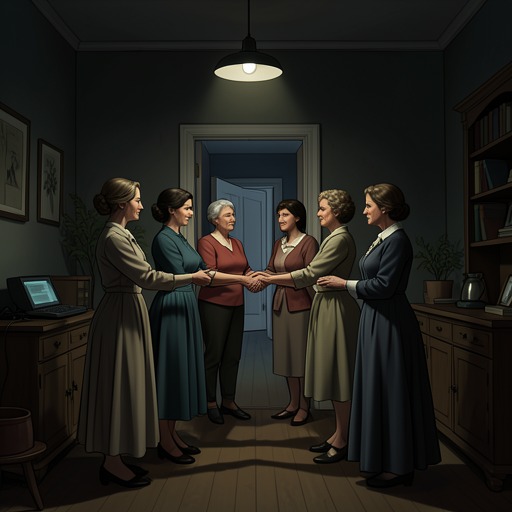
When Brett returns to Joshua House later, she expects to find Sanquita failing. Instead, Sanquita is sitting upright against her pillow in a brightly lit room, sipping juice. Tanya and Mercedes are beside her, sharing stories of their own labor. Sanquita’s wide-eyed response when she sees Brett underscores how much Brett’s presence matters to her, while the other women’s company makes the room a site of communal support. Jean later tells Brett that Sanquita had spoken to her, a connection that becomes important as Brett tries to understand Sanquita’s wishes concerning her baby. Brett argues against involving a family member Sanquita did not want near the child, insisting that another relative should be found if a family placement is necessary.
Legacy and Narrative Significance
After Sanquita gives birth and dies, members of the Joshua House community attend her funeral at Oak Woods Cemetery. Jean Anderson is there, as are the shelter’s friends, two teachers, Herbert Moyer, and Brett. The service’s impersonal eulogy contrasts with the particular knowledge and care represented by those who came from the shelter. When the gathering breaks up, Jean hurries back to Joshua House, while the teachers return to their jobs. Tanya, Julonia, and the other women walk up the grassy hill toward East 67th Street to catch the bus; Tanya lights a cigarette, takes a long drag, and passes it to Julonia. The closing image returns attention to the residents’ lives after the funeral, rather than allowing the ceremony to stand as the end of their story.
Joshua House therefore connects several kinds of care: shelter, teaching, food, medical advocacy, companionship, and the work of remembering. Its rules and routines show the practical structure of communal life; its residents’ relationships show that the house is more than a backdrop for Brett’s development. For Brett, returning to Carroll Avenue means moving from an assigned visit toward participation and responsibility. For Sanquita, the people associated with the house remain present through pregnancy, crisis, and death, and the shelter’s community carries her memory beyond the funeral.