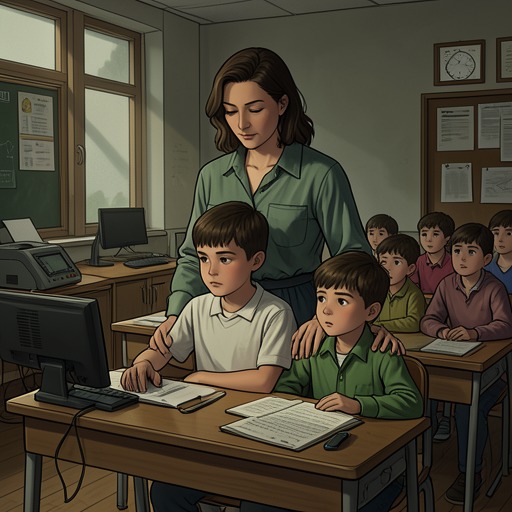
Peter Madison
The Life ListPeter Madison is an eleven-year-old sixth grader whose school expulsion brings Brett into his home as a teacher. Introduced through a psychiatric report and a first, uneasy visit, he is presented as a child in need of support but also as someone adults readily reduce to a diagnosis or a stereotype. His brief response to Brett suggests that reluctance and interest can coexist, without establishing what their work together will ultimately achieve.
Identity and School Situation
Peter’s file identifies him as a sixth grader with mental-health concerns. A psychiatric report records classroom aggression and his expulsion for the remainder of the semester, prompting Brett to ask what is wrong with him. Eve identifies the diagnosis used by Peter’s psychiatrist, Garrett Taylor, as conduct disorder. The report’s account makes clear that Peter’s difficulties have already had a concrete educational consequence: he is out of school for the rest of the term.
The arrangement offered to him is homebound instruction twice a week. Eve explains that, under an Illinois public-education statute, receiving those services counts as being educated. The provision gives Peter a way to continue schooling during his expulsion, but it also places the responsibility for teaching him in a private home rather than a classroom. Brett initially reacts to the case with alarm, contrasting its complexity with her earlier worry about shabby houses. The work will test her not only as a teacher but in her ability to meet a student whose circumstances resist easy solutions.
Eve describes Peter through a dismissive shorthand, calling his behavior “Little Shit Syndrome,” while attributing the problems she sees among children in the area to factors such as absent fathers, substance-abuse histories, and insufficient attention. Her remarks expose the risk of treating a child as a familiar social type before understanding his particular case. The evidence does not establish that every circumstance Eve lists applies to Peter; what it does show is how quickly professional and informal accounts can turn a complicated student into a label.
First Visit
Brett’s first visit takes her to Peter’s home on Wentworth Street. His mother, Autumn, answers while talking on the telephone, with a cigarette in hand, and gestures for Brett to come inside. The room is marked by cigarette smoke and cat urine; a black wool blanket covers the picture window, leaving the space without natural light. A framed image of Jesus hangs on the wall. These concrete details establish the setting of Peter’s instruction, but they do not explain his behavior or stand in for his perspective.
Autumn calls down the hallway for Peter to come out, threatening to break down his door. Brett, hearing the confrontation and recognizing Peter’s resistance, offers to return another time. The door then opens. Peter emerges from the gloomy hallway as a large boy with shaggy brown hair and a little fuzz on his chin. Brett introduces herself as Miss Brett; he passes her with the curt reply, “No shit.” The exchange is an abrupt beginning, neither a welcome nor a refusal to engage altogether: Peter comes out, but gives Brett no easy invitation to teach him.
Contact with Brett and Taylor
After the visit, Brett tells Garrett Taylor that Peter had been reluctant to leave his room. Taylor points to a detail Brett might otherwise have missed: Peter finally came out when he heard her say she was leaving. Taylor reads that choice as positive, suggesting that Peter wanted to meet her. That interpretation remains his, not a statement of Peter’s own motive, but it changes how Brett understands the encounter. Her initial apprehension gives way to relief, and the two adults continue discussing Peter before their conversation turns elsewhere.
Peter’s first appearance therefore sets up the central difficulty of the homebound arrangement: instruction depends on establishing contact with a student who has been expelled and who does not greet his teacher warmly. At the same time, his emergence from his room complicates the idea that he simply wants Brett gone. The scene offers a modest basis for continued work, not a resolution of his school exclusion or a record of later progress. Peter is introduced through other people’s reports, yet the small action of coming to the doorway gives him a presence beyond the diagnosis and disciplinary record.