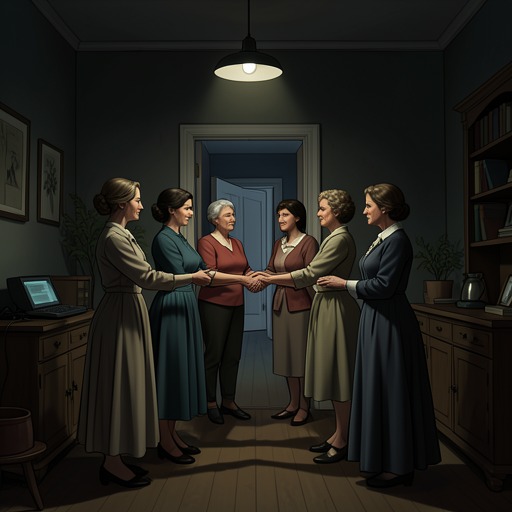
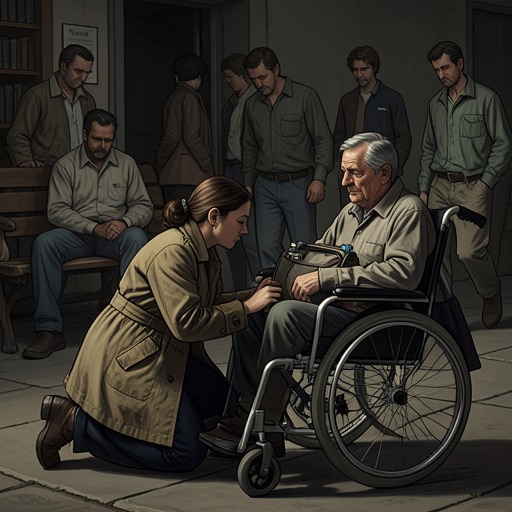
Sanquita House opens
The Life ListSanquita House opens as a shelter for women with children, an institutional answer to needs the novel has traced through Sanquita Bell’s precarious life and Brett Bohlinger’s care for her. The opening is marked by a pink program announcing a ribbon-cutting at 749 Ulysses Avenue on Sunday, August 7, at one o’clock in the afternoon. The book does not stage the ceremony itself; instead, it makes the announcement the last destination toward which Brett hurries, placing the new shelter alongside the family she has built and the losses that brought her there.
The announced opening
The program specifies the event with the crispness of a public notice: a Sunday date, a one o’clock start, a ribbon-cutting, and the name Sanquita House. It describes the institution as “Chicago’s newest shelter for women with children.” That designation gives the opening a concrete civic purpose. This is not simply a private home or a gesture of sympathy; it is a shelter for a particular group whose need for safety and support has been present throughout the story.
The stated address, 749 Ulysses Avenue, anchors that purpose in a specific place. The pink program is the scene’s central object, and Brett handles it as she prepares to leave: she lifts it from a stack and places it beside a picture of her mother, Elizabeth Bohlinger. The juxtaposition links the public announcement to the intimate history that surrounds it without explaining the shelter’s funding, administration, or day-to-day operation. Those details are not supplied. What the program does establish is the intended service, the location, and the time at which the opening will be marked.
Sanquita’s place in the story
The house’s name brings Sanquita into the final movement of the novel, after her death. As Brett’s student and friend, Sanquita had asked for practical help as well as personal concern. When Brett checked on her at Joshua House, Sanquita said she wanted help earning her diploma so that her baby would know her mother had been smart. Brett answered by taking out a chemistry book. Their relationship is thus shown through a specific act of teaching: the promise is not abstract encouragement but help with the work of completing an education.
Sanquita’s death makes the future of her child another urgent question. At a meeting with social worker Kirsten Schertzing, Brett explains that Sanquita woke after her C-section and told her to keep the baby. Kirsten notes that Sanquita’s medical chart records no other period of consciousness during the thirteen hours before her death. Brett’s account is therefore emotionally decisive but initially difficult to establish as evidence. The scene keeps the difference between what Brett believes she heard and what an official record can verify in view.
That distinction becomes consequential in court. Brett says that she and Sanquita were alone when Sanquita expressed her wish, though she also identifies Jean Anderson of Joshua House as someone Sanquita had spoken to earlier. The decisive document is a notarized statement dated March fifth, signed by Sanquita and declaring that she wanted Brett, her best friend and homebound teacher, to have sole custody of her child if the child survived her. Judge Garcia grants Brett temporary custody while adoption procedures are finalized. The sequence gives the name Sanquita House a resonance grounded in the story: Sanquita’s wishes and circumstances persist beyond her death, and Brett’s care becomes answerable to a formal public process.
From private care to public shelter
The opening announcement follows a narrative in which care has repeatedly taken material form. On Thanksgiving, Brett prepares a meal and brings it to Joshua House, where Sanquita is waiting at the door. The scene is modest in scale: food is packed into baskets and boxes, and Brett hands Sanquita a basket before returning to the car for more. It shows Brett’s willingness to respond to immediate need through ordinary work, rather than treating care as a sentiment alone.
The custody proceedings make that responsibility larger and more lasting. Brett’s account of Sanquita’s final wish is challenged, and social worker Kirsten warns that courts often favor family members. The signed, notarized statement changes the evidentiary situation; the judge can grant temporary custody on a written request rather than relying solely on Brett’s recollection. The shelter’s opening is not presented as a direct result of that court decision, and the text does not specify who established or operates the house. Its presence in the closing scene nevertheless broadens the story’s field of care: the final public notice names a shelter serving women with children, beyond the single mother and baby whose fate has occupied the courtroom.
The final scene and its contrast
Brett’s departure for the ceremony is framed through two forms of remembrance. She places the program beside her mother’s picture, then whispers a request for luck before hurrying to the car. The gesture brings the opening into contact with Elizabeth Bohlinger’s continuing place in Brett’s life, while the program points toward Sanquita’s name and the shelter’s public purpose. Neither remembrance is spelled out as an explanation for the other; the scene lets them stand together.
The final image also sets the ribbon-cutting beside Brett’s present family. She describes her husband and baby girl as the loves of her life, and the narration turns from the program to the family waiting in the car. The novel does not show the ribbon being cut or describe what happens inside Sanquita House. Instead, it closes on Brett moving toward the event, carrying the private histories of her mother, Sanquita, and the child she has promised to raise into a public occasion devoted to women and children. The opening therefore functions as a culmination without being reduced to a fully narrated ceremony: a dated invitation, an address, and a name are enough to make care visible beyond the household.