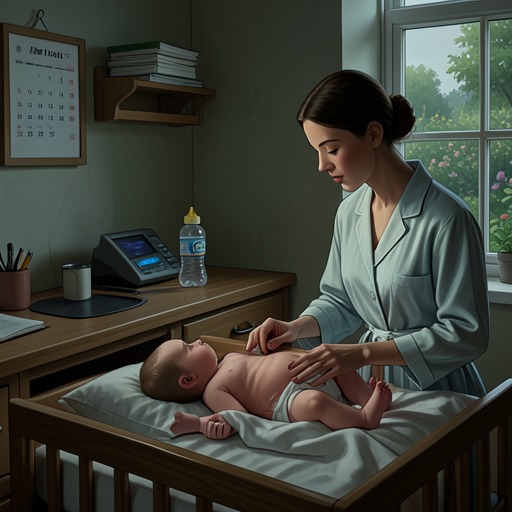
Shelley’s stay-at-home motherhood burnout
The Life ListShelley’s stay-at-home motherhood burnout is a crisis of identity as much as a struggle with childcare: she leaves meaningful work to care for her children, then discovers that loving them does not make full-time parenting the life she wants. Her eventual return to speech pathology, alongside Jay Bohlinger’s decision to try staying home, turns private exhaustion into a practical renegotiation of family life.
The decision to leave work
Shelley is Brett Bohlinger’s friend and former college roommate, and after marrying Brett’s brother, Jay Bohlinger, she and Brett keep the affectionate habit of calling each other sisters. When she tells Brett that she has quit her job, the decision sounds settled. She and Jay have agreed that one parent should stay home with the children, and the inheritance from Brett’s mother means they do not need Shelley’s additional income. Shelley says a replacement was available from her maternity leave, had already been interviewed, and started immediately, so there was no need for her to train anyone.
That smooth handover does not mean the choice is emotionally easy. Brett hears a catch in Shelley’s voice and recognizes that her cheerful account of how neatly everything worked out is incomplete. The gap between the practical explanation and the strain beneath it foreshadows a more difficult question: whether leaving work has cost Shelley more than a salary.
A vocation set aside
Before staying home, Shelley worked as a speech pathologist in the rehabilitation unit at Saint Francis Hospital. She helped adults with traumatic brain injuries relearn not only speech but also reasoning, negotiation, and social interaction. The work had been more than employment to her; she had described it as a calling. That history makes her later feeling that she is nothing without the job a particularly sharp reversal. She has not simply exchanged one set of tasks for another: she has lost a role in which her expertise, effort, and sense of purpose were visible to her.
At first, Shelley presents the new arrangement as an opportunity to give her children what they supposedly missed in day care. She imagines joining neighborhood mothers at the park, arranging playdates, and attending toddler yoga. She also connects her professional knowledge to her concern about her son Trevor’s speech, joking that perhaps she can finally teach her own child to talk. The joke falters as she begins to mention what Trevor still cannot say. Her expertise, once exercised with adults at work, now follows her into motherhood, where concern about her child’s development can become pressure on herself.
Exhaustion and the break in the performance
After a couple of months at home, Shelley and Brett laugh together over children’s books, but the shared joke gives way to sobbing. Shelley says she loves her children, then breaks off; the unfinished thought captures how difficult it is for her to reconcile that love with her unhappiness. When Trevor rushes in and mispronounces Brett’s name, Shelley sharply corrects his R sound. Brett points out that he is only three and is not expected to pronounce it yet. Shelley’s response is not professional confidence but defeat: she speaks of her former career as something she no longer is, then says she is failing as a mother and cannot bear another playdate.
The episode exposes the strain created when her speech-pathology knowledge and her parental role collide. Instead of treating Trevor’s speech as a child’s ordinary stage of development, Shelley reacts as though she must correct it, and then condemns herself for snapping at him. Her exhaustion is not presented as a lack of love: she says plainly that she loves her children. The problem is that affection does not erase the isolation or make every part of the role satisfying.
She also fears that the change has altered her marriage. Shelley tells Brett that Jay is losing interest in her because she has nothing to share; she describes herself as boring, exhausted, and a bad mother. Brett repeatedly advises her to return to work, but Shelley resists deciding after only a couple of months, insisting that she must give staying home a fair chance. That hesitation reveals how much the decision has become a test of whether she can succeed at a role she thought she ought to want.
Return to work and a new family arrangement
Later, Shelley tells Brett that she has called her former supervisor and will return to work in May. She identifies a weekend in New Orleans with Jay as the turning point. Away together, the two of them felt like a couple again rather than only a mother and father. As they packed to go home, Shelley began to cry and admitted that she was unhappy in her new role. Jay responded without judgment or guilt: he told her to go back to work.
The decision changes more than Shelley’s employment. Jay meets with the chair of his department and secures a leave of absence: he will finish the semester, then take a year off, with the arrangement to be assessed afterward. Shelley thinks he will do well at home, noting that he has more patience than she does. The exchange gives the family a way to redistribute care rather than treating Shelley’s unhappiness as something she must overcome alone.
Shelley’s burnout therefore ends not with a rejection of her children but with a clearer distinction between loving them and being fulfilled by full-time care. Her earlier belief that a good family arrangement required one parent to stay home had placed that work on her; her return to speech pathology and Jay’s trial as a stay-at-home father loosen that assumption. When Brett visits again, Shelley can make light of Trevor’s pronunciation and speaks openly about returning to work. The change is modest but telling: her professional identity is no longer something she must mourn in silence, and family care becomes a shared experiment rather than a measure of her worth as a mother.