Disorientation and navigation
The Lighthouse (Alison Moore Edition)Disorientation and navigation shape Futh’s journeys not as a single mishap but as a recurring conflict between the wish to move freely and the inability to establish where he is or how to proceed. Ferries, motorways, footpaths, buses, maps, timetables, and a faulty car all promise forward movement; again and again, however, Futh misreads a route, misses a connection, or discovers that the means of continuing has failed. The resulting delays make navigation a practical problem with emotional weight: he keeps moving, but movement does not guarantee that he is getting closer to his intended destination.
Routes and Early Failures
Futh’s first drive onto the continent begins with a small act of orientation. As the ferry reaches the Dutch terminal, he moves his watch forward by an hour and prepares to drive out onto the continent, behind the wheel in another country for the first time. The adjustment marks his passage into unfamiliar territory, but it cannot make that territory feel familiar or ensure that he will find his way through it.
The drive to Hellhaus soon turns into a more consequential error. After stopping at a rest area to eat the meat pie Carl’s mother gave him, Futh returns to the motorway and drives until late afternoon, when he realizes he has missed his turning some way back. Trapped between junctions, he cannot turn around. Rather than immediately escaping the wrong route, he presses on in the wrong direction and accelerates; by the time he reaches Hellhaus, it is dreadfully late and dark. The missed exit thus produces not a quick correction but an extended journey whose consequences are measured in lost time and a difficult arrival.
This mistake recalls an earlier drive with Angela, when Futh held a UK road atlas and gradually recognized that they were going the wrong way around the M25. The place names at successive exits accumulated as evidence, and Angela sensed that the route was wrong, but Futh stayed silent, hoping he might still be mistaken. In both episodes, the map or road signs provide clues before he acts on them. The delay between noticing the evidence and admitting the mistake enlarges the error: a route can still be corrected, but hesitation keeps carrying him farther from the intended way.
Lost on Foot
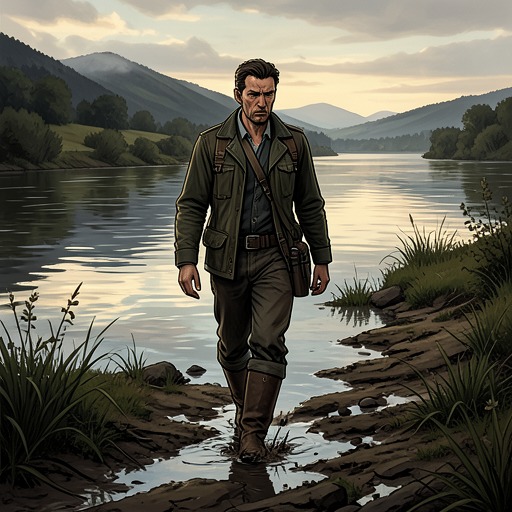
The same difficulty returns on Futh’s walk. In the afternoon, he realizes that he is lost and studies his map in a field, searching for features that should be visible but are not. He has no sense of direction, and the compass he pulls from a side pocket of his rucksack proves broken. The sun is high but offers no useful guidance. With no reliable instrument to settle the question, he looks back along the trampled grass and considers how many earlier points might have been missed turns.
Futh decides to keep going until he finds someone who can tell him where he is. After walking for well over an hour without seeing anyone or finding shelter from the sun, he reaches a small village. A man smoking outside a house studies Futh’s map; cigarette ash spills into its folds. When the man points out the location, Futh understands the scale of the mistake: he has been walking in the wrong direction for hours and has as far to go as when he set out after breakfast, perhaps farther. The map can represent his position only once someone else interprets it. His own effort has not merely failed to shorten the journey; it has restored its original distance.
He retraces his steps and takes a path that should lead to his last stop before Hellhaus. The route offers little reassurance: there is no signpost, only an opening in a hedge, a narrow gap between paths. Futh is not surprised that he missed it before, and even now he is not certain he is going the right way. The consequences are bodily as well as logistical. His sandal straps saw against sunburn and new blisters, and when he reaches the hotel he is exhausted, hungry, and too late for dinner. Navigation’s cost is registered in painful feet, lost time, and the failure of the day’s simple plan.
Maps, Timetables, and Failed Corrections
The next morning, Futh considers abandoning the final day of walking and going instead to Utrecht, where he might visit Carl. The proposal depends on several linked journeys: he would need to take a bus to Hellhaus, retrieve his car, and then drive onward. He thinks through the possibility of arriving unannounced and reasons that he was invited, but the plan remains conditional on routes and connections he has yet to verify.
Unable to find a bus timetable at the hotel, Futh goes out to look for a stop. He eventually finds what appears to be the right one about a mile from the centre, near the river, and deciphers its schedule: three direct buses to Hellhaus run on weekdays, in the morning, early afternoon, and evening. The information seems to make the detour manageable. He packs his suitcase, leaves it by the door, and takes snacks from the breakfast buffet for the ride. Preparation briefly replaces uncertainty with a sequence of steps.
That sequence falters at the stop. After eating lunch and arriving in time, Futh waits for the bus. When it does not appear, he checks the timetables at neighboring stops, rereads the first schedule, and considers whether he has misread the time, mistaken the day, or arrived just too late. He cannot identify an error, so the absence of the bus remains unresolved. He weighs alternatives: hitchhiking brings no response, he has seen no taxi, and walking back into town to find one would be both difficult and expensive. He finally waits for the evening bus, turning a planned change of route into hours spent in the heat.
Even boarding does not deliver him neatly to his destination. Futh gets off at the wrong stop and has to walk before reaching Hellhaus. The intended visit to Utrecht becomes still less feasible when he checks his car and finds a flat tyre. Broken glass lies in the gutter; in the boot, where he expects a spare, there is instead the old flat tyre he removed earlier. He gives up the plan and returns to the itinerary he had meant to change.
Movement and Constraint
Across these journeys, navigation depends on more than knowing a direction. Futh needs an accurate map, a working compass, a correctly identified bus stop, a bus that arrives, and a usable spare tyre. Each failure interrupts a different form of mobility: the motorway prevents turning back between junctions; the footpath provides no signpost; the timetable cannot explain a missed bus; the car cannot proceed on a flat tyre without the missing spare. The obstacles are mundane, but their accumulation makes travel contingent on equipment, information, timing, and other people’s help.
The pattern also complicates the idea that travel offers Futh an uncomplicated escape. He sets out across borders and landscapes, but repeatedly finds himself farther from the route he intended, uncertain about how to correct course, or forced to return to an earlier plan. His eventual arrival at Hellhaus does not resolve that pattern: the hotel is visible in the sunset, yet his car has failed and the Utrecht detour is abandoned. Disorientation therefore links geographical movement to a more persistent condition of uncertainty. Futh keeps seeking a way forward, while maps, schedules, and vehicles provide only partial guidance and never guarantee arrival where he means to go.