Escape and entrapment
The Lighthouse (Alison Moore Edition)Escape and entrapment form a persistent tension in Futh’s life, joining childhood fear to adult habits and fantasies of disappearance. He repeatedly looks for a way out—of a dangerous household, a room, a failing marriage, even his own identity—but escape remains provisional. The novel gives that conflict physical shape in a climbing frame, an attic rope ladder, a wedding-night window and a moth beating against a lamp: openings are visible, yet safety and freedom never quite coincide.
Childhood: Safety at the Edge of Home
After Futh’s mother leaves, his father is already drunk by breakfast, and the violence Futh encounters afterward comes without warning. Futh tries to stay out of his father’s way. Sometimes he climbs onto his climbing frame and remains there until darkness hides the ground below. From that height the lawn might be an ink-black lake or an emptiness into which he could fall; the darkness offers distance, but the bright square of the kitchen window remains visible. His refuge is therefore not an exit from home so much as a precarious position from which he watches it.
The window becomes a kind of signal. Futh studies his father moving through the kitchen—taking food from the refrigerator, sniffing it, searching cupboards, opening a tin and lighting the hob—to judge when it is time to go in for supper. If he waits too long, the meal will be cold; if his father sits alone at the bare table, Futh knows to wait until he has gone out before entering and putting himself to bed. The child’s movements are governed by observation and timing, not by any reliable assurance of safety. Escape begins as the effort to avoid being noticed and to choose the least dangerous moment to cross a threshold.
The house also contains the possibility of a different kind of proximity. Across the fence is Gloria’s house, while Futh’s friend Kenny lives there with her. Years later, when Gloria invites Futh in, he initially tries to decline. He is alone and has not had supper, however, and imagines that she might set something nice on the table for him. He climbs down from the frame and crosses the fence after her. The movement takes him from an isolated lookout into an adult’s kitchen, but it does not resolve the unease attached to entering someone else’s space.
Learned Exits and the Moth
As an adult, Futh habitually determines how he could escape from any room in which he is staying. He imagines emergencies in which fire or a psychopath blocks the usual exit, a practice he traces to his twenties, when he lived in an attic flat. Concerned about stair fires and burglars, Aunt Frieda gave him a rope ladder. The ladder gives his precautions an object and a practical use: a way out can be prepared in advance. Yet the habit persists beyond that particular danger. Knowing an exit has become important in itself, a private procedure for making an unfamiliar room feel less inescapable.
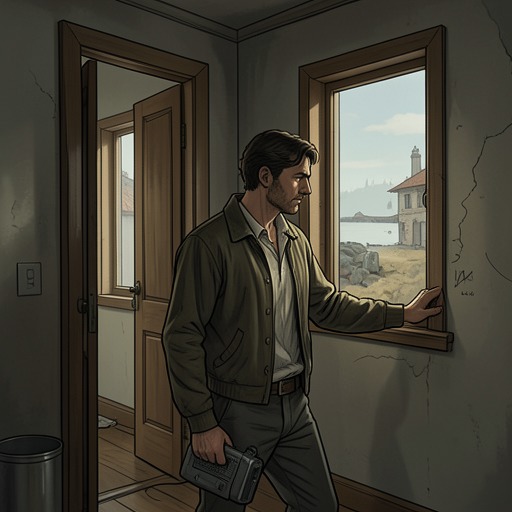
That procedure turns into a more immediate calculation when Futh opens a window after supper. In the dark he looks for a roof to climb onto, a pipe to hold, or a soft place to land. Below him is pavement, a long way down, and he wonders whether a jump from that height would break anything. The open window offers a route outward, but the height makes it uncertain whether departure would mean safety or injury. The scene brings his long-standing attention to exits close to the bodily risk that the imagined escape cannot remove.
A moth flies into the room and repeatedly disrupts Futh’s attempt to read. He opens the curtains and window to let it out, understanding that it is seeking the moon as a navigational aid, although he cannot see the moon from where he stands. It moves away from the artificial light toward the opening, then returns to the lamp and bumps against the hot bulb. Its flight figures a difficulty that also shapes Futh’s own life: an apparent direction out can be lost, while the light that attracts can become a source of harm. Futh, meanwhile, is distracted by a stranger’s mascara stain on the pillowcase and by thoughts of home and Angela, and cannot stop reviewing how he annoyed her during their marriage. The room’s physical entrapment and the marriage’s emotional aftermath occupy the same restless night.
The image of capture appears again in Gloria’s kitchen. Futh watches a Venus flytrap with its red leaves open; Gloria warns him not to touch it. A moth has already been caught, with its legs and the edges of its wings visible between the closed leaves. Futh wonders how it happened, having looked away only briefly, and is sorry to have missed the moment of capture. Gloria tells him that the trap will open again in a week or so and that what remains will blow away. The interval makes the capture neither instantaneous nor permanent: the creature struggles inside a mechanism whose release is expected, but only after time has passed and the moth has been diminished. Futh’s later memory of the sight, brought back years afterward by sea creatures moving uselessly in supermarket refrigerators in Japan, gives the image a further life beyond the kitchen.
Rooms, Routes, and the Performance of Safety
At his wedding reception, Futh withdraws from the function room’s noise and flashing lights. A back door stands open onto a dark patio as rain begins to fall. Outside, he maps the garden’s boundaries: the patio, the wall bearing a security light, the corridor along one side, a hedge screening the road, and the function-room wall at the far end, with the bedroom he has booked above it. He chooses a place against that wall where guests cannot see him and where the light’s sensor apparently does not reach. The garden gives him a temporary retreat, but even there he selects his position by calculating visibility and the limits of illumination.
When he goes upstairs, he looks from the dormer window and assesses the sloping roof beneath it. He cannot see the ground, but reasons that a jump would end on grass or, at worst, in the nettles near where he had just stood. Satisfied that he is safe, he draws the curtains. The sequence echoes the child watching the kitchen window from the climbing frame: in both cases, a view of an exit or refuge is also a view requiring judgment. At the reception, the route is not simply open or closed; Futh must decide where he can be seen, what lies below a window, and whether the place he has reached counts as safe.
The night does not settle into uncomplicated marital intimacy. Futh waits in bed for Angela, then wakes when the security light flashes through the curtains. He sees her crossing the patio in her wedding dress and disappearing through the back door. He anticipates that she will return with the smell of cigarette smoke on her skin, hair and mouth, and closes the window and curtain. Later he reaches across the bed and finds her there, her skin still cold from being outside, but she does not answer when he asks whether she is awake. The open back door, the window and the bed connect movement and separation within the same night: the wedding brings them together in a room, but does not make their shared space emotionally secure.
The Forest and the Wish to Disappear
During his walk, the forest turns Futh’s concern with finding an exit into a landscape of physical disorientation. As the afternoon fades, the viewpoints disappear and the path seems to lead farther into the trees. He fears that he may never find his way out and imagines the trees shifting and spreading to enclose him. With no torch in his backpack, he can barely see where he is stepping or tell what his boots sink into and what cracks beneath them. He considers turning back, recalling an account of deep-sea divers who lose their sense of up and believe they are rising even as they descend. Instead, he continues until the trees thin and he emerges into twilight, where streetlights guide him back toward civilisation. The return is real, but it comes through persistence rather than a clear view of the route ahead.
The physical walk also presses against his wish not to return to his old life. Futh imagines the boxes waiting in his new flat and resents their connection to the past and to a marriage that is over. He would rather enter a bare, neutrally painted space with basic furniture than face belongings carried forward from his marriage; he would even prefer not to go back at all. The imagined new flat promises a change of surroundings, yet the boxes show how much of the past would travel with him. Wanting to leave and being unable to leave the past behind are not separate conditions here; they meet in the same unwanted contents.
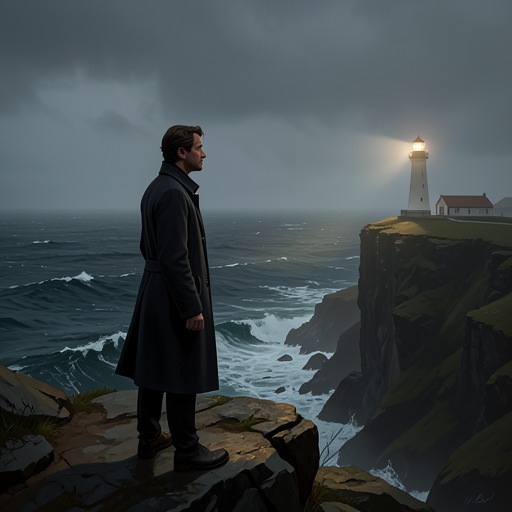
Futh remembers that, as a child, he often fantasised about running away, changing his appearance and name so that nobody could find him. The fantasy still appeals to him, and he considers whether he could remain in Germany or go to New York, leaving Angela, his father and Gloria to wonder what happened to him. Even the imagined disappearance ends with a question of recognition: he wonders who would be the first to notice his absence. His father’s response to his mother’s departure offers a darker counterpoint. He burned her remaining possessions, including books, framed photographs, her Open University work, clothes and walking boots, then scrubbed the house until disinfectant was left as its lingering smell. Yet Futh knows that some traces survived: books hidden under his mattress and the silver lighthouse he still carries. The attempt to erase an absent person cannot fully succeed, just as the fantasy of leaving does not guarantee release. Across these episodes, the novel treats escape not as a single act of crossing a boundary, but as a repeated negotiation with danger, memory and the things that remain.