Ester
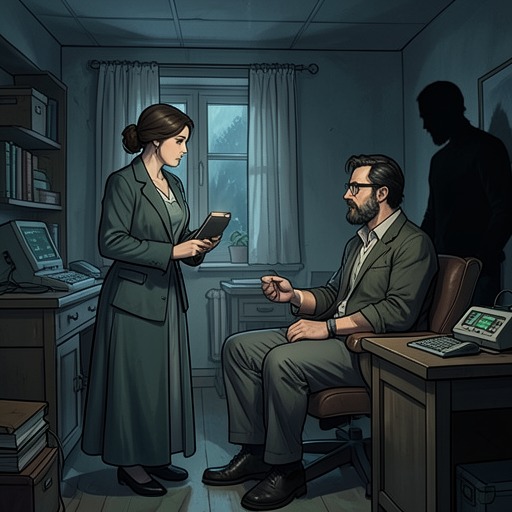
The Lighthouse (Alison Moore Edition)Ester’s life at the Hellhaus Hotel is organized around work that repeatedly brings her into other people’s rooms and close to their bodies. She cleans, serves meals, and tends the bar, but hospitality in her hands is never only a professional role: it can become nourishment, flirtation, sexual encounter, or exposure to her husband’s violence. The hotel is both her workplace and her home with Bernard, and its doors and corridors offer little protection between those parts of her life.
Identity and Daily Work
Ester is nearing forty and works through the ordinary demands of the hotel day. After finishing the downstairs rooms, she removes her rubber gloves, mixes tonic into a shot of gin, and drinks her first gin of the day. At that quiet hour before lunch, she notices a male customer staring but does not immediately turn to meet his eyes. Even small acts of service can carry friction: when she finds a red lipstick smear on her glass, she calls over the new girl to show her, but the girl takes the glass merely as dirty crockery. Ester’s attempt to make the stain legible goes unanswered.
The physical labor continues alongside her work at the bar. She has toilets, sinks, and baths to clean, floors to mop, carpets to vacuum, and beds to make; a sexual encounter with a guest does not remove the rooms from that schedule. The man is quick, and she still has two rooms to finish before lunch. The scene makes the hotel’s economy plain: intimacy does not suspend her duties, and the bed is simultaneously a place of sex and a surface that must be cleaned and remade.
Ester’s habits also show a private life sustained through small routines. She keeps Venus flytraps descended from a single plant her mother brought from home, dividing and repotting it until she has half a dozen. She waters them, feeds them insects found on the windowsills or flies she has swatted, and tickles their leaves shut around their prey. The plants sometimes die despite her care. She talks to them while putting them in the sunshine and smokes nearby, her ash falling onto their leaves. This patient, repeated tending contrasts with the abruptness and coercion that mark other forms of intimacy around her.
Guests, Care, and the Hotel’s Boundaries
Ester’s encounters with guests range from routine service to bodily closeness. A male customer first catches her attention at the bar while eating an egg; she notices the butterfly tattoo on the back of his hand and goes through the internal door toward the guest rooms. In the vacated room, he looks fixedly at her breasts. His gaze recalls the scrapbook of breasts she collected as a flat-chested teenager, images taken from her mother’s catalogues, travel brochures, advertisements, and magazines kept by her father. In the present, she gets onto the bed without really looking at the man himself. Her recollection connects the exposure of her adult body with an earlier private fascination, without making the encounter an uncomplicated expression of desire.
Her attention to guests can take the form of feeding them. When Futh arrives late at the hotel, Ester has been waiting for him and watches his suitcase roll across the floor before he reaches her. She takes his suitcase, arranges for it to go upstairs, and brings the cold-meat supper that has been waiting under clingfilm in the refrigerator. When she enters his room with her master key, she hears him showering and singing. She wants to feed him, yet would rather avoid conversation with a man who calls her Ester as if he knows her; she is also annoyed that he is late and has not apologized. Care and resentment occupy the same gesture.
On another occasion, Ester welcomes a young guest, seats him at a table, and brings his cold meats. When he hesitates, she first offers him sausage and then puts a strip of ham directly between his lips, feeling his teeth against her fingertip. He eats quickly and silently, then asks to go to his room before finishing the meal. Ester assigns him room ten, next to her own room, and carries his rucksack to the lift despite his insistence that she need not. After she leaves him, he remains holding out a low-denomination note. The exchange makes the boundaries of hospitality tangible: food, room assignment, bodily contact, and payment are brought into close proximity, though the guest does not respond to her gestures as she may expect.
Marriage, Exposure, and Violence
The hotel’s physical arrangement makes Ester’s private life vulnerable to discovery. A door marked PRIVATE separates the guest rooms from the rooms occupied by her and Bernard. Bernard comes through that door and sees Ester hurrying out of room six. Moments later, a male guest appears partly concealed in the doorway, his bare shoulder, spine, leg, and blue-veined foot visible before he retreats and locks the door. The sequence reveals an encounter through fragments: Bernard does not need to enter the room to understand that Ester has been with the guest.
The aftermath is not limited to suspicion. Early one morning, Futh sees a new bruise on Ester’s face beneath her make-up. She offers no explanation; after he thanks her, she nods, takes his empty plate, and walks away before he can form a question about breakfast. The ordinary service interaction leaves the mark of violence visible while keeping its cause unspoken.
Later, Ester returns to room ten with fresh bedding and her cleaning trolley. Bernard is already walking away from the mess he has made of a man who did not leave in time. As he passes Ester in the doorway, he leans close and warns her not to let there be a next time. His warning gives the hotel’s rooms a double function: they are spaces Ester must prepare for guests, and spaces where Bernard can enforce control through violence. The scene establishes the threat without resolving what will happen to the injured guest.
Desire, Choice, and Change
Ester’s own history with Bernard begins in a different register. He lies in the grass, touches a cornflower to her cheekbone, and compares its blue with her eye before asking her to leave with him. She agrees after only a moment. When she introduces him to her parents, her mother asks whether she is sure, and her father tells her she can still change her mind. The memory records a choice made quickly, but also the doubts voiced around it. The later marriage, shaped by Bernard’s absences, moods, and violence, stands in sharp contrast to this beginning.
In the present, Ester has begun making an effort each day, even when Bernard is away and cannot notice. Her hair now seems very short and white to her, making her think of her father. She wears old clothes and flat shoes for cleaning, then plans to change into a pink satin dress and heels, adding perfume after her nap. Dressing up makes her feel good, and she knows someone may look and appreciate the effort. Her wish to be seen persists alongside the more troubling male gaze that reduces her to her breasts or treats her body as available.
Bernard is away for two nights visiting his mother, a trip he always makes alone. Ester has suggested that he go without her; at first she makes excuses, then stops giving reasons, and he stops asking. When he returns, he is in a bad mood, carrying ironed underpants and paired socks. Ester imagines the criticism his mother might make of her for being too busy to visit, and the suggestion that a cheap cleaner could do her work. Her service labor thus extends in imagination into the marriage and its family expectations, even when she is absent from the visit.
Ester’s character is defined less by a single declared intention than by the repeated collision of care, work, desire, and constraint. She feeds guests, tends plants, dresses to be noticed, and enters rooms where intimacy can become a source of danger. The hotel lets her move continually between public hostess and private resident, but it does not give her a secure boundary between those identities. Her attentive gestures reveal agency in how she approaches others; Bernard’s violence and the routines of service reveal how sharply that agency is limited.