Ester and Bernard
The Lighthouse (Alison Moore Edition)Ester and Bernard’s marriage joins a hurried decision to live together with an increasingly distant, controlling domestic life. At Hellhaus Hotel, their private apartment lies behind a door marked “PRIVATE,” beside the rooms they serve; the hotel’s everyday traffic repeatedly brings their strained relationship into view. Their history survives in Ester’s keepsakes and in remembered gestures of affection, but their present is marked by silence, separation within the marriage, and episodes of intimidation.
Marriage and Its Origins
Ester marries Bernard soon after ending her engagement to his brother, Conrad. Bernard acts quickly, apparently afraid she might change her mind, return to Conrad, or choose someone else. She goes with him to the small town where he lives, away from her brother-in-law, former boyfriends, and familiar acquaintances. In Ester’s understanding, this distance is meant to keep her faithful. The marriage therefore begins not simply as a new attachment but amid rivalry, haste, and Bernard’s wish to restrict the alternatives available to her.
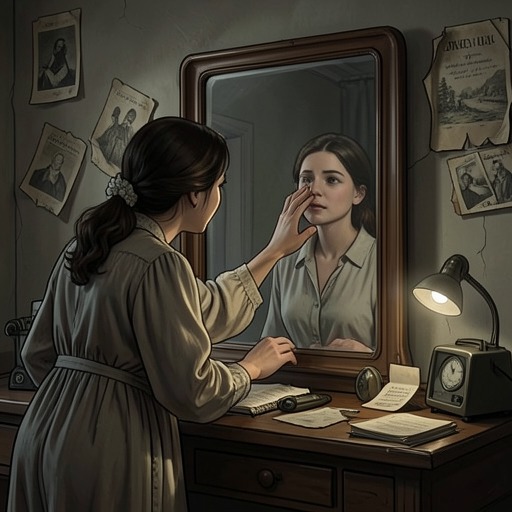
Ester’s recollections preserve a more tender version of Bernard. She keeps mementos from their early courtship in an envelope in her bedside drawer, including a dried flower she sometimes lifts to her nose. One memory places the young Bernard beside her in a field, holding a cornflower near her cheek and asking her to leave with him. She suspects he would no longer remember their first-date film, or perhaps even the cinema outing itself. The keepsakes preserve a courtship that seems to belong to another life, even though the man she remembers is still her husband.
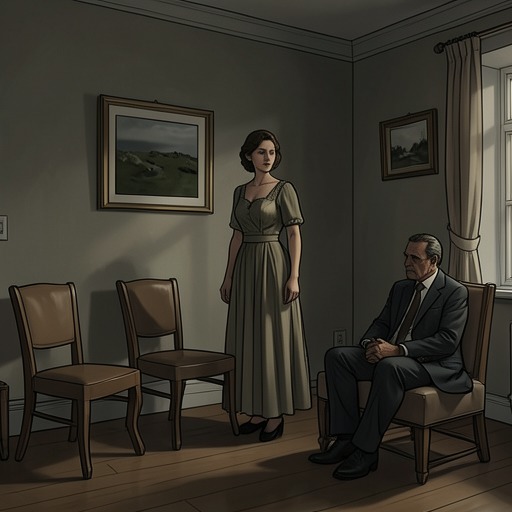
The contrast grows sharper over nearly twenty years. Bernard once fell asleep holding Ester close; now he turns away and wants space, sometimes using a sleep mask and earplugs. Ester observes that his attention is most evident when other men notice her. Their shared bed remains part of their routine, but it no longer guarantees mutual closeness: the physical arrangement persists while their former intimacy recedes.
A Marriage Inside the Hotel
Their domestic life is inseparable from Hellhaus Hotel. A door at the end of the upstairs corridor divides the guest rooms from the rooms occupied by Ester and Bernard. The threshold marks a distinction between their work and their home, yet the distinction is fragile: Ester can enter guest rooms with a master key, and guests or staff can encounter the couple near their private quarters.
Ester’s work includes cleaning rooms and preparing for guests. She also carries food upstairs, including a supper plate kept ready for Futh after his arrival. She has been waiting for him, and his lateness and failure to apologize irritate her; although she wants to feed men, she would rather avoid a conversation with this guest. These small acts of service place her in a role that is both practical and personal, while Bernard’s presence in the hotel gives their marriage a public setting as well as a private one.
The hotel’s boundary is also a source of conflict. Bernard warns Ester when she leaves the apartment door unlocked, calling it an invitation, and reprimands her when she forgets to switch off lights. On one occasion, after Ester has been in a guest room, Bernard sees her hurrying out and then sees a male guest appear at that same doorway. The scene gives him grounds for suspicion, but the account does not establish the full nature of the encounter. The next morning, Futh notices a bruise on Ester’s face beneath her makeup. Bernard, now behind the bar, silently refuses to answer Futh’s breakfast question and tells him to leave. Futh cannot understand the response and eventually packs. The episode turns the hotel’s private marital tension into a consequence for a guest, while leaving the cause of Ester’s bruise unstated.
Silence, Control, and Remaining Keepsakes
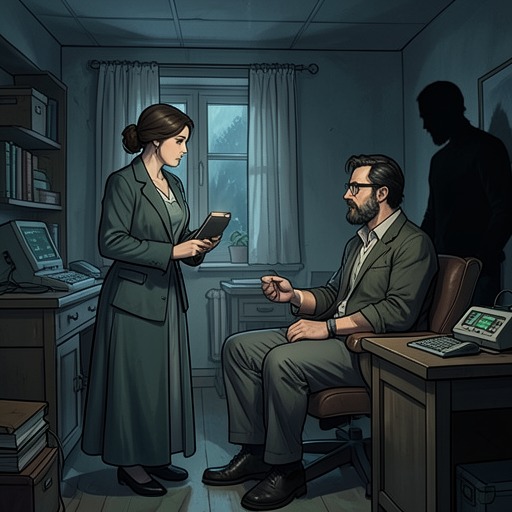
Bernard’s conduct in the apartment is often defined by what he does not answer. In the morning, he rises, attends to his routine, and gives Ester only a grunt of acknowledgment. She talks while he dresses, but he does not reply or look at her. The silence is not an isolated pause: it accompanies a household rhythm in which she cleans up after him and moves on with her own work. Bernard takes pride in his appearance and follows careful personal routines; Ester’s attention to these habits does not produce a reciprocal conversation.
There are also moments when his control becomes physical. When Ester appears dressed up, Bernard asks who she is trying to impress, holds her by the upper arms, and releases her only after she meets his gaze. She then lets him undo her dress, but the scene does not restore the intimacy she recalls. His actions leave her uncertain whether he is trying to seduce her or delaying, and later he looks at her as though she reminds him of someone else. Ester’s unspoken wish is to be recognized as herself. The scene compresses the marriage’s central imbalance: she seeks acknowledgment from a husband whose attention feels conditional and whose touch can be intimidating.
Ester’s private objects offer a counter-record to that present. She keeps tokens of the early relationship close by, while Bernard’s indifference makes the remembered courtship feel increasingly remote. Another object, a lighthouse-shaped perfume case, links their marriage to a wider history: Bernard gave Ester a wooden lighthouse perfume case as a wedding present, and she later discovers the scent of violets inside it. Its resemblance to the silver lighthouse found in a guest’s belongings connects the hotel’s private rooms to the lives of its visitors. Objects and remembered scents carry what the couple rarely communicates aloud, but they do not repair their estrangement.
The Marriage’s Public Consequences
Ester and Bernard’s relationship is repeatedly exposed through the hotel’s arrangement of service, access, and privacy. Ester can move between guest rooms and her apartment, while the marked private door is meant to keep those spaces apart. Her unlocked door and the incident witnessed by Bernard show how easily that separation can fail. His response is not confined to the couple: Futh, a paying guest, is denied a clear explanation and told to leave, then later discovers that the silver lighthouse he cannot find has been put away in Ester’s room. The hotel thus makes their domestic conflict tangible through hospitality and exclusion, without resolving what either spouse knows or intends.
The marriage remains in place, but the evidence emphasizes distance rather than reconciliation. Ester continues to preserve traces of the young Bernard, while the present-day Bernard turns away, withholds response, and sometimes asserts control directly. Her keepsakes and his routines occupy the same home, yet they point in opposite directions: she holds on to an earlier intimacy, while their daily life offers little sign that it can be recovered. Their relationship is therefore defined by the gap between the courtship Ester remembers and the guarded, unequal partnership they continue to inhabit.