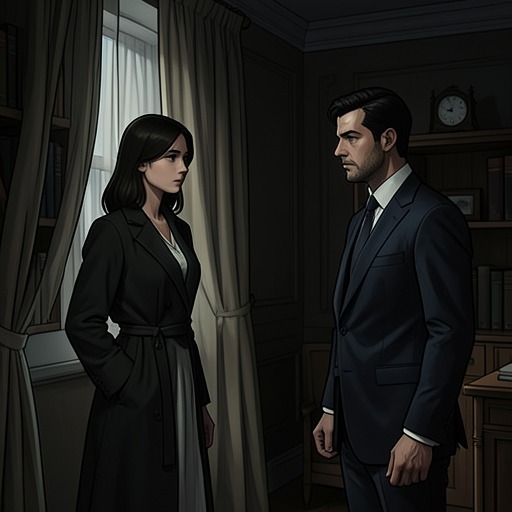
Ester goes with Bernard to Hellhaus
The Lighthouse (Alison Moore Edition)Ester goes with Bernard to Hellhaus after accepting his invitation to leave with him, a choice that carries her from courtship into a shared home and working life. Although her parents caution her that she can still reconsider, she does not change her mind. At Hellhaus, Bernard runs the pub while Ester manages the accommodation, making her departure the beginning of both a partnership and a division of labor that shapes the hotel’s daily life.
The Decision to Leave
The courtship turns on a direct invitation. Bernard lies in the grass beside Ester, touches a cornflower to her cheekbone, and compares its blue with the blue of her eye before asking her to come away with him. Ester waits only a moment before agreeing. As he moves the flower to her necklace and blouse buttons, she lies back in the fallen leaves. The scene makes the decision feel immediate: the invitation is followed not by extended negotiation but by her assent and physical closeness.
Ester then introduces Bernard to her parents. Her mother asks whether she is sure, and her father tells her that she can still change her mind. Their words register the seriousness of her choice without establishing that they forbid it. Ester nevertheless goes with Bernard to Hellhaus, making her decision consequential rather than provisional.
A Shared Life at Hellhaus
At Hellhaus, Bernard runs the pub and Ester manages the accommodation. She takes bookings, receives guests, and does the housekeeping, while a cleaner arrives early each morning to take care of the bar and public areas before breakfast. Ester herself looks after the guest rooms. The move therefore establishes a practical partnership in which their work is divided across the hotel, while Ester’s responsibilities repeatedly bring her into contact with its visitors and their private rooms.
The inn is often quiet. Of its ten bedrooms, only a few are occupied at a time, and some remain empty for entire seasons. Ester once leaves a bathroom light on and its window open, then does not return for weeks; when she finally does, she finds the white glass bowl of the lightshade full of moths. The neglected room gives a concrete measure of the sparse, sometimes unattended life of the accommodation she manages. It also links the hotel routine to Ester’s long-standing interest in collecting moths, an interest Bernard regards as hoarding.
The Hotel’s Public and Private Boundaries
The life Ester begins with Bernard joins their residence to a place of commercial hospitality. At the hotel, she prepares food and receives guests, but the rooms are also part of the couple’s private domain. A door marked “PRIVATE” separates the guest corridor from the rooms occupied by Ester and Bernard. The boundary is physical, yet the hotel’s operation continually brings Ester across the guest side of it: she enters rooms to tend to guests, including the room where Futh stays.
When Futh arrives late, Ester has been waiting for him and regards him with irritation; she later brings up the cold cuts prepared for his supper. Early the next morning, he sees a fresh bruise on her face beneath her makeup. She does not stop to speak with him, and he remains unable to ask his question before she walks away. Bernard, meanwhile, tells Futh that he should go. These later scenes do not alter Ester’s earlier decision to go to Hellhaus, but they reveal the setting that decision created: a workplace where care, access, and exclusion coexist, and where the boundary between the couple’s home and their guests’ lodging can become charged.