Ester takes Futh’s silver lighthouse
The Lighthouse (Alison Moore Edition)Ester’s taking of Futh’s silver lighthouse is a covert exchange, not a confrontation: she puts her own perfume vial into his case, conceals the case in a drawer, and expects him to leave before he notices it is missing. When Futh searches her private rooms, he finds the lighthouse among her perfume bottles. Its passage from his luggage into Ester’s possession draws together the novel’s material plot and Futh’s most persistent associations of scent with his mother and her departure.
Background and the object’s history
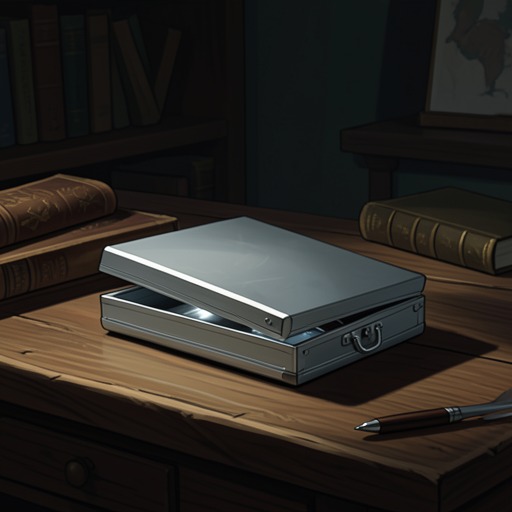
The lighthouse case carries a history older than Futh’s stay at the hotel. His grandfather handed it to Futh’s father, explaining that it had belonged to his own mother and should be returned to Ernst. In the car after the visit, Futh’s mother admired the case and its vial, approved of the fragrance, and applied it to her wrists and throat. The smell of violets filled the car. The object was meant to be returned, but it remained bound to Futh’s family instead, and to the memory of his mother wearing its perfume.
That association acquired the force of loss during the family’s holiday in Cornwall. After the glass vial broke, Futh’s mother left the family; on the train home, the broken vial remained inside the case in his pocket. His hands and boots smelled strongly of violets, while his sleeping mother smelled of orange. Years later, when he worked in the manufacture of artificial odours, octyl acetate made him sad. The case is therefore not just a collectible or a container: its changing condition and custody preserve a history Futh cannot recover by ordinary conversation.
Ester also has a personal investment in lighthouse-shaped perfume containers. The morning after her wedding, Bernard gave her a wooden lighthouse holding Dralle’s Illusion, a vintage perfume she had specifically requested. She knew there were silver and wooden versions, and felt disappointed to receive the smaller, cheaper wooden one. This history gives the transfer a pointed material contrast: the silver case associated with Futh’s family sits beside the wooden case associated with Ester’s marriage, while the perfume itself passes from one container to the other.
Ester’s exchange and concealment
Before Futh discovers the loss, Ester has already made her decision. She applies violet perfume and stops the vial. The silver lighthouse standing beside her wooden one has no bottle in it, so she puts her vial into the silver case and returns the emptied wooden container to a drawer. She hopes Futh will not notice that his item is missing. If he does, she plans to blame the people who transported the luggage; by the time any answer comes, she expects him to have left.
The object’s new place among Ester’s belongings makes the act deliberate, even as its motive is left unstated. She does not discard or damage the case. Instead, she incorporates it into her own collection and uses it to hold the perfume she has been applying. Her action depends on the distinction between the case and what it contains: to Futh, the lighthouse is the missing possession; to Ester, it can also function as a vessel for her scent. The substitution connects two separate histories without resolving either one.
Futh’s search
Futh realizes during a bath that he has not seen the lighthouse in his suitcase. After searching again, he goes downstairs in his pyjamas to ask after Ester, but cannot understand the barmaid’s brief reply in German. He does not ask the barman who refused him breakfast earlier in the week. Instead, he goes back upstairs and enters through a fire door marked private.
Hidden in Ester’s bathroom, he watches her bring in his supper: cold meat, boiled eggs, and salad under clingfilm. She sets the plate on the dressing table, puts the silver lighthouse away in a drawer, takes out cigarettes and a red lighter, and smokes by the open window. Futh breathes in some of the smoke. When he opens a bathroom bottle and smells camphor, the scent carries him back to the dark interior of his mother’s wardrobe, an intimate, remembered space he had wished he could capture as Essence of Mother. The present search thus opens onto an earlier form of hiding: as a child, he had sat inside that wardrobe, enclosed by his mother’s clothes and their smells.
After Ester leaves, Futh searches the dressing table. One drawer holds makeup and jewellery; in a small box he first mistakes a moth for a brooch, then touches its still wings. Another contains underwear, including the pink satin knickers he found beneath his bed the week before. The last holds dozens of perfume bottles, from cheap to expensive, including a blue glass skyscraper and Ester’s little wooden lighthouse. Beside them is the silver case he has been seeking.
Discovery and significance
A slam at the apartment’s front door makes Futh jump just as he takes out the silver lighthouse. He retreats to the bathroom, trembling, still holding both the case and the pink satin knickers. He fears Ester will discover him and that he will be told to leave the hotel; he imagines sleeping in his car without a blanket and missing breakfast again. In his other hand, the lighthouse feels unusually heavy, though he is only vaguely aware of the difference. The recovered object does not bring him security: it leaves him concealed, exposed to discovery, and uncertain of what will happen next.
The episode makes the lighthouse’s physical custody part of its emotional meaning. For Futh, the silver case carries the trace of his mother through violet perfume, the broken vial, and the sensory fragments he retains of her. For Ester, it becomes an addition to a collection that already includes the wooden version she resented receiving. Her quiet transfer of the vial and her plan to postpone any explanation turn a private object into another instance of failed communication: Futh can find the case, but neither its return nor its changed contents can repair the absences attached to it.