Ester’s affair and Bernard’s violent response
The Lighthouse (Alison Moore Edition)Ester’s affair with a hotel guest becomes a turning point in her marriage to Bernard when he discovers the encounter and responds with violence. The scene moves from a private arrangement in room ten to a search for Bernard in the hotel’s private apartment and, finally, his warning as he passes Ester. Its force lies not only in what he does to the guest, but in how abruptly Ester’s expectation of privacy gives way to fear of her husband’s return.
Setting and Background
Ester works amid the ordinary routines of the Hellhaus Hotel: serving at the bar, using the lift with a cleaning trolley, and preparing rooms. The encounter takes place in room ten, not in the private apartment she shares with Bernard. That distinction matters. Ester will not bring the guest into the marital bedroom or have him occupy Bernard’s side of their bed, so she chooses a guest room instead. The hotel’s working spaces and private spaces sit close together, but the encounter depends on keeping them separate.
The man is an unnamed guest, referred to in the scene as a question mark rather than given an identity. At the bar, he asks whether she wants another drink. Ester looks at him and at the clock, then nods and leads the way to the lift. The scene records their decision through these small actions rather than through an explanation of their relationship or intentions. The available evidence does not establish how long the affair has been going on; it shows this meeting and the danger created when Bernard returns unexpectedly.
The Encounter in Room Ten
Ester takes the guest upstairs in the lift with the cleaning trolley. She does not take him to her own room. In room ten, he lies on the bed and undresses only partly; Ester undresses on the other side of the bed and joins him. The narrative gives the encounter a defined location and sequence, while withholding any account of what either person believes the arrangement means. What is clear is that Ester has chosen a room apart from the one she shares with Bernard.
When Ester returns to the bar, the girl serving there tells her that Bernard is looking for her. Ester replies that Bernard is not due back until the next day. The exchange exposes the miscalculation at the center of the event: Ester has acted on her belief about his absence, but the girl’s report indicates that he is already somewhere in the hotel. Asked where he is, the girl thinks he is upstairs. Ester goes first to the private apartment, where Bernard’s holdall is on the end of the bed. She checks the bathroom, kitchenette, and sitting room, but does not find him. The sequence delays the discovery without removing the threat: his belongings are there, while he is not.
Bernard’s Return and the Aftermath
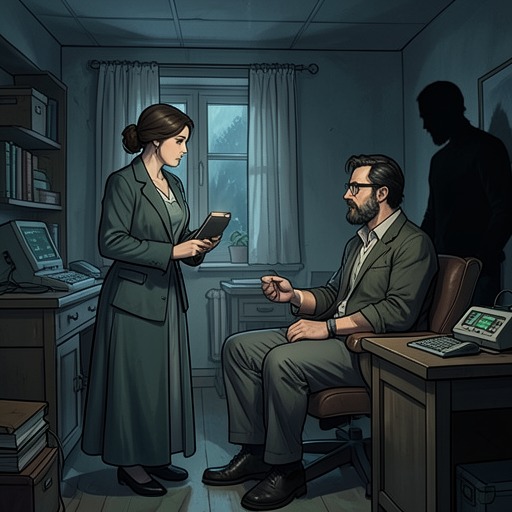
Ester goes back downstairs, collects her rubber gloves, and returns to room ten with the cleaning trolley and fresh bedding. Bernard is there. He is leaving the room after assaulting the guest, who has not left in time. The account does not dwell on the physical details of the attack; instead, it places Ester at the doorway as Bernard passes her. He pauses close enough that she feels the heat through his shirt and his breath against her cheek, then tells her, “Don’t let there be a next time.”
His warning makes the violence more than an interruption of the affair. Bernard addresses Ester as he leaves the scene, converting what has happened to the guest into a threat about what she may do in the future. The phrase gives the encounter a consequence that remains open-ended: it forbids a recurrence without explaining what Bernard would do if there were one. Ester has arranged a private meeting in a room she could treat as separate from their marriage; Bernard’s return demonstrates that this separation offers no protection from his control.
Marriage, Memory, and Narrative Significance
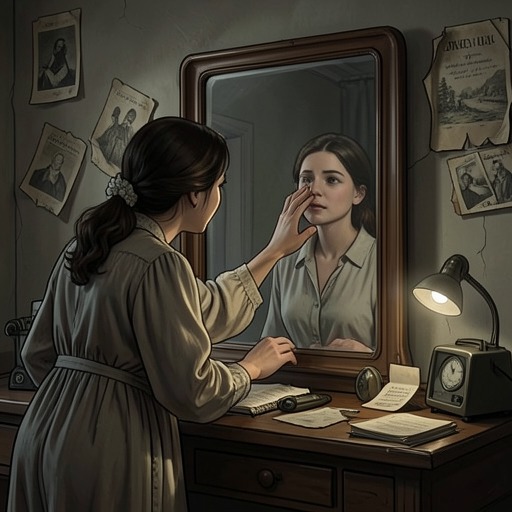
The event presents Ester and Bernard’s marriage through a contrast between domestic familiarity and danger. Ester knows which side of the bed Bernard sleeps on and refuses to let the guest lie there. Yet the couple’s private apartment, with Bernard’s holdall placed on the bed, becomes part of the search that leads her back to the guest room. Ordinary objects and hotel routines—the holdall, the trolley, the gloves, and fresh bedding—mark the setting in which the violence occurs. Ester’s return with clean linen cannot undo the assault; she arrives as Bernard is leaving, and his warning replaces any open discussion between them.
The hotel’s camphor scent also connects this scene to the book’s recurring movement between present encounters and earlier memories. Bernard’s side of the bed has a camphor-scented pillow. Elsewhere, Futh’s remembered childhood wardrobe is associated with camphor, leather, and the secret traces of his mother; her departure leaves him with the scent of violets. Years later, the smell of octyl acetate makes him sad, linking his work with artificial odours to the memories of his mother and the perfume she wore. In a later scene at the hotel, camphor again draws Futh back to the dark interior of that wardrobe. These echoes do not explain Ester’s affair or Bernard’s attack, but they place the event within a narrative in which scent carries memory across rooms and periods of time. The affair’s immediate result is violence and a warning; its wider significance lies in the way private spaces, intimate associations, and unresolved histories overlap without offering safety or understanding.