Failed communication and silence
The Lighthouse (Alison Moore Edition)Failed communication and silence form a recurring pattern in Futh’s life: signals are sent, words are exchanged, and gestures are made, yet recognition or response often fails to follow. The pattern ranges from the shared torch game with Kenny to adult encounters in which language divides Futh from others or his attempts to speak are simply not answered. It gives the novel’s silences a concrete shape: a light waiting in darkness, a door closing on an incomprehensible conversation, a hand held too long, or a gaze turned away.
Signals Without Shared Meaning
As boys, Futh and Kenny stand at their bedroom windows at lights out, facing one another across their gardens with torches. They flash in repeated patterns, sometimes three flashes and sometimes a flash, a pause, and another flash. The exchange resembles Morse code, but it does not mean anything. Its value lies instead in the fact that each boy answers the other: the light travels across the dark space between their homes and returns. For Futh, the exchange resembles a lighthouse on the horizon, a visible signal that makes waiting for the next flash part of the connection.
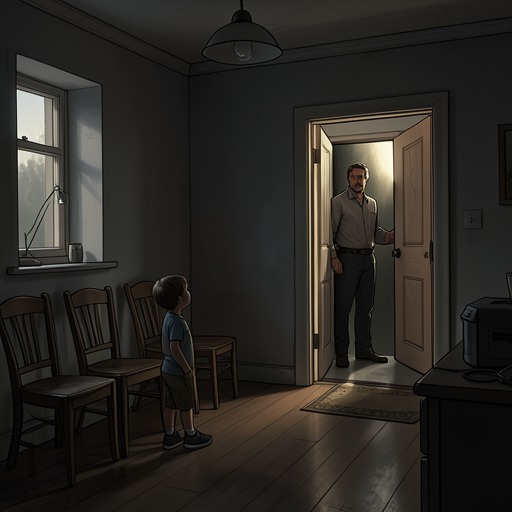
The game also depends on its limits. When Kenny’s light stops, Futh knows that Kenny has gone to bed and gets into bed himself. Later, halfway through junior school, Kenny leaves suddenly with his father. Nobody tells Futh that Kenny is going or has gone. Futh continues to stand at his window with his torch, repeating the familiar flashes like a signal meant to summon a response, but the opposite window remains dark. The old ritual has not changed; what has changed is the possibility of an answer. Its repetition makes the absence legible without explaining it to him.
When they meet again at Christmas in a butcher’s shop, the gap between them becomes verbal. Gloria greets Futh and his mother, while Kenny has already gone outside to wait. Futh joins him and asks why he left. Kenny answers that he went with his father, leaving the larger question of why his father left unanswered. The exchange supplies a literal explanation for Kenny’s departure but not the account Futh is seeking. Their childhood closeness, once sustained by a reciprocal signal, has given way to a conversation that does not bridge their different understandings.
Recognition and Misrecognition
Years later, another brief exchange makes the gap between being known and being recognized explicit. At a lecture-theatre gathering, Angela leaves her friends and stands beside Futh while looking at Kenny. She asks whether she knows Kenny; he indicates Futh and says that Futh knows her. Angela then says she does not know Futh. He explains that they went to the same school, and she responds as though she does not remember that they did. The sequence is small but sharply staged: Futh’s claim of shared history is present, yet it does not produce recognition from Angela.
The scene differs from Kenny’s departure because the exchange is face-to-face rather than a signal sent into darkness. But its structure is similar: Futh reaches toward a connection whose meaning is not shared by the other person. Kenny acts as an intermediary, identifying the connection, but cannot make Angela acknowledge it. The dialogue establishes not that the past never happened, but that having occupied the same school does not guarantee that it survives as a mutual memory.
Language, Doors, and Exclusion in Utrecht
On the drive to Utrecht, Carl directs Futh through the city to an old three-storey house divided into flats. At the entrance, Carl presses an intercom button, and a woman answers in a language Futh assumes is Dutch. Carl identifies himself and says he has a guest, speaking in English for Futh’s benefit. The arrangement makes Futh present but dependent on Carl to interpret the encounter: he can hear a voice at the other end of the intercom, but cannot understand what it says.
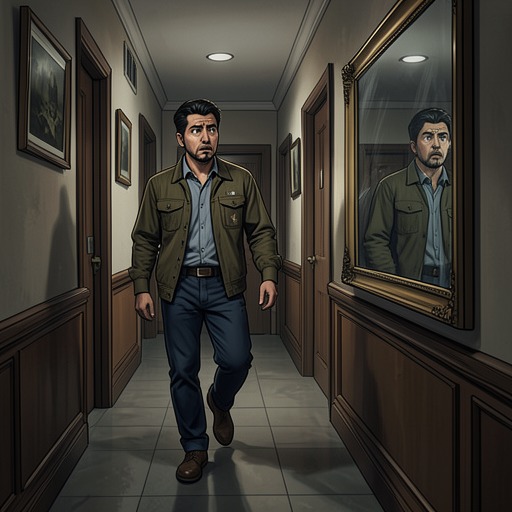
Inside the flat, Carl calls for his mother. She eventually comes in from another room, greeting her son with air kisses while Futh waits to be introduced. The domestic setting becomes harder for him to read when Carl’s mother glances toward the door through which Carl has gone, announces that she knows what he is doing, and leaves to speak to him angrily behind a closed door. Futh hears her voice but cannot make out the words. The scene offers sound without access to its content, placing him outside a conversation whose consequences affect whether he is welcome.
The same division returns when Carl’s mother goes to the kitchen to prepare food. Left on the sofa, Futh sees Carl quietly admonishing her through the swinging door, then sees her answer in a hushed voice. They speak in Dutch, which Futh does not understand. The swinging door repeatedly opens and closes before slowing to a stop, giving the exchange a visible rhythm while withholding its meaning. Futh associates the scene with childhood, when he tried not to hear his parents whispering furiously behind closed doors. An adult visit thus reproduces the form of an earlier domestic exclusion: voices carry through a barrier, but understanding does not.
Carl eventually comes out and tells Futh that his mother did not mean to make him feel unwelcome. This reassurance is itself a form of mediation, just as Carl’s English at the intercom had been. Futh says he should leave, and Carl’s mother returns with a parcel for the journey. Carl follows Futh into the hallway, tells him that he does not have to go and that he really wants him to stay, and holds his hand a little too long as they part. Futh thanks his hosts from the doorway and waits for a reply, but none comes. The encounter contains several efforts at welcome and explanation, yet it ends with a spoken courtesy left without an answer and Futh descending the stairs with the parcel in both hands.
Attempts to Speak and the Body’s Response
At breakfast in a hotel, Futh tries to begin a conversation with a woman reading a novel. His first greeting receives no response. When he asks about her book, she moves her gaze to the top of a new page and turns her head slightly away. He tries again in German, recasting the question as whether the book is good, but the woman still does not engage. The changes in language do not alter the encounter: his attempts to open a conversation meet with increasingly visible nonresponse.
Futh then says that she wears the same perfume as his wife. The woman looks up, and her gaze falls to his trousers and to the hand he has deep in his pocket, gripping Futh’s silver lighthouse perfume case while his thumb circles its dome. He notices that the buffet queue has gone and moves on. The moment joins speech to a bodily gesture that may be read differently by the two people: Futh’s hand is occupied with an object he anxiously touches, while the woman’s attention settles on it. The scene records her look and his withdrawal without claiming that either fully understands the other’s response.
Recurrence and Significance
Across these encounters, silence is not simply the absence of speech. Kenny and Futh exchange many flashes, but their code has no meaning beyond the answering itself; after Kenny leaves, the same flashes expose the absence of reciprocity. In Utrecht, words continue behind doors or in Dutch, making sound audible while their sense remains inaccessible. At breakfast, Futh can change languages and choose a personal point of connection, but the woman’s attention does not become a conversation. In each case, communication is attempted, yet the other person’s response is missing, delayed, or available only through an intermediary.
The recurring pattern links childhood abandonment and adult social unease without making them identical. Kenny’s unexplained departure leaves Futh waiting for a signal that never comes; the later scenes give him more immediate evidence of what is happening, but not necessarily a way to participate in it. Repeated gestures—the torch flashes, the swinging door, the unanswered thanks, the hand around the lighthouse case—carry what direct explanation does not. Their recurrence makes failed communication one of the novel’s central forms of connection: silence separates people, but its repeated shapes also reveal how strongly Futh continues to look, listen, and wait for a reply.