Futh and Kenny
The Lighthouse (Alison Moore Edition)Futh and Kenny’s childhood friendship gives Futh an early experience of connection that is intimate in form but fragile in practice. They exchange torch signals from opposite bedroom windows, yet the signals carry no message beyond their repetition; when Kenny leaves without warning, Futh keeps flashing into a darkness that no longer answers. Later meetings do not restore the childhood closeness: an encounter in an alleyway exposes Futh to ridicule and assault, and in adulthood the two remain largely separate, their lives linked mainly through Gloria’s news.
Childhood Differences and Proximity
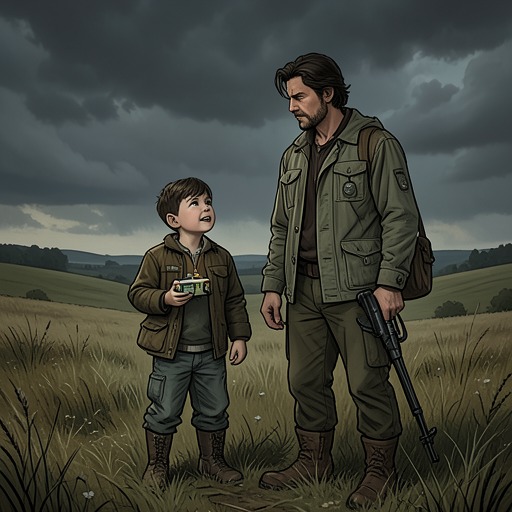
Kenny is Gloria’s son and Futh’s friend from the first year of junior school. Their homes stand on opposite sides of the fence at the bottom of Futh’s garden, close enough for the boys to see one another’s bedroom windows at night. But proximity does not mean likeness. Futh is not a people person, and he spends breaktime in the school library; Kenny has girls or a group of boys around him, plays football and army, goes orienteering with his father, and can build a bicycle from scratch.
The contrast is clearest in the boys’ different relationships to practical competence. When Futh takes apart his own bicycle, he cannot put it back together. Futh’s father refuses to help, so Futh places the gears, chain, pedals, and other pieces in a box in the shed, keeping them in the hope that one day he will know how to rebuild it. Kenny, by contrast, already possesses the skill Futh lacks. The detail makes their friendship a connection across unequal confidence and ability, rather than a partnership founded on shared interests.
Torch Signals and the First Separation
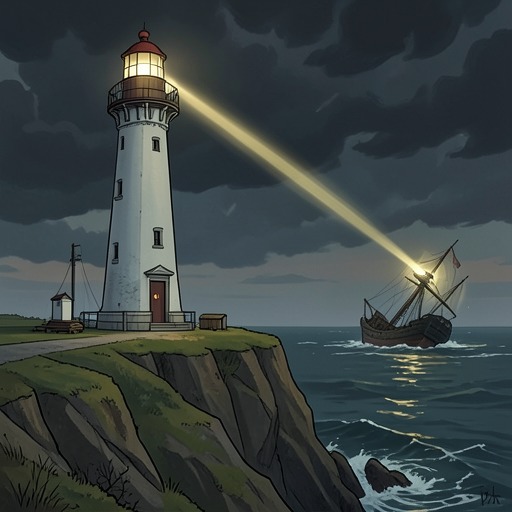
At lights out, the boys stand at their bedroom windows and flash torches at one another across the gardens. Their game resembles Morse code, but the flashes do not mean anything: Kenny sends a sequence, Futh sends it back, and the exchange repeats without becoming conversation. For Futh, the light resembles a lighthouse on the horizon. It appears, disappears, and leaves him looking into darkness for the place where it might return.
The routine has a small but precise ending each night. When Kenny’s torch no longer interrupts the darkness, Futh understands that Kenny has gone to bed and gets into bed too. In later years, he takes his torch beneath the covers and reads books from his mother’s bookshelves, sometimes literature that has been banned. The light thus connects their shared childhood game to a solitary practice that continues after the exchange itself has stopped.
Halfway through junior school, Kenny leaves suddenly when his father moves out and Kenny goes with him. Nobody tells Futh that Kenny is going or has gone. For several nights, Futh waits at his bedroom window and flashes his own torch, using the same repeated signal that had once been answered. Now it receives no reply. The friendship’s defining image changes from reciprocal light to an unanswered call: Futh keeps the form of their communication after its other participant is gone.
Reunion and the Alleyway Encounter
Futh does not see Kenny again until Christmas, when they meet at the butcher’s. Gloria, standing in line behind Futh and his mother, says hello; Kenny has already gone outside, and Futh joins him. When Futh asks why Kenny left, Kenny looks at him as if the answer should be obvious and says, “I went with my dad.” Futh asks why his father left. Kenny replies, “Well, he couldn’t stay, knowing about the affair, could he?” The exchange supplies Futh with the reason for the family’s separation, but it does not restore their earlier ease. Kenny’s blunt explanation names a circumstance Futh had not known; the childhood friend who had disappeared without explanation now answers, but in a way that underscores how much has happened beyond Futh’s knowledge.
A later meeting turns that distance into a physical ordeal. After a sleepover, Futh follows Angela home from school, misses his turning, and becomes lost on an estate that is surprisingly close to home. Choosing the wrong alleyway takes him the long way around. The passage is bounded by high walls and bends out of sight; as Futh rounds the curve, he smells cigarette smoke and finds Kenny there, blowing smoke rings among other boys, some of whom Futh recognizes from school.
Futh fears that Kenny may ignore or mock him, possibly exposing his bedwetting to the group. As he draws level, one of the boys says something that makes the others look at Futh and laugh. Futh catches Kenny’s look but keeps walking. An empty drink can strikes his shoulder, then a piece of broken brick hits the back of his head. The account establishes Kenny’s presence and look, but not that he throws either object. Futh reaches home with blood on his fingertips and cleans the wound himself; his father tells him he must learn to take care of himself. The encounter replaces the old reciprocal signaling with an unsettling public scene in which Futh passes through Kenny’s group without finding a way to speak or reconnect.
Adult Distance and the Friendship’s Afterlife
Futh does not see Kenny again until a university open day. They do not really keep in touch afterward. Instead, Gloria becomes the channel through which Futh learns the broad course of Kenny’s adult life: after school, Kenny works at a petrol station, then at a bicycle repair shop; he marries, has children, completes a course at a local college, and becomes a mechanic. The bicycle skill that once distinguished him from Futh acquires an adult continuation in his work repairing bicycles and, later, in his career as a mechanic.
When Kenny is hired by a second-hand car dealership, Gloria tells Futh that Kenny can get him a discount if he needs a car. Futh sometimes considers visiting the dealership to see Kenny, but he cannot drive and puts the idea off. By the time he buys a second-hand car in his forties, he goes elsewhere. The unrealized visit repeats the relationship’s pattern without reproducing the childhood scene: an opportunity for contact exists, but Futh does not take it.
The friendship therefore persists less as an active adult relationship than as a sequence of remembered signals, revelations, and missed chances. Its earliest communication is vivid but meaningless; its decisive departure is unannounced; and the later possibility of meeting again remains unused. The torch game supplies the relationship’s central image: a light can be seen across a small distance, but it cannot guarantee a reply, understanding, or return.