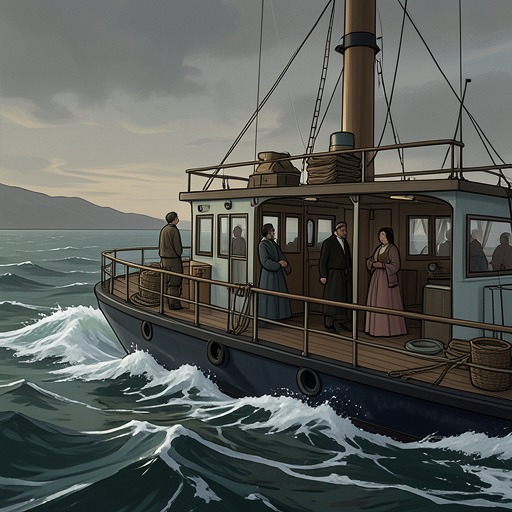
Futh drives Carl to Utrecht
The Lighthouse (Alison Moore Edition)Futh drives Carl to Utrecht after the two men meet on a ferry, taking him to his mother’s house during the outward journey to continental Europe. The ride becomes more than a practical lift in Carl’s later recollection: inside Futh’s car, on the ferry’s enclosed car deck, Carl experiences a sudden, bodily dread of being trapped and of disaster approaching. A week afterward, he searches the return ferry’s deck for his travelling companion but cannot call his name to mind.
Meeting and the journey to Utrecht
Carl remembers Futh as the man he met on the ferry the previous weekend, who accompanied him to his mother’s house in Utrecht. The journey is presented retrospectively, through Carl’s recollection on the return crossing; the text does not supply a detailed route or describe the visit itself. What it establishes is the basic exchange: Carl needs a lift, and Futh takes him to his destination. For Carl, the man is both a recent acquaintance and someone whose car carried him to a private family address.
The ride belongs to Futh’s first journey by car into another country. On arrival in the Netherlands, he moves his watch forward an hour and prepares to drive off the ferry onto the continent. That threshold gives the trip a practical geography: ferry, car deck, road, and Utrecht. Yet the narrative does not make travel feel like uncomplicated freedom. Movement depends on vehicles and crossings, while the enclosed spaces of transit can make a passenger feel confined rather than released.
The car deck and Carl’s premonition
A week later, Carl’s search for Futh on the ferry prompts him to remember the outward journey. The car deck returns to him as a close, mechanical enclosure: its throb and fuel smell, metal walls and floor, strip lights, orange paint, safety notices, hazard warnings, no-smoking signs, fire extinguishers, sirens, and flashing lights. He associates the space with an underground passage or a submarine, and the thought turns his stomach. The detailed inventory makes the setting feel less like a neutral link between destinations than a sealed environment from which escape might be difficult.
Carl recalls sitting in the passenger seat with a road atlas on his lap while the car waited below deck. He was seized by a dreadful feeling of entrapment and the sense that a disaster was about to happen; the feeling made him sick. He turned to Futh and asked, “Do you ever get a bad feeling about something?” At that moment the ramp was lowered, daylight and sky appeared, and Futh worked at some tune as they waited to drive out into the brightness. The scene sets Carl’s alarm against the ordinary movements of departure. The ramp opens; the car is able to leave. But the release of daylight does not erase the bodily intensity of the fear, which Carl remembers after the trip is over.
A remembered companion who cannot be named
The later ferry crossing shows how little of the encounter Carl can reliably retrieve. Although only a week has passed, and he has thought about Futh since, he cannot properly visualise him. He remembers a thin man with thinning hair, pale—though he wonders whether seasickness might explain the pallor—but these details do not bring the person fully back into focus. Most strikingly, he cannot remember the man’s name. It had suggested froth and the powdery wings of a moth, and had seemed to disappear even as he heard it.
Carl’s failure of recall gives the lift an afterlife defined by both intimacy and absence. Futh took him to his mother’s home, and Carl hopes to encounter him again on deck; nevertheless, the person who made that journey has already begun to vanish from his memory. The name’s association with froth and moth wings recalls the book’s recurring imagery without making the two men’s brief meeting into a lasting friendship. Their connection is real, but the return journey exposes its fragility: Carl remembers the car, the bodily unease, and the destination more readily than the name of the person who helped him.
The attempted return and the journey’s significance
Later, while walking near the end of his holiday, Futh considers changing his plans and going to Utrecht after all. He remembers that Carl invited him, believes he can find Carl’s mother’s house without the address, and works out how he might retrieve his car from Hellhaus and travel by bus. The possibility briefly gives his journey a new destination: instead of continuing as planned, he could return to the household he had once reached with Carl.
That return does not happen. Futh waits for the bus, decides to take the evening service after the expected one fails to arrive, and gets off at the wrong stop. Back in Hellhaus, he checks his car before going to the hotel and finds a flat tyre. The spare he expects is instead an old flat tyre—the one he had removed beside the road before driving home and finding Kenny leaving his house. He gives up on Utrecht and returns to his original itinerary. This later failure sharpens the earlier lift’s significance without changing what occurred: Futh once carried Carl successfully to Utrecht, but when he considers making the journey himself, uncertain transport and a disabled car close off the possibility. Across the linked journeys, mobility repeatedly offers a route toward another person, then subjects that route to delay, disorientation, or loss.