Futh’s Rhine walking holiday
The Lighthouse (Alison Moore Edition)Futh’s Rhine walking holiday is both a restorative expedition and a circuit through the losses he cannot leave behind. Recently separated and heading to Germany for a week-long trek, he walks in search of physical exertion and distance, but the circular route keeps his past close: his mother’s abandonment, his parents’ broken marriage, and his own failed marriage recur as the memories that give the journey its emotional direction. He expects to return to Hellhaus Hotel as if to a sanctuary, unaware that events there are unfolding in his absence.
Purpose and Narrative Frame
The holiday begins with Futh standing on the blustery outer deck of a North Sea ferry, a middle-aged man travelling to Germany after his separation from Angela. The journey promises a change of scene and a restorative walk, but it is not an escape from memory. As he travels, he revisits childhood and adult relationships, especially the loss that continues to shape his sense of what is missing: his mother left him when he was a boy, leaving a void he has tried to fill with a substitute attachment.
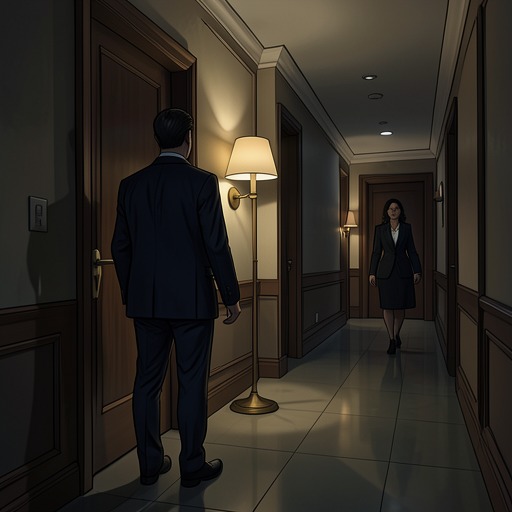
His first night in Hellhaus is already unsettled. The family-run hotel’s landlady is hospitable, but an inexplicably hostile barman disturbs him. In the morning he puts the encounter behind him and sets out on his circular route along the Rhine. That decision gives the walk a double structure: outwardly it is a sequence of roads and paths through Germany; inwardly it is a return to unresolved experience. The narrative’s knowledge also exceeds Futh’s. He believes he is heading back toward the hotel’s safety, while remaining unaware of what is happening there during his absence.
The Route and Its Bodily Demands
The walk is made up of concrete exertion rather than an effortless scenic passage. After a short ferry crossing, Futh applies sun cream to his white legs, forearms, and the small triangle of chest exposed by his open collar. He sets off with his printed directions, walking briskly and enjoying the physical act of moving, the fresh air, and twigs cracking underfoot. The river initially curves west, while the sun warms his back and dust gathers on his boots. These moments of straightforward pleasure offer a temporary contrast to the troubled interior journey that accompanies them.
His equipment, however, carries its own history. The new hiking boots are only days old, and Futh has ignored the shop assistant’s advice to break them in gradually at home. He packed them for the trip with the price tag still attached. They recall an earlier journey with his father, when Futh’s boots were too big even with two pairs of thick socks, as though bought to last for years. He probably never wore that pair again. In the present, the new boots turn the abstract idea of a fresh start into a physical trial: his feet become injured, and each further mile costs him more.
On one difficult day he dresses despite a worsening hangover, puts the lighthouse in his pocket, reapplies plasters to his damaged heels, and pulls on thick walking socks and the painful boots. He has to walk two miles to find an open bakery, so it is almost midday before the day’s hiking begins. The route leads across cornfields and into forest in late August, at harvest time, with green leaves, blackberries, mice, lizards, and insects in the undergrowth. Yet the landscape’s abundance offers little relief when rain clouds gather and the forest darkens around him.
Disorientation and Persistence
From the forest’s viewpoints, Futh could see the Rhine and the railway lines, with boats and trains travelling toward distant cities and onward toward the North Sea. But he is unable to attend to that wide prospect; the pain in his feet occupies him. His plasters have come away, and he knows that removing his boots might mean he could not put them back on. He continues instead, even as the viewpoints disappear and the path seems to lengthen into the gloomy woods.
As the afternoon fades, Futh begins to fear that the track is taking him deeper into the forest and that he may not find his way out. In the darkness, he imagines the trees shifting and spreading around him, enclosing him; he can barely see the ground or tell what his boots sink into and what cracks beneath them. He considers turning back, remembering an account of deep-sea divers who become confused about which way is up and believe they are surfacing while descending. He presses on. The trees eventually thin, and he emerges into twilight as streetlights come on. The episode makes disorientation bodily and immediate: his uncertainty about direction is intensified by fatigue, darkness, and the pain he has been trying to endure.
This ordeal does not end the holiday, but it changes the day’s practical course. Futh abandons the remaining hiking, finds the station, and catches a train to his next overnight stop. He rests his feet and leans his head against the rattling window as rain begins to fall. He has passed the midpoint of the circular walk and has more miles behind him than ahead. The route now measures progress in a way he can hold onto: each step brings him closer to Hellhaus, even when the forest has made escape feel uncertain.
Memory, Omission, and Return
The trek repeatedly opens onto Futh’s remembered past. Alongside his childhood friendship with the son of a lonely neighbour and the breakdown of both his parents’ marriage and his own, he returns most persistently to his mother’s departure and the emotional vacancy it left. The journey therefore does not simply place old memories beside present scenery. Its circular form gives those memories a recurring pull: forward movement does not prevent the past from remaining the story he comes back to.
Futh also carries the consequence of an omission from his first trip to Germany, which he made with his newly single father. He knows that he neglected to do something there and that this failure may have devastating repercussions on the present journey. The lighthouse in his pocket keeps an important object from that history physically with him, while the remembered warning that shipwrecks continued after a lighthouse was built gives the object’s protective associations an unsettling limit. The walk proceeds under the pressure of an unresolved past, not with the assurance that returning to familiar ground will undo it.
At the end of the week, sunburnt and blistered, Futh completes the circular walk and returns to Hellhaus Hotel. He regards the hotel as a sanctuary, but that expectation is undercut by his ignorance of what has taken place there while he was away. The journey’s return is thus geographically complete without guaranteeing refuge or resolution: Futh arrives back at the point from which he set out carrying his old anxieties, and without knowing what awaits him.