Futh’s failed attempt to visit Carl in Utrecht
The Lighthouse (Alison Moore Edition)Futh’s failed attempt to visit Carl in Utrecht turns a tentative change of plan into a sequence of small delays and practical reversals. He believes he was invited and tries to convert that opening into an unannounced visit, but he never reaches Utrecht: a missed bus, a long wait, and a flat tyre leave him returning to Hellhaus instead. The episode’s force lies in how ordinary obstacles accumulate until the imagined detour gives way to the itinerary he meant to leave behind.
The proposed detour
On the final morning of his walking holiday, Futh wakes early, hungry and unable to get back to sleep. His feet are tender and his body stiff; rather than complete the last day on foot, he seriously considers going to Utrecht. The idea is possible but uncertain from the outset. He would arrive without warning, has no address for Carl’s mother’s house, and would have to rely on remembering the way. Still, he recalls that Carl invited him and imagines that he could arrive by lunchtime, before Carl returned home in the evening.
The route he works out is indirect. Futh’s car is in Hellhaus, so he would first need to take a bus there and then drive to Utrecht. He considers taking his suitcase with him rather than sending it ahead by transit, avoiding the risk that it might arrive later and make him wait. In that version of the plan he could bypass the hotel, telephone from Carl’s mother’s house, and explain the change afterward. The careful sequence makes the impulse look almost like a practical itinerary, even though its destination depends on an unannounced visit and a remembered route.
Timetables and a missed departure
After coffee, Futh goes downstairs hoping to find the proprietor and ask for a bus timetable. No one is there, and the leaflets and telephone directory he finds offer no help. He looks up his own name and finds other people called Futh, but no schedule. Since the front door is open, he goes outside to look for a stop himself.
He walks farther than intended and finds what seems to be the right stop about a mile from the centre, near the river. The timetable appears to offer a workable connection: three direct buses to Hellhaus on weekdays, in the morning, early afternoon, and evening. Futh decides he can catch the first after breakfast. He returns to his room, packs his suitcase and sets it beside the door, makes the bed, and collects his watch from the bedside table. At breakfast he puts snacks in his rucksack for the ride. His preparations give the plan a tangible sense of readiness, but he is already physically strained.
After breakfast, Futh shakes so badly that he has to sit down. Instead of climbing the stairs to his room, he lies down on a sofa in the lounge, where a silent television shows the news, and drifts into an unusual sleep despite the coffee. He wakes anxious and discovers that he has missed the morning bus. The visit is not yet abandoned: he revises the timetable in his mind and expects to reach Utrecht by the end of the afternoon, in time for dinner.
Waiting for the next bus
Futh then discovers that his suitcase has been taken for transit while he slept. The proprietor tells him it is already on its way to Hellhaus. That defeats his preferred arrangement of carrying it himself and means he will have to go to the hotel after all, collect it, and explain his plans. The silver lighthouse is inside, making the suitcase more than a convenience: even while he is trying to leave the scheduled route, the object he is carrying binds the detour to Hellhaus.
With time before the afternoon bus, Futh considers buying a newspaper. The shop has only German papers; his written German is better than his spoken German, but he cannot make enough sense of the pages and leaves without one. He eats his packed snacks for lunch in a quiet place between trees. When he breaks up a bread roll and throws the pieces to some ducks, they do not notice; the current carries the bread away. The small incident echoes the day’s larger pattern: an offer is made, but nothing comes to meet it.
At the stop, Futh arrives in time and waits. As the minutes pass, he considers several explanations: the bus may be late, he may be at the wrong stop, he may have read the timetable or day incorrectly, or his watch may be slow and the bus may already have gone. He checks the timetables at neighbouring stops and rereads the first one, but finds no mistake. After almost an hour, he cannot establish what happened. There is still an evening bus, so he weighs whether Utrecht remains feasible. His hosts would have eaten by the time he arrived, though he might still get supper.
He briefly tries hitchhiking, standing at the kerb with his thumb out, but no one stops. He sees no taxi and does not want to walk back into town to find one; the cost would be an expense he has not budgeted for. The choices narrow to waiting several more hours or giving up. He waits, wishing he had bought a newspaper or kept the novel in his bag. Seeking shade, he has to move as it shifts, returning to the stop in the heat to check the timetable. When the evening bus comes, he boards and sits near the back, pleased to be travelling at last.
The return to Hellhaus
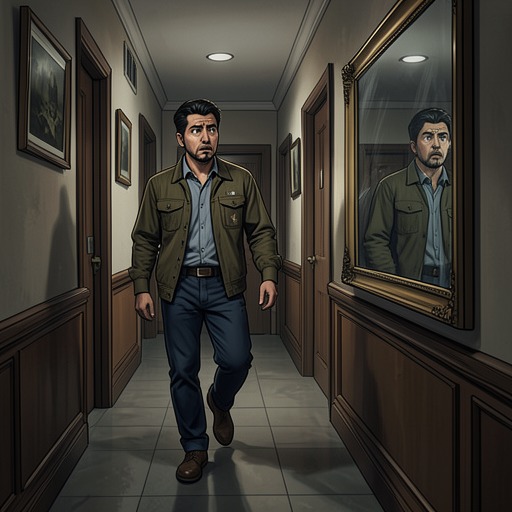
Futh gets off at the wrong stop and has to walk the remaining distance into Hellhaus. As the sun goes down, he sees Hellhaus Hotel from behind: the sunset blazes on its whitewashed wall and glares from the windows. The light is dazzling and almost painful, yet he cannot look away. The image of the hotel anticipates the end of his attempted escape from the established route: he is back at the place he had hoped to pass through, drawn toward it even as its brightness hurts his eyes.
Before going to the hotel for his suitcase, Futh checks his car. It is where he left it, but a tyre is flat. Broken glass lies in the gutter nearby; he wonders whether it was already there when he arrived and parked without noticing. He opens the boot expecting to find the spare, only to discover an old, flat tyre: the one he removed beside the road before driving home and finding Kenny coming out of his house. The missing usable spare turns the car from the means of reaching Utrecht into another obstacle.
Futh gives up the visit and decides he will have to sort out the car in the morning. He walks on to Hellhaus Hotel and returns, for the night, to the arrangements of his original itinerary. What he wants now is a quiet bar, a bedroom door and key, a soft carpet, a clean bed, a bath, a kettle, cold sausages and complimentary biscuits. He also wants his suitcase, the silver lighthouse, his pyjamas, and rest. Carl remains unvisited; the abandoned plan ends not in a dramatic confrontation but in Futh’s return to shelter and familiar possessions.
Significance of the failed journey
The attempted visit is shaped by Futh’s effort to make uncertainty manageable through logistics. He calculates buses, luggage, driving time, meals, and the cost of a taxi, but each practical detail produces another dependency: he must reach Hellhaus to get the car, the suitcase goes ahead without him, the bus does not arrive as expected, and the car cannot be driven as planned. His careful preparations cannot guarantee contact with Carl; the journey repeatedly turns on circumstances he cannot confirm or control.
The sequence also moves between the promise of departure and the pull of return. At first, the timetable seems to make Utrecht reachable; later, the evening bus offers one last possibility. But Futh reaches Hellhaus rather than Carl, and the flat tyre makes the reversal decisive. The silver lighthouse in the suitcase, the unusable spare in the boot, and the hotel’s bright wall are concrete reminders of the material ties that remain when the imagined visit falls away. Futh’s failed detour thus becomes a portrait of intention obstructed by delay, fatigue, and the limits of his preparations.