Futh’s father’s heavy drinking
The Lighthouse (Alison Moore Edition)Futh’s father’s heavy drinking is not merely a background habit: it helps govern the rhythms of family life, accompanies sudden violence, and sharpens the contradictions in his relationship with Futh. The narrative links alcohol to both frightening uncertainty at home and moments of apparent paternal attention, while the father’s later ridicule of Futh makes their shared vulnerability another source of humiliation.
Drinking and the Household
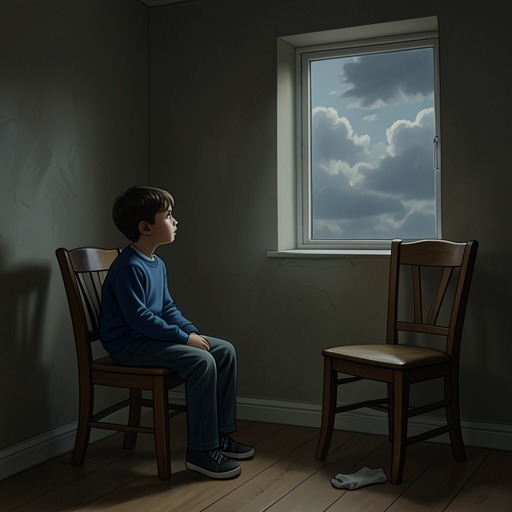
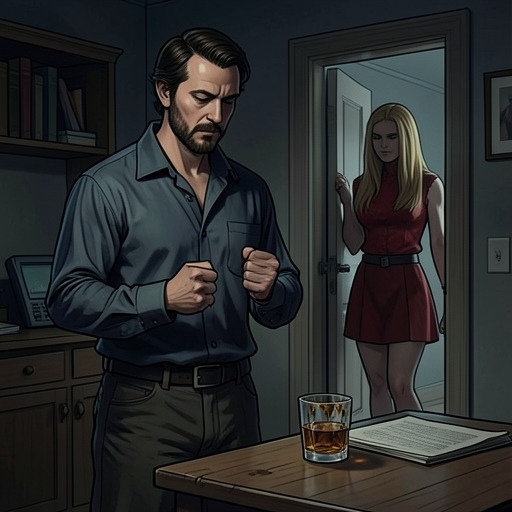
By breakfast on the day Futh’s mother has left, Futh’s father is already drunk. The account distinguishes what came before from what followed: before her departure, he had never hit Futh; afterwards, when he did, the blows came without warning, or without warning that Futh could recognize in time. The suddenness is compared to a bird striking a window, then lying still outside, perhaps dazed but possibly hurt or broken. Alcohol belongs to a changed domestic atmosphere in which danger is difficult to anticipate.
Futh responds by trying not to get in his father’s way. He sometimes stays outside on the climbing frame until darkness makes the ground below seem like either an ink-black lake or a void. The kitchen window remains visible as a bright square, connecting his refuge outdoors to the uncertain household within. Watching his father move around the kitchen—taking food from the fridge and sniffing it, searching cupboards, opening a tin, and lighting the hob—Futh learns when supper might be ready. If he waits too long, the food goes cold; if his father sits alone at the bare table, Futh waits for him to leave before going inside and putting himself to bed. The boy’s attention is trained on his father’s movements, turning ordinary decisions about eating and sleeping into exercises in timing and avoidance.
Care and Contradiction
The relationship is not presented as uniformly hostile. On a daytime ferry crossing to Europe, Futh’s father takes him to the cinema and buys him popcorn, sweets served in a mug from the duty-free shop, and more packets of peanuts than he can comfortably eat. Futh feels sick in the car on the journey from the ferry to their hotel in Germany. The trip preserves signs of indulgence and shared travel, but the excess food and the child’s sickness complicate the picture of care: generosity does not remove the instability associated with his father.
Later, the father’s drinking becomes part of a pattern of mockery. He makes fun of Futh for being unable to hold his drink, as if the same criticism could not apply to himself. His contempt extends to Futh’s delayed driving lessons and test, his lack of confidence with cars, running out of petrol, and paying other men to change a headlight bulb. He also ridicules Futh’s work trying to make paper smell like apples, dismissing the effort in favour of real apples that can be eaten. The sequence shows the father turning Futh’s inexperience and unusual work into occasions for scorn, even as his own drinking gives the taunt about alcohol an unmistakable hypocrisy.
Lasting Significance
The evidence presents heavy drinking through its effects on daily life rather than through a diagnosis or a single explanatory confession. It is associated with a father who may be drunk at breakfast, whose violence is experienced as sudden, and whose household routines require Futh to watch and wait. The Germany trip offers a counterpoint of treats and travel, but does not resolve that uncertainty; later, the father’s ridicule makes alcohol part of a broader pattern in which he judges Futh for weaknesses that his own conduct makes difficult to separate from himself.