Futh’s maternal abandonment
The Lighthouse (Alison Moore Edition)Futh’s maternal abandonment is the formative loss around which his memories and later search for intimacy repeatedly gather. His mother leaves without an address, turning a familiar home into a place of absence and uncertainty. The departure is not only a childhood event: during Futh’s Rhine walking holiday, it returns as the memory he comes back to above all others, the wound he understands as having left a void that needed a substitute.
The Departure
The memory emerges during the crossing of the North Sea, as Futh lies on a ferry trying not to think about Angela and the marriage that has ended. The distress of that present separation recalls the earlier one: his heart feels as it did when his mother left. The narrative thus places two losses beside each other without treating them as equivalent. His adult separation has prompted the journey; the remembered childhood departure supplies its older, more persistent emotional depth.
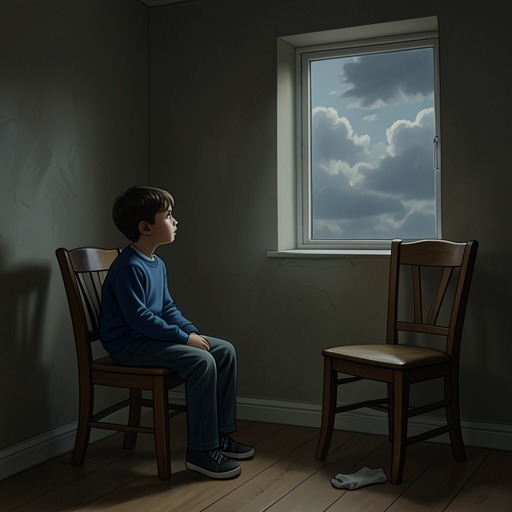
The decisive scene begins at night. Futh wakes to find his mother’s face above him, lit by moonlight coming through a gap in the curtains. She leaves his room, and he is left alone in the dark with the smell of violets and the sound of her footsteps going downstairs. The moment is defined by what remains after she is no longer there: a scent, a departing sound, and a child left to understand absence without explanation.
By breakfast, she is gone. Her explanation is that she is going home, meaning New York, three thousand miles away. Only after she has left does Futh discover that she has given him no address. He searches the kitchen pin board, but finds only the beginning of a shopping list, written in a nearly flat line of handwriting that he cannot decipher. The small, unfinished note cannot tell him where she has gone or how to reach her; it is a domestic trace that makes the lack of an answer more concrete.
The Household Afterward
The departure changes the conditions of life with Futh’s father. Before his mother leaves, his father never hits him; afterward, he does, without warning, or without warning that Futh can recognize in time. The suddenness is central to the child’s experience. The narrative compares the blows to birds striking windows: a sickening impact followed by the sight of a still body whose injury may be difficult to judge. Violence becomes another abrupt event that Futh must register after it has already happened.
Futh responds by trying not to get under his father’s feet. Sometimes he remains outside on top of his climbing frame until darkness hides the ground beneath him. From there, the lawn seems as though it might be an ink-black lake or a void into which he could drop, yet he feels safer outside than in the house. The bright square of the kitchen window remains visible in the dark, connecting his refuge to the household he is avoiding.
He learns to read his father’s routines instead of relying on reassurance. Watching him search the fridge, sniff food, open cupboards, or light the hob tells Futh when to go in for supper. If he waits too long, the meal will be cold and spoilt; if his father sits alone at the bare table, Futh knows to wait until he goes out before entering to put himself to bed. These observations show a child managing uncertainty through attention to small practical signals. Safety depends on judging when to approach and when to stay away.
Erasure and What Remains
Futh’s father responds to the departure by destroying what Futh’s mother has left behind. Before Futh wakes, he builds and lights a bonfire, feeding it her books, framed photographs, unhung pictures, folders of Open University work, and the pin board with its indecipherable lists. He smashes furniture before burning it, and throws in clothes, kitchen curtain material, and even her walking boots, along with Futh’s own. He pulls up the flowers and weeds in the garden bed she had planted and neglected. The destruction extends from possessions to the domestic setting itself: after the fire, he cleans the house until disinfectant replaces the lingering signs of her presence.
The attempted erasure is not complete. Futh supposes that microscopic particles must have escaped the cleaning, and he remembers books hidden under his mattress. Most importantly, he still carries the silver lighthouse perfume case everywhere. Against the fire, the housecleaning, and the removal of visible traces, these concealed or portable remnants preserve a connection that his father’s actions cannot entirely eliminate. The contrast gives material form to Futh’s predicament: the household tries to make his mother absent even from memory, while objects and sensory impressions keep her presence available to him.
Memory, Distance, and Lasting Significance
Futh’s response to the loss includes searching for an image of the place to which his mother has gone. He looks in the library for pictures of New York, finding skyscrapers whose mirrored windows catch the light of sunrise and sunset and shine at night beside the river. The city becomes something he can look at from far away, not a location he can reach through an address or a message. His mother’s departure therefore leaves both an emotional gap and a practical impossibility: Futh has no way to follow or contact her in the memory presented here.
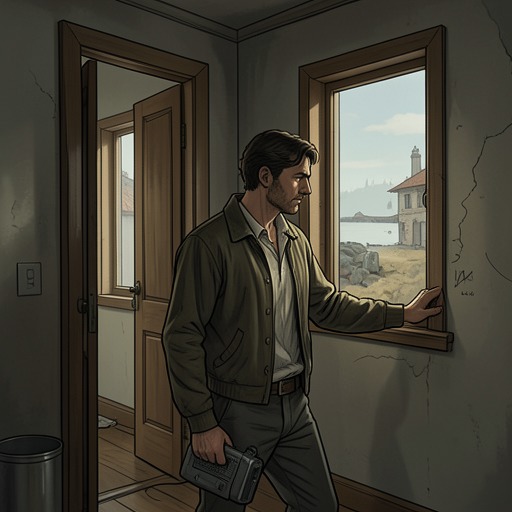
The wound returns during the walking holiday as Futh reflects on his childhood, his parents’ broken marriage, and his own broken marriage. The narration identifies his mother and her abandonment as the person and event affecting the others most deeply, and describes the absence as a void for which he has sought a substitute. That recurrence makes the abandonment more than background biography. It is a recurring measure of departure and a source of emotional pressure that accompanies Futh into adulthood, even as the memory itself remains strikingly specific: moonlight, violets, footsteps on the stairs, an unreadable list, and the kitchen window shining through the dark.