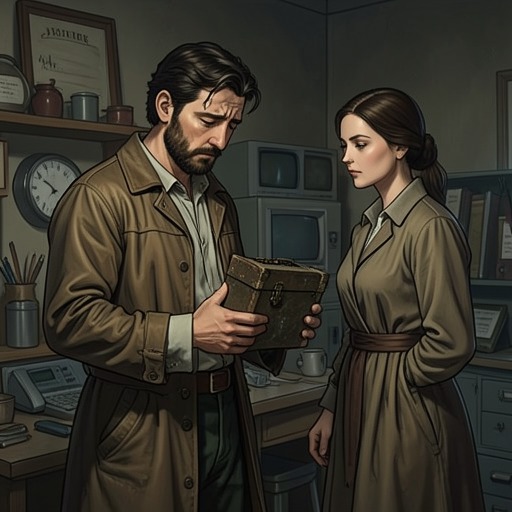
Futh’s mother
The Lighthouse (Alison Moore Edition)Futh’s mother is remembered less through a sustained account of her life than through the objects, scents, and departures that mark her relationship with Futh. She is at once physically close—a face above his bed, a perfume on his skin, a presence in the dark of her wardrobe—and unreachable: she leaves without resolving what her departure means to him. That contrast becomes a lasting pattern in Futh’s memory, where violets, oranges, cigarette smoke, and camphor preserve fragments of her even as he struggles to hold on to her actual presence.
Identity and Recollection
The narrative presents Futh’s mother chiefly through her place in the family and through Futh’s recollections. She is married to Futh’s father and has a son who watches her closely, but her private feelings remain difficult for him to read. Even when she is in the room with him, the scenes often turn on what she does not explain: she leaves his bedside, keeps a suitcase packed, or lies with her eyes closed while the family gathers around a picnic. The silences leave Futh to make meaning from small, vivid details.
One night, Futh wakes to find her face above him, lit by moonlight coming through a gap in the curtains. After she leaves, he is alone with the smell of violets and the sound of her footsteps going downstairs. By breakfast she is gone, and his father is drunk. Futh remembers a stark change in the household after her departure: his father, who had not hit him before, later strikes him without warning. The comparison in Futh’s memory is to a bird hitting a window, followed by the shock of finding it motionless on the ground. His mother’s leaving therefore registers not only as loss but as the beginning of a more dangerous domestic life.
The Cornish Holiday and the Broken Vial
The holiday in Cornwall, England, gathers the tensions of the marriage into a single exposed landscape. On the cliffs, Futh’s father lectures about lighthouse technology, keepers, and shipwrecks, describing the work of tending a light that might guide ships safely home. The account offers a language of care and warning, but it does not bring the adults closer. Futh’s mother lies in the heat with her clothes and boots in a heap nearby, a tube of sunblock, cigarettes, and a lighter beside her. Her husband continues talking; she eventually opens her eyes, sits up, and lights a cigarette, the smoke overwhelming the scent of her sun cream.
Smoking is one of the few habits Futh associates with her private independence. His father dislikes it, so she usually smokes furtively, and Futh knows only a handful of occasions when she did so: after passing her driving test, completing her Open University degree, and finishing the painting of the old house for sale. The cliffs are the only time he recalls seeing her smoke openly. Her small exasperated sound and his father’s failure to notice it sharpen the distance between them, while her cigarette becomes an action she takes in full view of the family rather than a hidden reward after a task.
The silver lighthouse perfume case carries another strand of that family history. Futh’s granddad gives the case to Futh’s father and tells him it should be returned to Ernst. In the car, Futh’s father passes it to Futh’s mother; she admires the case and the vial inside, approves of the scent, and applies it to her wrists and throat. The car fills with violets. Later, on the cliffs, Futh takes the case from her handbag. He wants to smell her scent but keeps the vial stoppered. While his father speaks about lighthouses and their warnings, the object in Futh’s hands holds a more intimate, fragile version of safety: his mother’s fragrance, preserved in a container he can carry.
The holiday ends in an abrupt rupture. After Futh’s mother tells her husband, “Do you know, how much you bore me?”, he begins packing the picnic. She remains lying in the sun until she stands and says, “I’m going home.” Futh sees redness on her cheek, then discovers that the vial has broken and cut his palm. Perfume stings in the wound and spills onto the grass and his walking boots. The scene turns the scent that had connected him to her into something painful and irretrievable. On the train home, the case and broken glass are in his pocket; his unwashed hands and boots smell of violets, while his mother carries the scent of the orange she has eaten. The contrast preserves two separate traces of the same journey rather than restoring their closeness.
Leaving the Family
The morning after the return from Cornwall, Futh finds his mother in the kitchen, where it smells of coffee. She is wearing a pink summer dress he recognizes from his parents’ honeymoon photographs as her going-away dress. The brightly coloured suitcase he had seen packed and hidden beneath the bed is now by the back door. His father is still upstairs. His mother kisses Futh, takes the case, and leaves; the movement is so quick that Futh is left holding her coffee cup, still warm in the suddenly empty kitchen.
The suitcase makes the departure feel prepared rather than spontaneous. Futh has previously watched his mother zip it shut after an argument with his father, lift it down, and put it under the bed. Its clothes and toiletries are already packed, and he can tell from the creases in the clothes that they have not just been taken from the wardrobe. He understands it as a bag kept ready in case she needs to get away quickly. The later sight of it at the back door confirms what the hidden preparation had suggested, but gives him no time to intervene or ask her to stay.
Scent, Memory, and Narrative Significance
Futh’s mother persists in the novel through an unstable catalogue of smells. As a child, he makes a nest in her wardrobe among shoes and skirts; its darkness smells of leather, secret cigarette smoke, and the camphor used in mothballs during summer. This is the scent he would want to bottle as “Essence of Mother,” but the perfume he actually possesses offers violets and oranges instead. The difference matters: the imagined essence is a composite of a private refuge and concealed habits, while the available scents belong to particular moments that cannot be kept intact.
The association continues into Futh’s adult life. When he works in the manufacture of artificial odours, octyl acetate makes him sad, linking professional contact with constructed scents to the remembered orange on the train. Later, while hiding in Ester’s bathroom, he uncaps a bottle of camphor and is pulled back to the dark interior of his mother’s wardrobe. These returns do not recover his mother as a person; they revive the bodily force of particular places and absences. Her presence is consequently both intimate and incomplete: a smell can bring the past near, but it cannot undo the departure that gave those memories their weight.