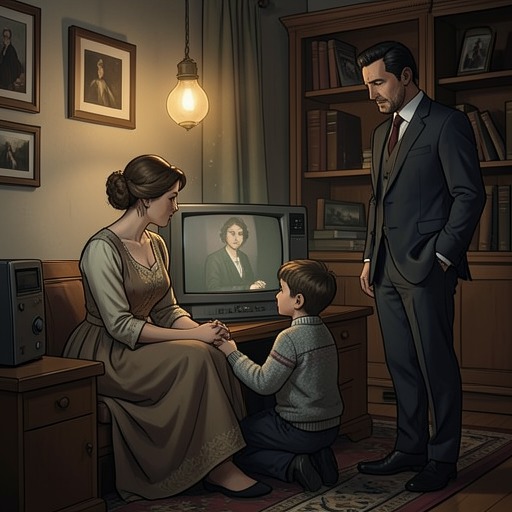
Maternal abandonment and substitute intimacy
The Lighthouse (Alison Moore Edition)Maternal abandonment and substitute intimacy form a lasting pattern in Futh’s life: after his mother leaves without an address, he continues to seek her in other women, remembered domestic comforts, and scents that preserve what ordinary family life could not. The loss is not followed by a stable replacement. Instead, his father’s silence and violence, his sexualized memories of women brought into hotel rooms, and Gloria’s mixture of care and boundary-crossing make closeness feel both sustaining and unsafe.
The departure and its afterlife
Futh’s mother is already gone by the time he and Futh’s father take a holiday together when Futh is twelve. On the ferry, his father mentions that she once sold popcorn, then shifts to a memory of usherettes’ high heels. The detail offers a fragment of her life, but not the conversation Futh wants: he longs for someone to begin speaking about her, yet when she is mentioned, the account tends to spoil the possibility of comfort. Her absence is thus present in the family as both silence and a source of disappointment.
The departure itself is starkly incomplete. Futh’s mother says she is going home, meaning New York, thousands of miles away; only after she has left does Futh discover that she left no address. On the kitchen pinboard, he finds only the beginning of a shopping list, written in a hand that has become almost indecipherable to him. The ordinary domestic scrap cannot lead him to her. His search for pictures of New York in the library gives him images of a distant city, not a way to contact his mother.
Her leaving also makes another family history newly painful. Futh learns that his German grandfather left home young, settled in England, and never saw his parents or brother again, despite thinking often about returning. Futh dislikes the idea that someone can leave so abruptly and never see family again. The grandfather’s story gives abandonment a generational echo, but does not make it easier for Futh to understand his own mother’s departure.
The remembered night of her leaving condenses the loss into a sensory scene. Futh wakes to see her face above him in the moonlight; after she leaves the room, he is alone with the smell of violets and the sound of her footsteps going downstairs. By breakfast she is gone, and Futh’s father is already drunk. The later violence in the home marks a consequential change: before the departure, his father had never hit him; afterward, blows come without warning, or before Futh can recognize what is about to happen. Futh tries to stay out of his father’s way, sometimes sitting on his climbing frame until darkness hides the ground, while watching the lit kitchen window to judge when it is safe to go inside.
Replacement and the father’s household
Futh’s father gives the loss a contradictory lesson. During a walk, he warns Futh to be careful of women, presenting marriage and children as a path to ruin; shortly afterward, he says they can do without Futh’s mother. Futh understands that the women his father brings into hotel rooms are substitutes for her. Some resemble her, and Futh watches them going into the bathroom and in the mirror at night, while also desiring them. The replacement is therefore not a resolution of the mother’s absence: it reproduces her image in transient encounters and draws the child into an adult atmosphere he cannot make sense of.
That pattern persists into Futh’s later sexual life. Years pass before he sleeps with a girl and longer before he meets Angela, but even then he finds himself thinking about the women from his father’s hotel rooms. The memory is not simply a recollection of particular women; it links adult desire back to a childhood formed by absence and substitution. Intimacy arrives with a history already attached to it, rather than as a clean break from the past.
Gloria’s care and its uncertainty
Gloria supplies something the household does not reliably provide: food, company, and an invitation into a warmer domestic space. After Futh’s mother leaves, he goes to Gloria’s house around supper time as often as he can. She feeds him even when he has already eaten, and sometimes offers him a new liqueur or cocktail to try. Her practical attention answers hunger, but it also draws Futh toward a relationship whose limits are unclear.
The pattern recurs when Futh is an adult and, during the months before moving out from Angela, spends time alone in his garden. Gloria calls to him from the other side of the fence and persuades him to come in. At her kitchen table he moves into a corner of the bench and looks back through the open window toward his climbing frame. The image makes the invitation double-edged: he has left the dark place where he thought himself hidden, but remains visually and emotionally oriented toward it.
In another remembered evening, Gloria makes popcorn while a film begins and remarks that it is just the two of them now. She rubs hand cream into her hands; the smell of tangerines mingles with the popcorn. Futh falls asleep on the sofa against her and wakes in the morning in Kenny’s bed, where Kenny angrily orders him out. Afterward, Kenny’s visits no longer coincide with Futh’s. When Futh asks whether Kenny is there, Gloria says he is elsewhere but invites Futh in to keep her company anyway. Her companionship continues, while the awkwardness of the sleepover remains unresolved.
A later visit intensifies the uncertainty without explaining it away. As Futh watches a moth caught in a plant, Gloria touches the back of his neck and the top of his back beneath his T-shirt. He stays still, registering the warmth and slight pressure, and realizes only afterward that she has stopped touching him. She returns with melting ice in her hand, refreshes his drink, cups his face, and says she can see his father in him; she also pats his knee and strokes his hair. When someone rings the bell and heavy footsteps go upstairs, Gloria tells Futh he should not be there and asks him to let himself out. Care, physical closeness, and sudden dismissal occupy the same encounter, leaving the meaning of her attention unsettled.
Objects, scent, and remembered intimacy
Scent gives Futh a form of access to his mother that speech and contact cannot provide. His grandfather’s silver lighthouse perfume case reaches Futh’s mother after Futh’s father gives it to her in the car. She admires the case and the vial, puts the perfume on her wrists and throat, and fills the car with the smell of violets. The object becomes part of a family inheritance and, for Futh, a container for the mother he cannot keep near him.
The remembered Cornwall holiday binds that perfume to departure and injury. After the vial breaks, Futh’s unwashed hands and boots smell strongly of violets on the train home; his mother, asleep by the dirty window, smells instead of the orange she has eaten. Futh knows the holiday is ending and wants the train not to stop, because stopping means going home and facing her departure. Much later, when he works in the manufacture of artificial odours, octyl acetate makes him sad. The smell’s power lies in its connection to the train, the broken vial, and the knowledge of loss, not merely in its resemblance to a pleasant perfume.
Futh’s imagined “Essence of Mother” is more complicated than violets. As a child, he makes a nest in his mother’s wardrobe, among shoes and the hemlines of her skirts. He would like to bottle the combined smell of leather, secret cigarette smoke, and camphor from the mothballs she uses in summer; instead, he has violets and oranges. The contrast distinguishes the intimate, enclosed atmosphere he longs to preserve from the particular scents that actually accompany his memories of her.
The sensory connection returns years later in Ester’s bathroom. While hidden there, Futh smells camphor from a bottle and is carried back to the dark interior of his mother’s wardrobe. The memory arrives as a wrenching passage through time, collapsing the distance between a present search for the silver lighthouse and the childhood refuge he made among his mother’s clothes. Scent does not restore the lost relationship, but it makes its absence physically immediate.
A pattern rather than a replacement
Across these episodes, substitute intimacy never removes the original abandonment. Futh’s father offers other women instead of conversation about Futh’s mother; Gloria offers food and company, then moments of touch whose implications remain uncertain. The repeated movement between invitation and withdrawal echoes Futh’s childhood experience of waiting: he watches the kitchen window, listens for footsteps, and tries to judge when to enter or leave. Even his adult recollections return to that suspended position between wanting closeness and bracing for its cost.
The motif also explains why ordinary details carry such force. Popcorn recalls his mother’s work but comes through his father’s awkward, incomplete reminiscence; a perfume case preserves her scent but also travels with the memory of a broken vial; Gloria’s popcorn and tangerine-scented hand cream make a familiar domestic scene feel newly precarious. Futh’s longing is sustained by fragments rather than reunion. In this pattern, intimacy can feed, shelter, or briefly touch him, but it cannot make the absent mother present again.