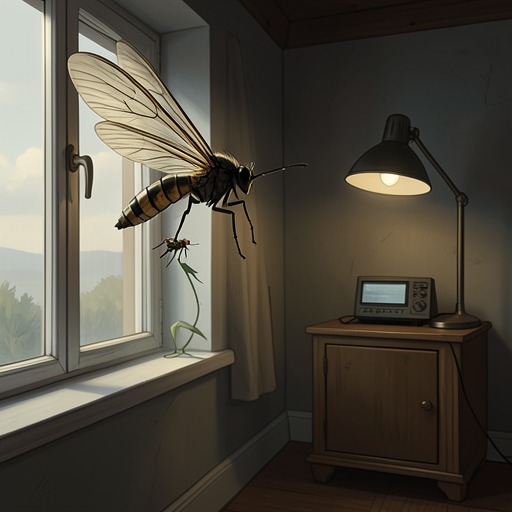
The moth motif
The Lighthouse (Alison Moore Edition)The moth motif connects acts of collecting and preservation with the failures of memory and recognition. It first enters Ester’s life as a creature drawn to a bedroom light, then recurs in the neglected rooms of Hellhaus and among the keepsakes Futh searches while looking for his silver lighthouse. Later, a moth’s powdery wings become part of Carl’s attempt to remember a man whose name has already vanished. Across these scenes, the moth is at once a living visitor, a pinned specimen, and a fragile trace that survives when a person or name cannot be securely recalled.
Ester’s first moth and the work of collecting
As a girl, Ester visits the Museum für Naturkunde in Berlin and encounters collections of preserved fish and invertebrates, stuffed mammals, and butterflies and moths pinned to display boards. The scale and stillness of the exhibits disturb and fascinate her. A few days later, reading a romantic photo story in her bedroom with the light still on, she watches a moth fly through the open window and circle the bulb. She catches it and pins it to the cork board. This first moth becomes the beginning of her collection, which is also her first collection of any kind.
The contrast between the museum and Ester’s bedroom makes the act of collecting intimate rather than grand. The museum offers an enormous inventory of stilled creatures; Ester begins with one moth, encountered in the ordinary setting of a room at bedtime. Yet her own small specimen repeats the museum’s basic gesture: a creature that once moved is made still, fixed in place, and kept for looking. The narrative also preserves the moth’s physical delicacy. Ester remembers the tickle of its powdery wings trapped between her palms, a bodily sensation that remains vivid long after the first encounter. The collection stores specimens, but memory holds the touch that preceded their stillness.
The hotel’s rooms and the moths at the light
At Hellhaus, Ester manages the accommodation while Bernard runs the pub. The hotel has ten bedrooms, but only a few are usually booked; some rooms remain empty for entire seasons. In one of the bathrooms, Ester leaves a light on and a window open, then does not return for weeks. When she eventually comes back, a white glass bowl forming the lightshade is full of moths.
The scene turns the hotel’s emptiness into a condition for accidental accumulation. The moths are not pinned or deliberately gathered: they enter through an open window and collect around a light that has been left burning in an unattended room. Their presence echoes Ester’s first moth, also drawn inside by a bedroom light, but changes the scale and meaning of the encounter. What began as a single chosen specimen becomes a mass of unplanned arrivals in a space forgotten for weeks. The bowl holds them like a display, though no one has arranged them there. The hotel’s empty rooms thus resemble a collection formed without a collector, where neglect itself allows the moths to gather.
A specimen among Ester’s private belongings
Years later, the motif appears in a different kind of private space. Futh enters Ester’s room while searching for his silver lighthouse. In a drawer of make-up, worn lipsticks, jewellery, and small boxes, he finds what he first takes to be a moth brooch. Looking closer, he realizes it is a real moth pinned to a square of foam inside a lidless jewellery box. He touches its stilled wings before closing the drawer.
The moment brings Ester’s collecting into contact with Futh’s search, without resolving what he is looking for. He has entered the room for the lighthouse, but the pinned moth interrupts the search: for an instant, he mistakes a preserved creature for an ornament, then recognizes its stillness and touches it. The moth is preserved alongside the intimate contents of a dressing table, among objects kept in drawers rather than displayed publicly. Its placement recalls Ester’s original specimen pinned to a bedroom cork board, while the touch recalls the powdery wings she once felt between her hands. The scene does not establish that this is the first moth she collected; instead, it shows the collection persisting as part of her private world, encountered by someone who does not know its full history.
Moth wings, names, and imperfect memory
On the ferry, Carl searches the faces around him for the thin, pale man he met the previous weekend and accompanied to his mother’s house in Utrecht. Although only a week has passed, Carl cannot clearly visualize him and cannot remember his name. He recalls it as a name that made him think of froth and the powdery wings of a moth, but the name disappears even as he tries to recover it. The man is Futh, though Carl’s recollection does not securely retain him.
Here the moth is no longer a specimen held in a room; it is an association inside a failing act of recall. Its powdery wings offer Carl a sensory and verbal path toward the missing name, but the association cannot restore it. That failure reverses the earlier scenes of preservation. Ester’s pinning makes a moth remain available to sight, and Futh’s touch confirms its material presence; Carl, by contrast, has only an image of delicate wings and an absent name. The motif links people through details that persist unevenly: a remembered touch, a moth left among keepsakes, a name that seems to vanish. Its recurrence makes preservation less a guarantee against loss than a record of how incomplete remembrance can be.