Ester’s abusive marriage to Bernard
The Lighthouse (Alison Moore Edition)Ester’s abusive marriage to Bernard emerges not through a single confrontation but through recurring signs of physical harm, the routines of their shared hotel, and an intimate encounter in which recognition fails. The narrative sets her labor and moments of guarded self-direction against Bernard’s controlling presence, making the marriage legible in both public spaces and the apartment they share.
Visible Evidence and Recurrence
At the hotel bar, Ester’s bruised upper arms are visible beneath her vest top. The detail is part of a wider portrait of her appearance, but it also gives the marriage’s violence a physical presence in an ordinary workplace. The narrative does not explain the origin of every mark; instead, the bruises establish a condition that returns in later scenes and cannot be concealed simply by continuing with the day.
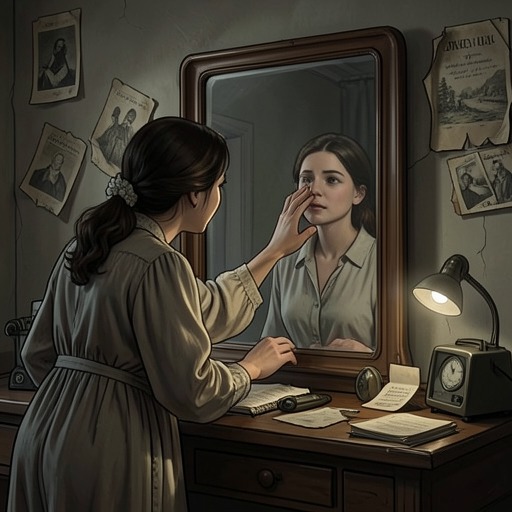
On a Sunday morning, after spending the night at the hotel, Futh sees a new bruise on Ester’s face despite the makeup she has applied. She is sitting at the bar with coffee and an orange, and the encounter remains brief: Futh thanks her in German, she nods, and then she walks away with his empty plate. He watches her go, unable to turn his wish to ask about breakfast into a completed question. The episode joins the visible sign of harm to the novel’s pattern of failed communication. Ester does not explain the bruise, and Futh’s attention does not become an exchange in which she can respond or be heard.
The narrative’s restraint about cause matters. The marks recur around scenes of the marriage, while the text gives a more direct instance of Bernard’s forceful handling later. Together, the episodes make abuse an ongoing condition rather than an isolated incident, but they do not make every bruise an explicitly narrated consequence of a particular act.
Hotel Labor and Domestic Control
Ester’s working day is organized around the hotel’s needs. She remains in the bar and dining room through breakfast, receives departing guests’ keys and complaints, and then cleans bedrooms. She considers going upstairs to lock the apartment but does not do so immediately. After a break at the bar, she returns to cleaning the remaining rooms; the sequence places the private space of the marriage just above a workplace where her attention is continually required.
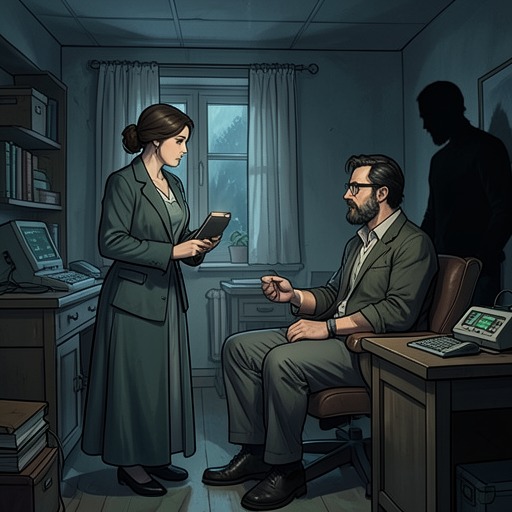
The division of their routines is visible at lunch. Ester usually eats bar snacks if she is hungry, while Bernard prepares his own meal in the private kitchen because he dislikes other people handling his food. When he finishes, he leaves his plate on a table and approaches Ester at the bar. Leaning across the space between her and her drink, he repeats his warning about leaving the apartment unlocked, framing her decision as an invitation to trouble. The warning is not presented as a discussion between equals: his closeness and position at the bar turn an instruction about the apartment into an assertion of control in her workplace.
Ester is not shown as wholly without initiative. Later, while the new employee is on a break and Bernard is in the cellar, she asks a tourist to buy her a drink. The man looks wary, and the episode supplies no outcome or clear motive for her approach. Its significance lies in the contrast it introduces: Ester can initiate contact, yet her action occurs within a day and a marriage structured by Bernard’s presence and by the hotel’s demands.
Private Intimacy and Recognition
When Ester enters the apartment, Bernard follows her upstairs. He questions her appearance and holds her by the upper arms; she says nothing and looks directly at him until he relaxes his grip. That brief response gives her a limited form of resistance, but it does not end the encounter or establish equal control over it. The narrative links his handling of her to her expectation that bruises will remain afterward.
The scene then shifts into the couple’s bedroom. Bernard closes the curtains, though the room remains light, and prepares for bed; Ester stands beside it and gets under the covers when he draws them back. The narration presents these actions without suggesting mutual ease. Bernard looks at her as though she reminds him of someone whose identity he cannot place. Ester’s inward response is a wish to be recognized as herself. That moment makes emotional estrangement part of the marriage’s harm: even within physical proximity, she experiences herself as unseen by her husband.
Bernard’s familiar camphor smell fills the scene as his eyes close. The detail connects this private encounter to the novel’s attention to scent, while also ending the episode without reconciliation or explanation. The marriage continues as a bodily and domestic fact, but the scene offers no sign that its underlying imbalance has changed.
Narrative Significance
The marriage is rendered through recurrence and contrast rather than through a complete account of its history. Bruises appear in public view; Bernard’s warning crosses from the apartment into Ester’s working day; and a private encounter combines physical pressure with a failure of recognition. These separate circumstances create a pattern without requiring the narrative to state that every injury has the same immediate cause.
Ester’s position at the hotel sharpens that pattern. She serves guests, cleans rooms, and remains responsible for the routines around the bar, while Bernard’s control enters both the shared apartment and the space where she works. Her brief acts of silence, sustained eye contact, or initiative do not erase that imbalance, but they keep her from being represented only as a passive object of it. The result is a marriage defined by the tension between her attempts to retain a measure of self-possession and the recurring evidence that Bernard’s authority reaches into her body, labor, and private life.