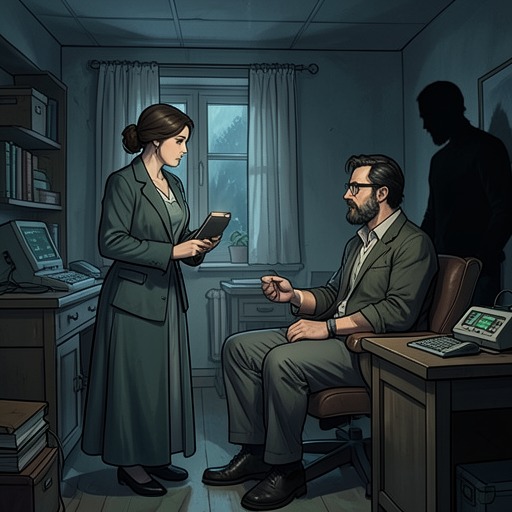
Ester’s tryst with an unnamed guest
The Lighthouse (Alison Moore Edition)Ester’s tryst with an unnamed guest is a clandestine encounter inside the hotel where she works and lives, and it exposes how unstable the boundary is between guest hospitality and the couple’s private life. Ester deliberately uses room ten rather than her own bedroom; Bernard’s unexpected return then makes the hotel’s connected spaces the route by which the encounter is discovered and violently interrupted.
Setting and Circumstances
Hellhaus Hotel is both a place of business and the home Ester shares with Bernard. A door marked PRIVATE separates the guest rooms from the rooms occupied by the couple, making the division between public accommodation and private life a physical feature of the building. The tryst takes place on the guest side of that threshold, in room ten, rather than in Ester and Bernard’s own quarters.
The unnamed man is identified in the narration only as a question mark. That withholding leaves him without a personal history or a stated motive; the episode concentrates instead on Ester’s decisions, the room she chooses, and the threat of discovery. The exchange between them suggests this is not their first encounter: he asks whether she wants the same again, and she leads him upstairs. The story does not explain how they met or establish a fuller relationship.
The hotel’s ordinary routines continue around their meeting. Ester has been working among the guests and the staff; the new girl is serving at the bar while Ester sits there. The episode therefore begins not in a separate private world but in the public space where Ester performs her work, before she guides the guest from the bar to the lift and into a guest room.
The Encounter in Room Ten
Ester will not take the man to her own room. She refuses to have him in the bed she shares with Bernard, and instead brings him to room ten, where the sheets are only barely cool. The choice is practical and significant: the encounter remains within the hotel’s guest accommodation, not in the space most directly associated with her marriage.
In the room, the guest lies down and undresses only partly, leaving his T-shirt and socks on. Ester undresses and joins him on the bed. The narration gives no name to the man and no account of a conversation between them about their relationship. The scene is defined by its guarded arrangements—the familiar request for a repeat encounter, the borrowed guest room, and Ester’s separation of this meeting from Bernard’s bed—rather than by any disclosed promise or future plan.
Afterwards, Ester returns to the bar, where the new girl tells her that Bernard is looking for her. Ester believes he is not due back until the following day and contradicts the news; the girl insists that he has returned. This brief exchange changes the conditions of the encounter. Ester has treated the hotel room as a temporary space apart from her marriage, but Bernard’s early arrival makes that separation impossible to rely on.
Discovery and Violence
Ester first goes to the couple’s private apartment and searches its rooms, but Bernard is not there. She then takes the lift back toward the guest rooms with her cleaning trolley and gloves, returning to room ten with fresh bedding. The shift from intimate encounter to housekeeping is abrupt: Ester is again moving through the hotel in the capacity of a worker, preparing to deal with the room after the guest’s visit.
Bernard is already leaving room ten when she opens the door. He has attacked the guest, who did not leave before Bernard arrived. As Bernard passes Ester, he warns her not to let it happen again. The novel does not dwell on the attack itself; its consequence is conveyed through the disordered bed, Bernard’s departure, and the threat he directs at Ester. The encounter has thus become not only a secret exposed but a moment of violence and control within the marriage.
Consequences and Significance
Bernard’s warning places the threat beyond the immediate harm to the guest: it makes Ester answerable to him for the possibility of another encounter. At the same time, the scene does not supply a fuller explanation of their marriage or show Ester’s response to the warning. The emphasis remains on what the hotel’s spaces allow and what they cannot conceal. Room ten offers a temporary alternative to the couple’s bedroom, but it cannot protect the guest from Bernard or Ester from his demand.
The episode turns the hotel’s service routines into part of its conflict. Ester leads the guest upstairs, returns to her work, and later comes back with the equipment and fresh bedding needed to prepare the room. Hospitality and privacy overlap: the same building that receives and accommodates travelers is the place where Bernard crosses into a guest room and discovers his wife’s encounter. The private door marks a boundary, but the characters’ movements show how readily it can be crossed.
The unnamed guest’s lack of identity also shapes the episode’s focus. Without a personal story to compete with the action, the encounter is framed through Ester’s attempt to keep her private life compartmentalized and Bernard’s sudden intervention. The tryst begins as an arrangement made inside ordinary hotel work; its consequence is that the distinction between guest space, marital space, and the authority Bernard claims over Ester collapses.