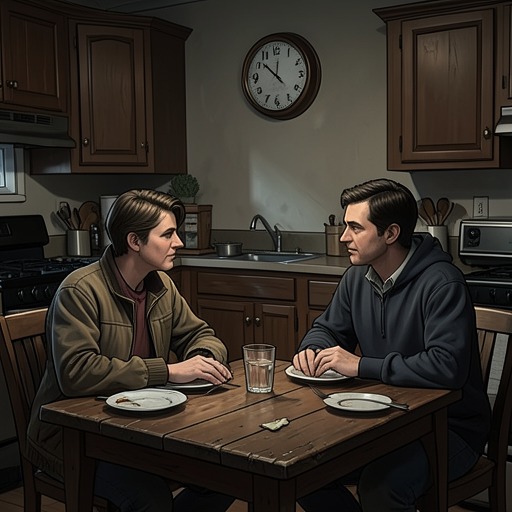
Futh and Angela’s honeymoon
The Lighthouse (Alison Moore Edition)Futh and Angela’s honeymoon is the lone holiday Futh arranges for them, and its catalogue of mishaps becomes an early measure of how poorly their married life begins. The trip is recalled alongside the wedding reception and through the honeymoon suitcase, a wedding present from Futh’s father. Its failure has consequences beyond the holiday itself: Angela later takes responsibility for planning their other trips, while the novel’s account of Futh preparing to leave and waiting apart from the celebration gives the honeymoon a quiet, uneasy prelude.
Wedding and Departure
The honeymoon takes shape against a wedding reception that Futh finds difficult to inhabit. His father, who serves as best man, has given him the suitcase as a wedding present. Futh had first asked a man from work to be best man and been turned down; at Gloria’s suggestion, he then asked Kenny, who laughed. When Futh finally asks his father, his father initially questions whether he has anyone else, but agrees and takes him for a drink. He frames the stag night as the burial of a boy’s life, a ritual phrase that sits uneasily beside Futh’s later difficulty making a confident beginning to married life.
At the reception in a local pub, Futh’s father slow-dances with Gloria. Angela’s mother repeatedly tries to draw Futh onto the dance floor, while Angela remains there and refuses to leave it, although Futh would prefer an early night. The buffet is drying out by the time he withdraws into the corridor, seeking relief from the disco’s noise and flashing lights. Through a propped-open back door he sees rain beginning to fall. Outside, he stands in the dark garden, where the rain brings back the smell of his wet coat in Angela’s car when they first met at a motorway service station. Even at the wedding, the sensory memory of their first meeting offers him a private refuge from the celebration around him.
Futh does not return to the function room. He goes upstairs to the bedroom, hears the party continuing below, and checks the window for a possible way out. The sloping roof and the grass below reassure him that he could jump if he had to. This practical check belongs to a wider pattern of anxiety, but here it also marks his distance from the wedding festivities: rather than rejoin the guests, he makes sure the room has an escape route.
Before bed, he takes care with his appearance. He hangs his damp clothes over the radiator and chairs, lays out the clothes he will wear to go away, and lines up his wallet, travellers’ cheques, and the confirmations for the flight, hire car, and honeymoon accommodation beside his watch. In the bathroom, he uses Angela’s wash bag and products, including her exfoliating cream and night cream. He goes to bed smelling of her, in a room without any visible lights, and waits for her to come upstairs. The scene establishes the departure as something carefully prepared by Futh, but gives no comparable assurance that he can control the intimacy of the evening or the trip ahead.
The Holiday’s Failures
The honeymoon itself is described as dreadful. Its problems accumulate across the practical conditions of travel: flights are delayed, luggage is lost, the couple have twin beds, and they suffer upset stomachs. Bad weather compounds the discomfort. Arguments arise because Angela has to do all the driving, and the hire car eventually breaks down. The account gives no destination or detailed itinerary; what it emphasizes is the repeated mismatch between the expectation of a shared celebration and a holiday marked by inconvenience, illness, and dispute.
Angela later gives the trip a blunt verdict: ‘It was bad,’ Angela told people afterwards. ‘I’m not sure you could have a worse holiday.’ Her retrospective account makes the honeymoon a story the couple can tell other people, but it also preserves the experience as a public measure of failure. The problems are not attributed to one isolated mishap. Delays, lost belongings, uncomfortable accommodation, sickness, weather, conflict over driving, and mechanical failure together make the holiday seem persistently adverse.
The responsibility is specifically assigned to Futh: the honeymoon is the exception to the pattern in which Angela arranges their holidays, and it is the one for which he is responsible. The evidence does not specify which arrangements he made or identify a single decision as the cause of the trip’s failures. Instead, the contrast is between his responsibility for this disastrous holiday and Angela’s later assumption of the planning role. That contrast gives the honeymoon significance beyond its immediate discomfort: it becomes the unsuccessful exception against which their ordinary division of holiday planning is defined.
After the Honeymoon
After the honeymoon, Angela takes care of all their holidays. Even at Christmas, she arranges visits to her mother and father, to Futh’s father, and elsewhere, while Futh goes along with her plans. The pattern suggests a practical transfer of responsibility after the one holiday he organized, without requiring the account to state that the honeymoon alone caused it. Its place in their shared history is clear: Futh’s single attempt remains an exception, and Angela becomes the usual organizer.
That arrangement eventually changes. At the previous Christmas, for the first time, Futh and Angela make separate plans. Futh goes alone to his father’s flat, which is in fact Gloria’s flat and was chosen for its closeness to Kenny and his family; Angela goes to her father’s house. The separate holiday plans mark a later condition of their marriage, not an outcome that the account attributes solely to the honeymoon. They do, however, make the earlier pattern newly legible: for years, Angela organized the holidays and Futh followed, until they began spending the occasion apart.
Memory and Significance
The novel introduces the honeymoon through objects and recollection rather than through a continuous account of the trip. The suitcase that Futh sees beside him in a later hotel room is the wedding present that accompanied his departure. Details of the wedding night, his preparations, and his hope that Angela will come upstairs lead into the remembered holiday and its failures. The suitcase therefore connects a concrete preparation for travel with a marriage whose later history includes growing separation.
Sensory memory also links the wedding and the honeymoon’s point of departure to the couple’s earlier meeting. Rain in the garden recalls the wet coat in Angela’s car at the motorway service station; in the bedroom, the smell of Angela’s toiletries lets Futh carry her presence into a night when he is waiting alone. These details do not turn the disastrous holiday into a romantic beginning. Instead, they set remembered closeness beside the awkwardness and practical trouble that follow: he can prepare his belongings, use her products, and remember their first meeting, yet the honeymoon itself becomes defined by mishap and argument.
As a time in the relationship, the honeymoon is thus both a failed holiday and a turning point in the couple’s practical habits. It is the only holiday Futh organizes; Angela’s subsequent planning becomes the norm, and the later separation of their Christmas arrangements shows that even this shared routine does not last unchanged. The narrative’s contrast between carefully lined-up travel documents and the lost luggage, delayed flights, and broken car gives the trip its particular irony: preparation cannot secure a smooth journey, just as the wedding’s promise of togetherness cannot prevent the couple’s increasingly separate lives.