Futh and Gloria
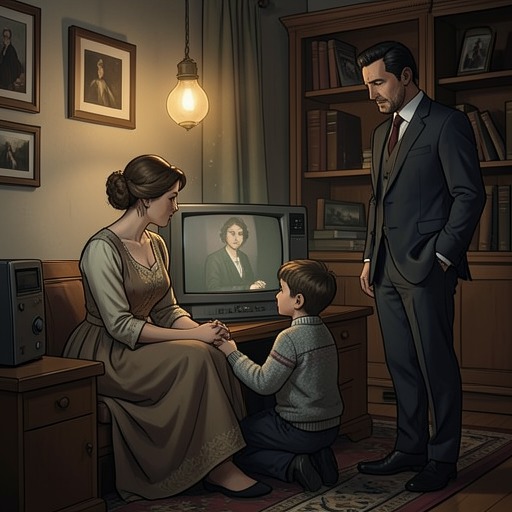
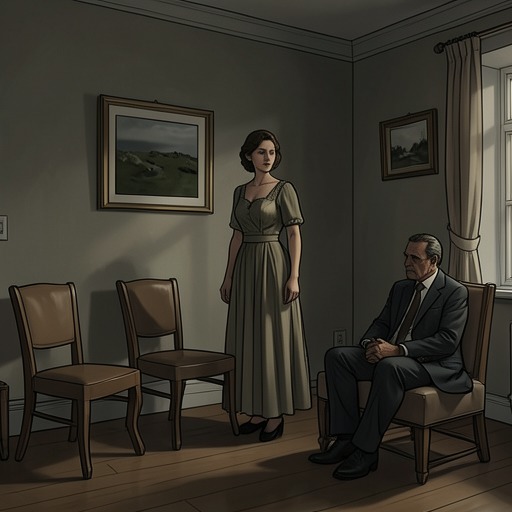
The Lighthouse (Alison Moore Edition)Futh and Gloria’s relationship grows out of neighboring households and shared loneliness, but its comforts are never simple. After Futh’s mother leaves, Gloria feeds him and draws him into her home; her care gives him a substitute domestic refuge while also making their closeness difficult to distinguish from a crossing of boundaries. As Futh grows up, the same mixture of attention, bodily contact, and unease returns in encounters that leave him uncertain where he belongs.
The Neighbor and the Lonely Child
After primary school, Futh spends free time alone on his climbing frame in the dark, looking toward Kenny’s empty bedroom window. Beneath it, Gloria eats supper by herself. Her quiet routine becomes familiar to him: she turns on the radio, calls in the cat, feeds it morsels from her plate, clears the kitchen, and goes upstairs to bathe. Later she returns in her nightie for a drink, sometimes takes out the rubbish, and, during a summer of drought, waters her garden in the dark. While nearby lawns dry out, hers stays lush. The contrast makes her home seem like a pocket of life and care within the neighborhood, even as Gloria herself appears solitary.
One evening she comes across the lawn carrying a rubbish bag and stops at the fence beside Futh. When she asks whether he is on his own, he cannot answer. Gloria says that she is lonely too and could use company. She also tells him that a holiday helped her after her husband left, recommending sunshine and cocktails as a way of putting the separation out of mind. Her sympathy is direct, but the exchange begins with Futh’s silence: she names their shared loneliness while he remains unable to meet her invitation with words.
Food, Company, and a Substitute Home
After Futh’s mother leaves, he starts going to Gloria’s house around supper time as often as he can. She prepares large meals for the two of them, and sometimes offers a new liqueur or cocktail as well as food. Even when he has already eaten with Futh’s father, he goes back for a second supper. Gloria tells him that he is hollow, making feeding him both an affectionate observation and a recurring form of attention. For a boy left alone with a father who does not fill that absence, her kitchen offers reliable company and more than enough to eat.
The domestic welcome also gathers Kenny into the picture. Futh had imagined Kenny lived far away, expecting postcards from abroad, but discovers that Kenny lives only a few miles away and regularly stays with Gloria. Sometimes Kenny arrives while Futh is at the kitchen table eating again. On one occasion Gloria arranges a sleepover and a film for the boys. Futh packs pyjamas, a toothbrush, a sleeping bag, and a torch, though he will use none of them. Gloria serves ham with apple sauce, then sends the boys to put on the film while she makes popcorn. Futh dislikes its smell, but the room’s other scent draws him: during the trailers, he opens Gloria’s hand cream and breathes in its tangerine fragrance. The visit is thus remembered not only as a shared household occasion but through the intimate sensory details of food, scent, and the place he hopes Gloria will occupy between him and Kenny on the sofa.
Care and Boundary-Crossing
Gloria’s attention is not confined to food or conversation. In a later visit, after Futh has been separated from Angela but has not yet moved out, he is again sitting alone on his climbing frame. Gloria comes over without the pretext of taking rubbish out and invites him to keep her company. He wonders how easily she can see him from her house and whether she has noticed him watching her. Though he first tries to decline, he has had no supper and imagines Gloria putting something nice on the table. He climbs down, crosses the fence, and follows her inside.
At the kitchen table, Gloria makes drinks with ice and liqueur. Futh moves toward the corner of the bench and turns his face toward the open window, through which he can see the climbing frame and the clouded moon. As they watch a moth caught in a plant, Gloria touches the back of his neck and the top of his back beneath his T-shirt, remarking that he has caught the sun. Futh stays still, registering the warmth and path of her fingertip; only afterward does he realize she has moved away and may not have been touching him for some time. She returns with melting ice, refreshes his drink, cups his face, and tells him, “I can see your daddy in you.” Her occasional pats on his knee and strokes of his hair extend the physical familiarity. But when the doorbell rings and heavy footsteps go upstairs, Gloria returns to tell him that he should not be there and that it is past his bedtime; she leaves him to let himself out and switches off the light. The abrupt dismissal unsettles the welcome, making the encounter feel both intimate and precarious.
The Pattern Repeated
In another domestic scene with Futh’s father present, Gloria places a hand on Futh’s thigh and tells him, “You’ve nobody looking after you.” She discourages him from getting up to greet the man in the kitchen, and her fingers tug at a loose thread on his trousers. Later she gives his leg a consolatory pat and squeeze. These gestures echo the practical care of the earlier meals, but now attention is concentrated on his body and accompanied by an implicit claim that he lacks anyone else to care for him. When his father says that Futh’s mother “got bored,” Gloria offers further consolation, saying that some women do not appreciate what they have. Futh’s reaction is not spoken: he puts down his cutlery, stands, and goes to the fire to pick up the poker.
Across childhood and adulthood, Gloria’s house remains a place Futh approaches when he is hungry or alone, and her gestures repeatedly answer a need for care that his family has left unmet. Yet the relationship offers no uncomplicated replacement for his mother. A meal, a perfume, a touch, or an invitation can carry comfort and unease at once; even a welcome may end with the light switched off and Futh sent back across the boundary between their homes.