Germany
The Lighthouse (Alison Moore Edition)Germany is both the destination of Futh’s restorative holiday and the setting where his present journey is shadowed by an earlier trip with his father. He crosses into the country hoping to walk a circular route along the Rhine, but the landscape becomes more than a refuge: its roads and paths repeatedly bring him face to face with mistakes, uncertainty, and an unreturned family object whose history began there.
A destination approached by ferry and road
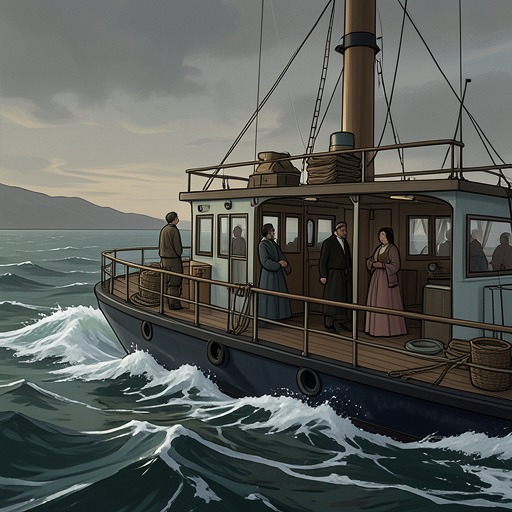
Futh arrives by North Sea ferry as a middle-aged man recently separated from Angela. On the crossing he avoids breakfast, goes out onto the wet outer deck, and watches the ferry approach the Dutch terminal. After moving his watch forward an hour, he anticipates driving onto the continent and into another country for the first time. His conversation with a fellow passenger turns quickly to the practical challenge ahead: Futh says he is bound for Hellhaus, near Koblenz, and admits that he may go wrong. Angela had usually driven long distances and was the better navigator; the road atlas waiting on the passenger seat cannot replace that experience.
After disembarking, Futh passes through customs and passport control and drives away from the ferry. The transition gives the trip the shape of a fresh start, but it does not remove the habits he brings with him. Germany is entered through procedures, roads, and a planned itinerary rather than through a broad portrait of the country. The narrative stays close to Futh’s limited perspective: where he is going, whether he can find the route, and what memories the journey makes difficult to avoid.
Hellhaus and the Rhine walk
Futh spends his first night in Hellhaus at a small family-run hotel. The landlady is hospitable, yet an encounter with a hostile barman unsettles him. He puts the episode behind him the next morning and begins his week-long circular walk along the Rhine, carrying the expectation that walking will offer some restoration after his separation. The route also gives space to memories of his childhood, his parents’ broken marriage, and his own, but his mother’s departure remains the past event to which his thoughts keep returning. Her abandonment left a void that he has spent his life trying to fill.
The holiday’s physical costs accumulate as the route proceeds. By its final stretch, Futh’s skin is peeling and his feet are tender; he puts sun cream on his face and thinning scalp, and notices that the skin between his sandal straps is burned while the covered strips remain pale. When he realizes he is lost, the map cannot match the features around him. He takes a compass from his rucksack, but it is broken; the high sun gives him no useful direction. After walking for more than an hour without finding anyone or shelter, he reaches a small village. The episode turns the walk’s promise of self-directed escape into a practical dependence on finding someone who can tell him where he is.
An earlier German journey and the silver lighthouse
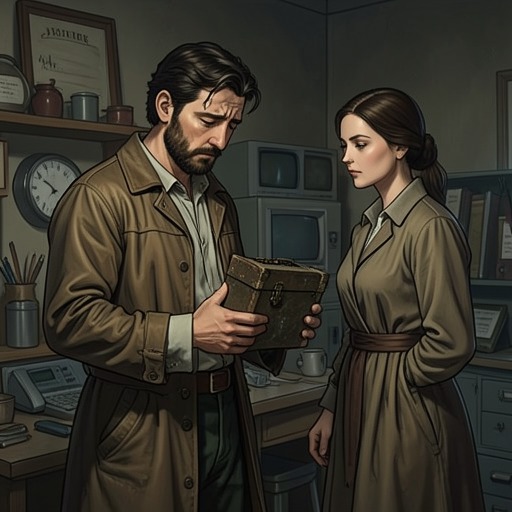
Germany also contains the memory of Futh’s first trip there, made with his newly single father. During that visit they gave up on walking and went to see Futh’s Great-Uncle Ernst. Futh carried a small silver lighthouse in a secret inner pocket of his coat. His grandfather had asked Futh’s father to return it to Ernst; it had belonged to their mother. The object’s presence in Germany therefore gives the earlier journey an obligation that Futh remembers, but does not fulfill.
The visit began without certainty that Ernst was alive or still lived in his parents’ house. Futh and his father did not make contact beforehand; they went on the chance that the house might still stand and that someone might be there. They found it maintained and lived in, parked some distance away, and waited after Futh’s father knocked. A net curtain twitched in an upstairs window. Just as they were about to leave, the door opened. The silver lighthouse remained unreturned, and the remembered omission now hangs over Futh’s new German journey as a source of possible consequences, not merely as a detail from childhood.
Roads, detours, and the abandoned alternative
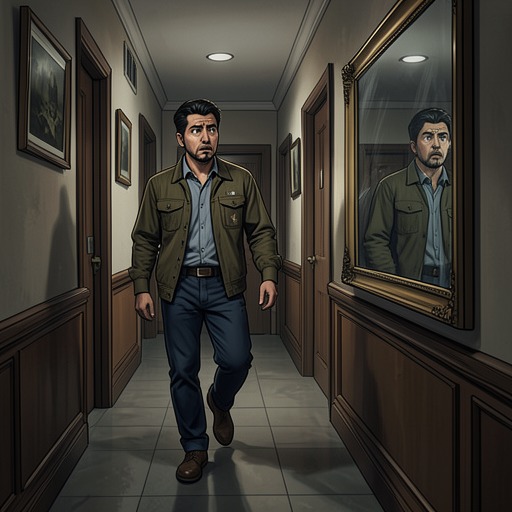
Futh’s present travel repeats the earlier journey’s uncertainty in a different form. Driving after a stop at a rest area, he realizes that he has missed his motorway turning. Unable to turn around between junctions, he presses on in the wrong direction, accelerating. The mistake recalls an earlier drive with Angela, when he saw from the road signs that they were taking the wrong way round the M25 but kept quiet, hoping he was mistaken. Her warning that the route did not feel right did not make him admit the error; silence allowed it to worsen. In Germany, the remembered episode makes navigation a pattern of delayed recognition rather than a single practical mishap.
Late in the holiday, Futh considers changing his plan and visiting Carl in Utrecht instead of completing the walk. Stiff and hungry at dawn, he works through the logistics: he would have to return to Hellhaus for his car, could take his suitcase on a bus, and might reach Carl’s mother’s house by lunchtime. He finds no timetable at the hotel, walks to a stop near the river, and discovers three direct weekday buses to Hellhaus. But when he waits for the first bus he cannot establish whether it is late, whether he is at the wrong stop, or whether he has missed it. He considers hitchhiking; no one stops. He waits for the evening bus instead.
After getting off at the wrong stop, Futh walks back towards Hellhaus and checks his car before asking about his suitcase. It is where he left it, but one tyre is flat. The spare he expects to find is the old flat tyre he had removed before driving home to find Kenny coming out of Angela’s house. With the car unusable until he can sort it out, he gives up on Utrecht and returns to his original itinerary. The failed detour makes the holiday’s limits concrete: each proposed route away from the hotel depends on transport, timing, or equipment that does not cooperate.
Narrative significance
Germany is presented through the friction between planned movement and actual arrival. Ferry schedules, road junctions, a walking map, a broken compass, and bus timetables all offer ways forward, yet none guarantees that Futh will reach the destination he intends. His return to Hellhaus at the end of the circular walk is especially charged: sunburnt and blistered, he sees the hotel as a sanctuary and comes back unaware of events that have unfolded there during his absence. The place that serves as the holiday’s base is therefore also the point toward which both the present itinerary and the unresolved past converge.