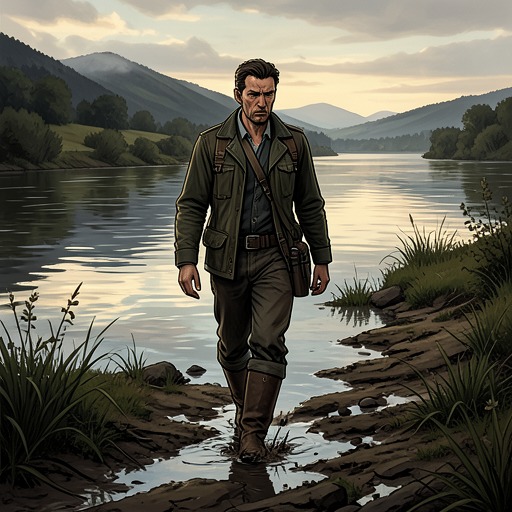
Rhine
The Lighthouse (Alison Moore Edition)The Rhine is the defining landscape of Futh’s restorative walking holiday: a river he follows on a circular route through Germany, crosses by ferry, and repeatedly sees from paths and forest viewpoints. It gives his journey a visible direction and a succession of destinations, yet it cannot guarantee that he will reach them. Against the river’s steady passage, Futh’s mistakes, sore feet, and abandoned plans turn travel into a test of whether movement can really deliver him from the past.
Route and Setting
Futh’s holiday begins with a North Sea ferry crossing. He watches the vessel arrive at the Dutch terminal, moves his watch forward an hour, and prepares to drive onto the continent for the first time. After a night at the Hellhaus Hotel, he sets out on a week-long circular walk along the Rhine. The river is not just a backdrop to the trip: it organizes the route that Futh follows and provides its recurring landmarks.
At the beginning of the walk, Futh takes a small ferry across the river. From the boat he looks back at Hellhaus, set against green hills and rocky outcrops, before the vessel pulls away through the fast-flowing, broad grey-green water. On the far bank he follows printed directions along the river, walking briskly in the sun. His new hiking boots gather dust from the dry path; they are only days old, and he has ignored the shop assistant’s advice to break them in gradually. The journey thus begins with forward motion already carrying the possibility of physical discomfort.
The landscape changes as the route continues. On one day Futh walks across cornfields and then through forest. It is late August, near harvest time, with green leaves still on the trees and blackberries on the bushes. Viewpoints open intermittently onto the Rhine and the railway lines beside it. From these heights, the river and its traffic extend the sense of a connected world: boats and trains travel toward Koblenz or Bonn, onward to Cologne or Düsseldorf, and farther toward Rotterdam, Utrecht, and the North Sea.
A Landscape That Does Not Ensure Direction
The river’s clear presence contrasts with Futh’s growing difficulty in navigating. Although the walk has printed directions and an apparent route to follow, his attention is often occupied by other things: memories, the effort of walking, or the pain in his feet. During the forest hike, the day darkens beneath gathering rain clouds and the tree canopy. Futh can see far from the exposed viewpoints, but cannot think about the panorama; his feet hurt too much. As the afternoon fades and the viewpoints disappear, the path seems to lead deeper into the woods. He fears that the trees are enclosing him and considers turning back, but continues until he finally emerges at twilight.
On another day he realizes that he is lost in a field. The map shows features that he cannot find around him, and he has no reliable sense of direction. He takes a compass from his rucksack, only to discover that it is broken; the sun, high overhead, offers no help. His uncertainty turns the route into a series of possible past errors, each missed turning a point at which the journey might have gone differently. He presses on in search of someone who can tell him where he is.
The Rhine also makes wrong turns legible without making them reversible. On a drive toward Hellhaus, Futh realizes that he has missed his motorway exit. Because he is between junctions, he cannot simply turn around; he continues in the wrong direction, accelerating. The episode echoes an earlier journey with Angela, when he had recognized that their car was taking them the wrong way around the M25 but stayed silent, hoping he might be mistaken. In both cases, recognition comes after the route has already carried him farther from where he intended to go.
The River and the Failed Detour
The Rhine’s wider network of towns and transport routes gives Futh an alternative to completing his walk. Stiff and hungry at dawn, with tender feet, he considers abandoning the final day and going to Utrecht, where Carl would be home that evening. He thinks through the logistics: first he would have to return to Hellhaus to collect his car; he might take a bus rather than risk his suitcase arriving later; and he could explain the change of plan by telephone after reaching Carl’s mother’s house. The river journey, in other words, is not an isolated pilgrimage but one option among roads, buses, and possible visits.
That alternative depends on transport that proves less dependable than his plan requires. Futh finds a bus stop and reads its timetable, identifying a morning service to Hellhaus. After lunch, he waits for the bus, first assuming that it is late, then checking nearby stops and reconsidering whether he has read the time or day incorrectly. Nearly an hour passes. He wonders whether the bus has already gone, perhaps just before he arrived. He considers hitchhiking, but no one stops; unwilling to walk back into town for a taxi, he waits for the evening service instead.
The detour finally fails at Hellhaus. After getting off at the wrong stop and walking the remaining distance, Futh checks his car before going to the hotel. It has a flat tyre. In the boot he expects to find a spare but instead discovers the old flat tyre he had removed by the roadside before driving home and finding Kenny leaving his house. With no usable replacement, he gives up the plan to go to Utrecht and returns to the itinerary he had hoped to escape.
Narrative Significance
The Rhine connects scenes of attempted escape with the practical limits that keep Futh moving along, or returning to, predetermined routes. A ferry carries him from one bank to another; a printed map appears to promise reliable progress; distant towns suggest a route out of the walking holiday. But the walk is repeatedly interrupted by sore feet, darkness, a broken compass, missed exits, a late bus, and a flat tyre. Mobility is real, yet control over where it leads remains uncertain.
The river’s views also sharpen the contrast between distance and attention. From a viewpoint Futh can see a long stretch of water and the trains and boats moving through the region, while his own awareness contracts to his painful feet. The landscape offers breadth that he cannot always take in. As he walks, he repeatedly revisits the abandonment that marked his childhood and the earlier German trip connected to his father. The present route therefore carries both the promise of a restorative holiday and the weight of memories that travel with him.
At the end of the week, sunburnt and blistered, Futh returns to the Hellhaus Hotel without knowing what has unfolded there while he was away. The circular route brings him back to its starting point, but it does not deliver a clean break from his anxieties or history. The Rhine’s persistent presence gives the holiday its shape; its changing banks and far-reaching connections make movement seem possible, while Futh’s repeated disorientation and thwarted plans expose the narrowness of his escape.