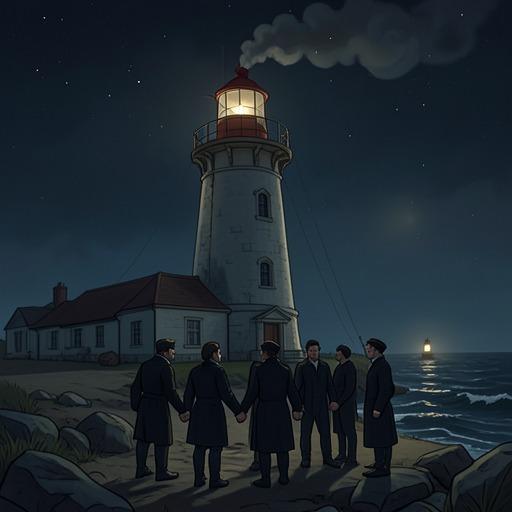
1940 Lighthouse Fire
The LighthouseThe 1940 Lighthouse Fire killed three Germans trapped inside Combe Island’s disused lighthouse, but its significance extends beyond the deaths: the fire became the means of concealing them, and the story survived through Saul Oliver’s souvenirs and a late, uncertain account of who actually lit the straw. Decades later, the arrival of Dr. Speidel provided the first confirmation beyond the objects Saul had kept.
Landing and Fire
On the night of 10 October 1940, three Germans from the occupied Channel Islands landed on Combe Island. Their purpose was never established. Raimund Speidel speculated that the young men might have been bored officers undertaking reconnaissance or pursuing some private enterprise; they may have known the island was evacuated, or discovered that by chance. One possible plan was to plant a German flag atop the disused lighthouse, an act that would have caused alarm if carried out.
After first light, the three men climbed the lighthouse, presumably to look over the island. Saul Oliver found their boat and worked out where they had gone. The tower’s ground floor was being used to store animal fodder and was packed with dry straw. In the account first related, Saul set the straw alight, sending flames and smoke up into the top chamber. The fire spread through the interior while the Germans were above it.
Their apparent escape route was blocked. They could not get out onto the lantern: its railings had become unsafe, and the door had long been nailed shut to prevent accidents. All three died, probably by suffocation. The building’s condition, originally a measure against accidents, had left the men unable to flee once the fire took hold.
Bodies and Concealment
After the flames had burned out, Saul discovered the bodies halfway up the tower. He carried them back to their boat, took the boat out using the dinghy from his sailing boat, and scuttled it in deep water. The deaths were thereby separated from the island: there was no surviving boat to point to the landing, and the bodies were removed rather than left at the lighthouse. The account does not establish exactly when each act occurred beyond Saul’s waiting for the fire to burn out before finding the bodies.
The story initially had no independent documentary support. Saul kept a revolver, a pair of binoculars, and a compass as trophies. As far as his later confidante knew, no other boat landed during the war, and no inquiries were made afterward. The three men were probably recorded as missing, presumed drowned. The ordinary explanation of disappearance thus outlasted the hidden account of the fire.
Conflicting Accounts
The account came to light through a story Saul told years later, when he was barely coherent and within two weeks of death. His listener could not tell whether he meant to confess or boast, or why he had chosen her. She had lost touch with him during and after the war, had left her university career to drive an ambulance in London, and only rarely returned to the West Country. She regarded Saul’s story as partly familiar from rumor, but believed she had heard as much truth as he was willing to disclose.
There was a further complication. Saul had also told her that a boy, playing with a box of matches found in the house, set the straw alight. The boy panicked afterward and denied having been near the lighthouse; Saul said he had seen him. The listener believed this version at the time, but later doubted it. The two reports leave responsibility unsettled: the first account assigns the ignition to Saul, while the later recollection attributes it to the boy. The episode establishes the fire and its fatal outcome more firmly than it establishes who struck the match.
Belated Confirmation
Saul gave the three souvenirs to his confidante before he died. They remained the only evidence she knew of for his story until Dr. Speidel arrived decades later. His arrival was described as the first confirmation beyond the keepsakes that the account was true. It did not remove every uncertainty: the purpose of the landing remained conjectural, and the conflicting testimony about the fire’s ignition remained unresolved.
The episode is disclosed during an investigation into Nathan Oliver’s death, when Dalgliesh asks about the old story and whether there was evidence for it. The reply connects a wartime disaster, a concealed set of deaths, and a present-day inquiry without making the past a settled explanation for the murder under investigation. The remembered account instead shows how an event can be transmitted through rumor, a dying man’s testimony, and objects retained as trophies, each offering a different degree of certainty.