Adam Dalgliesh
The LighthouseCommander Adam Dalgliesh is the detective at the centre of the Combe Island investigation, where Nathan Oliver’s apparent hanging proves to be a staged murder. A senior Metropolitan Police officer whose responsibilities as permanent Assistant to the Commissioner have become difficult to define, he brings a small team, a forensic pathologist, and a habit of testing assumptions to an isolated community already uneasy about its privacy. His investigation turns on a shift in perspective: the crucial question is not only who came to the island, but who left it.
Identity and Background
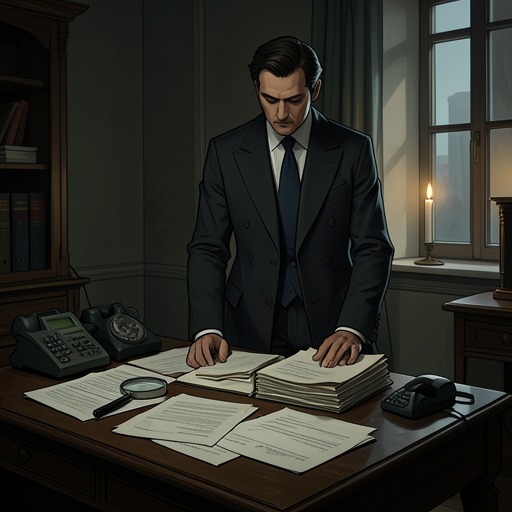
Dalgliesh is accustomed to urgent summonses, though they do not always concern murder. When he is called to Assistant Commissioner Harkness’s office at New Scotland Yard on Saturday, 23 October, he recognizes the meeting’s ominous character. The reaction is not simply a response to the officials’ tense faces: for him, unnatural death carries a particular unease because it reminds even the most organized institution that some events cannot be managed by bureaucracy.
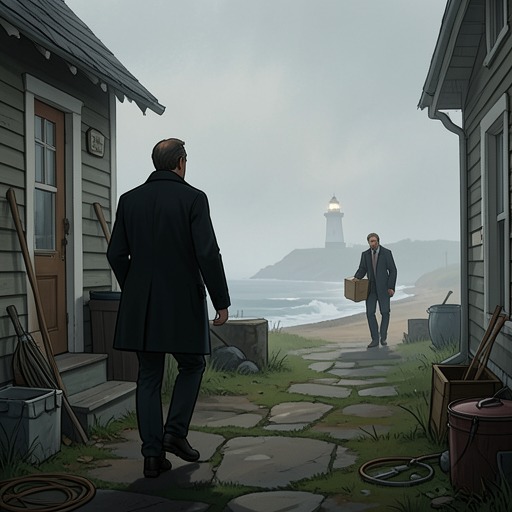
He arrives on Combe Island with Inspector Kate Miskin and Sergeant Francis Benton-Smith. He elects to take only the officers he needs at first, deferring a larger scene-of-crime team and photographer unless the death proves to be murder; he also arranges for the retired pathologist Edith Glenister to examine the body. His judgment of Benton-Smith is measured but confident: he values his intelligence, courage, and common sense, while recognizing that the new partnership with Kate must work despite Piers Tarrant’s departure. Dalgliesh does not require his officers to be friends, but does require mutual respect and cooperation, and trusts Kate to help establish them.
The investigation also has a private counterpoint. Dalgliesh’s relationship with Emma Lavenham is intimate and sustaining, but their busy, separate lives limit the time they can spend together. He had first told her he loved her in a letter and privately wonders whether that choice had spared him the sight of possible rejection; it had not been rejected. Their carefully planned hours together, and the ordinary pleasures of meals, performances, and conversation, matter all the more because his work periodically carries him into other people’s suffering. On the island, a recording of Mozart’s The Marriage of Figaro recalls music he and Emma had shared in London. He thinks of her, but does not call: the silence between them seems to respect the separateness of his work and her life.
Arrival and the Investigation
At Combe House, Dalgliesh asks for frank accounts of Oliver’s relations with residents and visitors rather than accepting general reassurances. Rupert Maycroft describes Oliver as demanding and difficult, a regular visitor whose birth on the island gave him a right of admission under the Trust deed. Oliver had also wanted Atlantic Cottage, where Emily Holcombe possessed a lifetime right to live. These circumstances give the detective a map of local tensions, not a verdict: he explicitly resists exaggerating personal traits or assigning motives without evidence.
Dalgliesh structures the inquiry in stages. He plans to interview people individually, but first questions the group about whether anyone saw Oliver after he left dinner or on the morning he died. The group setting has a purpose: statements can be challenged at once, and reactions may reveal relationships that private interviews conceal. The precision of the timeline matters. Even a difference of ten minutes could determine whether an alibi holds, and Dalgliesh initially expects Glenister’s estimate to place the death at about eight in the morning.
Glenister’s examination establishes that Oliver died between about 7:30 and 9:00, probably nearer the earlier time. The marks on the neck point away from suicide: distinct bruises suggest fingers, and the ligature’s imprint is consistent with a climbing rope. Glenister’s later report confirms that Oliver died of asphyxia caused by manual strangulation. His internal injuries include a fracture caused by pressure to the neck and a bruise where his head was forced against something hard; an attempt had also been made to wipe the rope clean. Dalgliesh’s working conclusion is therefore clear: Oliver was strangled, and the hanging came afterward.
A witness complicates the timing without resolving the murder. Dr. Raimund Speidel says he had arranged to meet Oliver in the lighthouse at eight, reached its locked door at 8:06, and approached by the under-cliff path in the hope of remaining unobserved. Millie Tranter, meanwhile, admits that she read Speidel’s open note and had not treated its delivery as urgent because the appointment was not until morning. Dalgliesh gathers these details as evidence to weigh, rather than allowing either the missed meeting or the delayed note to settle the question of guilt.
Method, Judgment, and New Deaths
Dalgliesh’s method is to keep a hypothesis provisional while making the known facts explicit. During an evening review at Seal Cottage, he lays out the island map with Kate and Benton-Smith and asks them to state what they know about the presumed murderer. This is not just a planning exercise: it disciplines speculation, helps expose gaps, and keeps the investigation from mistaking a plausible story for proof. He is similarly cautious in public, reluctant to call Oliver’s death murder before Glenister’s findings confirm it.
The investigation widens when Dalgliesh finds Adrian Boyde dead on the stone floor of Combe Island Chapel. Boyde lies partly covered by the green cope, with blood visible through the silk; a folding chair and a long cardboard box stand nearby. Though ill and in pain, Dalgliesh reacts as an investigator: he avoids touching the scene until he can put on gloves, returns to Seal Cottage, and reports the murder to Maycroft. Later, SARS exposure and the island’s voluntary quarantine put the case under additional pressure. Guy Staveley explains that Dalgliesh and others have been exposed, describes the symptoms to watch for, and says that Kate and Benton-Smith are handling Boyde’s murder while Dalgliesh is cared for.
Illness and the Reversal in the Case
Dalgliesh becomes gravely ill. His last fragmented memories of Tuesday morning include being helped into a buggy and insisting that he must remain on Combe Island: he fears losing contact with Emma, but also knows that work connected with the lighthouse is unfinished. By Wednesday evening his mind is clear but his body is weak. A relentless cough makes breathing difficult, and Staveley and Jo Staveley give him oxygen. His confinement does not end his investigation; it forces him to reconstruct it from the details he has heard and the assumptions he had made.
The decisive insight comes without triumph. Dalgliesh realizes that the case has been viewed from the wrong direction. Instead of concentrating on visitors who had arrived since Oliver’s previous visit, the inquiry must consider who had left. Martha Padgett, recently carried from the island in her coffin, had seemed peripheral; so had the missing blood sample associated with Dan Padgett. Dalgliesh now concludes that the sample was never in the bag: what went overboard was old shoes, handbags, and library books. The apparent loss has concealed, rather than destroyed, the evidence.
He reconstructs a possible motive with caution. Dan may have gone to confront Oliver to demand acknowledgment and financial provision, carrying hope and anger into a private walk along the lower cliff. A quarrel and a fatal grip to Oliver’s neck would explain the strangling; the hanging would then be an attempt to make homicide look like suicide. But Dalgliesh understands that motive and opportunity are not enough. The case remains circumstantial until the blood and hair samples can be found, and he urgently asks Kate to locate them and establish who had access to the surgical gloves.
Kate and Benton-Smith search Dan Padgett’s cottage and find the samples concealed beneath butter in a tub. Under the butter are two foil-wrapped packages: one contains a blood vial labelled with Oliver’s name and date, the other a hair sample wrapped in tissue. Their discovery turns Dalgliesh’s reasoning into tangible evidence. Kate and Benton photograph the find, preserve it in an exhibit bag, seal the bag, and sign its label. Dalgliesh has supplied the crucial change in the search; his colleagues secure the proof while he is still too ill to work at the scene.
Relationships, Responsibility, and Ending
Dalgliesh’s dependence on Kate’s judgment is visible both in the investigation and in his illness. At five in the morning, anxious that his coughing might return or that he might lose the ability to speak, he insists on seeing her. His immediate concern is not simply to announce a solution but to give her the task that can make it provable. Earlier he had relied on her to manage the working relationship with Benton-Smith; now he entrusts her with the urgent search that the case requires.
His relationship with Emma remains present even when illness and police work narrow his attention. In his confused memories he fears that she might not find him if he were taken from the island, while his earlier thoughts suggest that both partners accept the distance imposed by his work. The novel sets this private bond beside the detective’s professional separateness: he can think of Emma with longing, yet does not ask her to enter the investigation or interrupt its demands.
Dalgliesh’s final response to failure is deliberately modest. After Padgett’s second murder, Kate reports Padgett’s belief that Boyde knew what was coming and wanted to die. Dalgliesh resists claiming that he understands Boyde better than Padgett did; he admits that failure ought to teach humility, then prepares to return to his work. The conclusion does not make detection a triumph over every loss. Dalgliesh can reconstruct the truth about Oliver and direct his team toward proof, but the later death of Boyde exposes the limits of what investigation can prevent. His authority rests not on certainty about every human motive, but on disciplined attention, a willingness to revise his theory, and recognition of what remains unknowable.