Adrian Boyde’s alcoholism
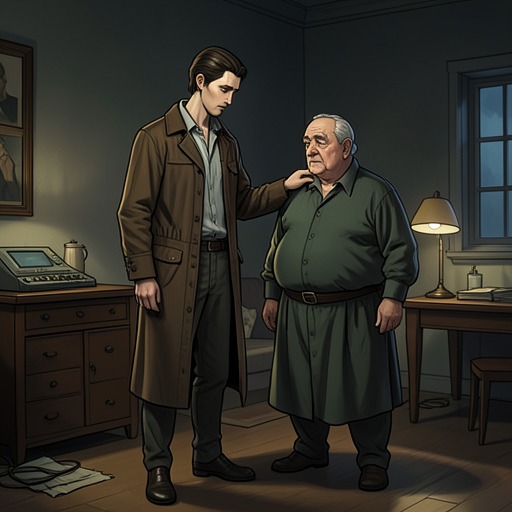
The LighthouseAdrian Boyde’s alcoholism is both a condition he struggles to manage and a vulnerability Nathan Oliver deliberately exploits. Boyde had maintained more than a year of sobriety on Combe Island before Oliver gave him wine at supper, setting off a relapse that undid that hard-won stability. The consequences extend beyond the drinking itself: Boyde vanishes from the island, and his recovery depends on sustained, private care from Mrs. Burbridge and Jago.
Background and sobriety
Boyde had served as a vicar before coming to Combe Island. His appointment there followed a collapse during Holy Communion: he dropped the chalice and fell down drunk while administering the service. A churchwarden who knew that Mrs. Burbridge had moved to the island contacted its previous secretary and suggested Boyde for a job. He was competent, already able to use a computer and numerate, and, at first, the new arrangement worked. He remained sober on the island for more than a year, giving those around him reason to hope that he could continue.
Alcoholism was also part of a larger crisis in Boyde’s religious life. He left the Church partly because of his drinking, but more substantially because he had lost faith in some of its dogma. He came to believe that a good and all-powerful God could not both account for the world as it is, and that life was a struggle between good and evil. His crisis of faith and his addiction are distinct, but both mark the failure of the stability his former role as a clergyman might have seemed to promise.
Oliver’s deliberate provocation
Boyde’s sobriety ended during one of Nathan Oliver’s quarterly visits. Oliver invited him to supper and gave him wine, though he knew Boyde was an alcoholic. The relapse was not presented as an accident: Oliver wanted to observe what happened when someone fighting alcoholism was given alcohol. He was writing a drunkard character and wanted to witness the process closely, with Boyde available to him on the island.
The episode turned Boyde’s recovery into material for Oliver’s work. For Boyde, the drinking undid more than a year’s effort; for Oliver, it supplied an opportunity to watch a controlled descent. That imbalance makes the relapse an act of exploitation as well as a destructive interruption of Boyde’s sobriety. Someone, possibly Oliver, his copy-editor, or his daughter, carried Boyde back to his cottage. He took a couple of days to sober up, while those on the island did not initially know what had happened or how he had obtained wine.
Disappearance and care
Two days later, Boyde went with Jago to collect the weekly supplies and disappeared. Later that month, Mrs. Burbridge found him paralytic on the doorstep of her London flat. She took him in and looked after him for several weeks, then moved with him to an isolated cottage near Bodmin Moor. Because the tourist season had not begun, she was able to find inexpensive accommodation there. They stayed for six weeks.
Mrs. Burbridge contacted Guy Staveley and Rupert Maycroft to say that she was safe and Boyde was with her, but did not disclose their location. She did tell Jago, who came to help when he had weekends off. Between them, she and Jago kept Boyde within sight, a demanding arrangement that Mrs. Burbridge remembered as tedious at the time but, in retrospect, as a period of unexpected happiness. Their days included walking, talking, cooking, playing cards, watching old BBC serials, and reading. When Boyde felt ready, they returned to Combe Island. No one asked questions about his absence or what had happened.
Significance
Boyde’s alcoholism makes recovery visible as a fragile, shared undertaking rather than a solitary triumph. His year of sobriety is broken by Oliver’s calculated intervention; the effort that follows depends on practical care, watchfulness, and the willingness of Mrs. Burbridge and Jago to remain with him. The island’s silence leaves the circumstances unexamined, while the account of the six weeks away gives that silence a contrast: Boyde is not reduced to his relapse in the private routines that help sustain him.
The episode also sets the intimate costs of Oliver’s artistic observation against its stated purpose. Boyde’s suffering becomes useful to a novelist precisely because Oliver can arrange access to it, while the work of helping Boyde recover falls to others. His alcoholism therefore connects the personal effort of staying sober with the book’s wider concern about the harm done when another person’s pain is treated as material to be used.