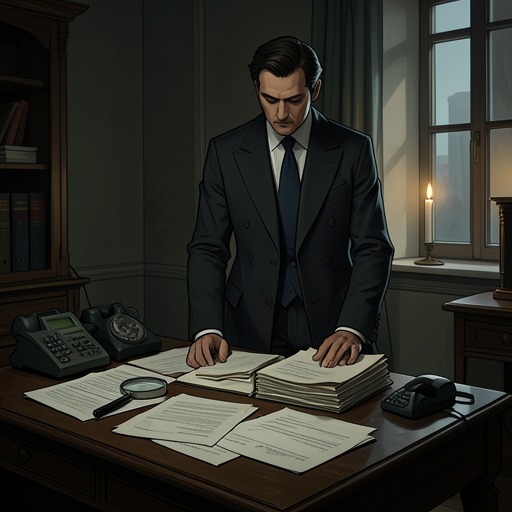
Alexander Conistone
The LighthouseAlexander Conistone is a crisis manager in government whose orderly faith in precedent coexists with a striking talent for improvisation. He introduces the political stakes of the death on Combe Island and briefs Adam Dalgliesh on the island’s past; his combination of bureaucratic confidence, eccentricity, and practical imagination gives the investigation its first shape.
Identity and Background
Conistone works for the Foreign and Commonwealth Office and has acquired a reputation for crisis management. He believes emergencies can be handled through precedent and departmental regulations, a conviction that suits the formal habits of public service. Yet when those familiar methods fail, he can produce imaginative initiatives that appear, by ordinary bureaucratic logic, likely to end in disaster—and somehow do not.
His appearance reflects the same doubleness. He wears the careful pinstriped conformity of a civil servant of the 1930s, while his strong, bony face, mottled cheeks, and unruly, straw-like hair give him the look of a farmer. In an increasingly conformist and politicised service, he is regarded as one of its remaining eccentrics.
The Combe Island Case
Conistone is among the officials waiting for Dalgliesh at New Scotland Yard on the morning of Saturday, 23 October. The meeting concerns the death on Combe Island, and Conistone explains why its classification matters: murder would be the most embarrassing possibility, while suicide would also carry serious implications; accidental death would be easier for the government to manage. Publicity is likely in any event because of the victim.
The urgency is heightened by a possible top-secret international conference that the Prime Minister hopes to hold on Combe Island in early January. No date has been set, but the security rating would be exceptionally high. Conistone puts the investigation plainly to Dalgliesh and, before Dalgliesh can respond, Assistant Commissioner Harkness confirms the importance of the security arrangements. Conistone’s briefing makes the murder inquiry inseparable from the government’s need to understand what has happened before the island could host such a meeting.
The Island’s History
Conistone gives Dalgliesh a compressed history of Combe Island because, he says, ignorance of it could put the investigator at a disadvantage. The Holcombe family owned the island for more than four hundred years, having acquired it in the sixteenth century; the exact circumstances were unclear. Its title was later ratified by Henry the Eighth after the removal of Mediterranean pirates who had used the island as a base for slave-trading raids along the Devon and Cornish coasts.
The family took little interest in Combe until the eighteenth century, visiting occasionally for its bird-life or for picnics. In the early twentieth century, Gerald Holcombe restored the cottages, built a house and staff accommodation in 1912, and made the island a setting for family holidays. The First World War changed that pattern: two elder sons were killed, one in France and one at Gallipoli. The remaining son, Henry, was consumptive and unfit for military service. With the family’s investments dwindling, he established a charitable trust in 1930, transferred the island and its property to it, and intended Combe to offer rest and seclusion to men bearing professional responsibilities.
Narrative Role
Conistone is both the government’s crisis manager and the investigation’s initial guide to the island. His explanation places Dalgliesh’s assignment within two pressures at once: the unresolved possibility of a violent death and the prospect of a highly classified conference. His account of the trust’s founding also establishes that Combe’s seclusion is not incidental but part of its purpose. The man who trusts regulations to contain emergencies is therefore the one who first connects the case’s immediate demands with the history and institutional design of its setting.