Art as the Exploitation of Suffering
The LighthouseArt as the Exploitation of Suffering is the idea that an artist may turn another person’s pain into material for fiction by provoking, observing, and controlling the conditions of that suffering. In the account given by Mrs. Burbridge, Nathan Oliver does this to Adrian Boyde: knowing Boyde was an alcoholic, Oliver gives him wine while writing a drunkard character, undoing more than a year of sobriety. The episode makes the ethical problem concrete. Artistic observation is not merely looking when the observer has helped cause the distress being watched.
The Adrian Boyde episode
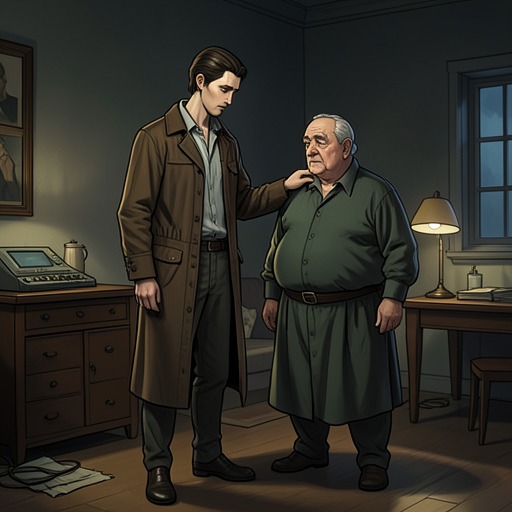
Mrs. Burbridge traces Boyde’s recovery to his arrival on the island after a disastrous episode at a church where he had taken over from her husband as vicar. During Holy Communion he dropped the chalice and collapsed drunk. A churchwarden who knew Mrs. Burbridge had moved to the island contacted the previous secretary, and Boyde was offered work. She describes him as competent, numerate, and already able to use a computer. For more than a year he remained sober, and the islanders hoped that he would continue to do so.
The rupture came during one of Nathan Oliver’s quarterly visits. Oliver invited Boyde to supper and gave him wine. Mrs. Burbridge says Oliver knew Boyde was an alcoholic and claims that the invitation was planned: Oliver was writing a book with a drunkard character and wanted to observe what happened when an alcoholic was given wine. On her account, the relapse was not an incidental consequence of hospitality. It was an experiment conducted on a person whose efforts to stay sober were known to the experimenter.
Mrs. Burbridge’s explanation stresses why Oliver would choose Boyde rather than observe drunkenness in a public place. She argues that Oliver needed someone trying to resist his addiction, and wanted time and privacy to control the circumstances and watch each stage. She further supposes that he wanted a subject available when his novel reached the relevant point. The distinction is central to the concept: Boyde’s suffering offers more than a recognizable image for a fictional character. In this telling, his private struggle becomes an accessible, repeatable scene, while the writer retains control over when and how it unfolds.
After the supper, someone—Mrs. Burbridge is uncertain whether it was Oliver, Dennis Tremlett, or Oliver’s daughter—must have carried Boyde to his cottage. It took two days for him to sober up. The islanders knew only that he had been drinking and could not understand how he had obtained wine. He later disappeared while out with Jago Tamlyn to collect weekly supplies. When Mrs. Burbridge went to her London flat later that month, she found Boyde on her doorstep, severely drunk; she took him in, cared for him for several weeks, and eventually brought him back to the island. It was while they were together that he told her what had happened. Her account therefore connects Oliver’s alleged act to a longer aftermath: the relapse did not end when the supper ended, and recovery required care from someone other than the writer who had used him as a subject.
Observation, privacy, and control
Mrs. Burbridge presents the incident as characteristic rather than exceptional. She says Oliver watched people and made use of them, seeking out their particular forms of suffering to see them descend into what she calls their own hell. In her view, his novels reflected this practice, and, if no one else was available, he might experiment on himself. Her denunciation is not a neutral account of artistic method: she is shaking with outrage as she speaks, and her forceful judgment shapes how the reader receives her claims. The charge is nonetheless specific. She objects not simply to a writer representing misery, but to a writer engineering access to another person’s misery so that he can study it at close range.
Her suspicion about Oliver’s death extends the same logic but remains speculation. She imagines that he might have tried the experience of hanging on himself: putting a rope around his neck, stepping beyond the lighthouse rail, and holding on while coming close to death. She describes the narrow strip of space beyond the rail and pictures the attraction of feeling danger while believing oneself still in control. In this theory, even the artist’s own body becomes a possible instrument of research. But Adam Dalgliesh’s assessment rules out the crucial premise: Oliver did not make the marks on his neck, and he was already dead before his body was launched into the space below. The distinction matters. Mrs. Burbridge’s idea reveals the pattern through which she understands Oliver, but it does not explain the actual manner of his death.
The observer’s compromised position
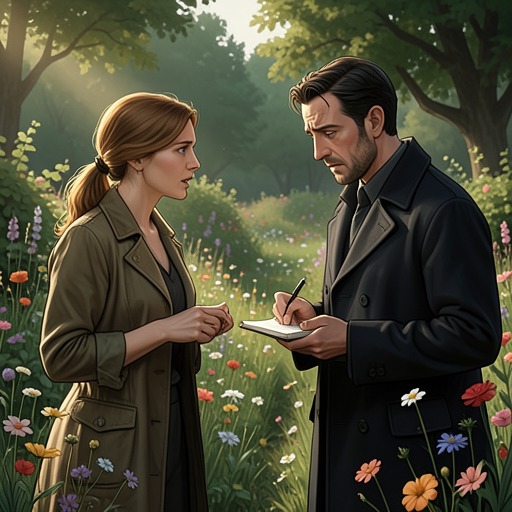
The concept also reaches beyond Oliver through Adam Dalgliesh’s private reflection on his own work. As a poet, Dalgliesh recognizes that natural beauty and attractive human faces have never been enough for him; he has needed the material he associates with Yeats’s foul rag-and-bone shop of the heart. His verse, he thinks, draws on the pain, horror, and wreckage of the tragic lives that make up his police work. He therefore cannot consider the artistic use of suffering as a problem belonging only to the novelist under investigation.
The uncomfortable parallel is that Dalgliesh’s profession requires him to enter the privacy of other people, including the dead, while his poetry draws nourishment from the lives and suffering encountered through that work. The parallel does not erase the difference between investigating a death and provoking a relapse for literary observation. It does, however, prevent the novel’s ethical question from settling into a simple opposition between a bad artist and an innocent observer. Dalgliesh is conscious of the contradiction between guarding his own privacy and having chosen work that violates the privacy of others; his awareness makes the boundary between witnessing suffering and appropriating it part of the concept itself.
Fiction, evidence, and the lost proofs
The dispute over Oliver’s proofs gives a related, more limited view of art’s material consequences. When Adam Dalgliesh asks Mark Yelland whether he burned the proofs of Oliver’s new novel on Saturday morning, Yelland denies it. He argues that destroying them could not prevent publication and would cause little more than inconvenience or delay. Adam Dalgliesh then notes Dennis Tremlett’s account that Oliver had made important changes to the galleys, changes that were now lost. Yelland acknowledges that loss as unfortunate for literature and Oliver’s readers, while maintaining that the burning was an act of personal spite and not his own.
The episode does not establish who burned the proofs, and it should not be treated as evidence that Yelland did so. Its relevance is the contrast between the novel as a work being made and the suffering from which, according to Mrs. Burbridge, Oliver drew his material. The proofs contain revisions to a literary work; Boyde’s relapse is a lived consequence that cannot be reduced to a revision or restored by recovering pages. In this contrast, the question is not whether fiction may depict suffering, but what obligations arise when an artist’s desire to observe becomes an intervention in another person’s life.