Belonging and the Search for “Home”
The LighthouseBelonging and the Search for “Home” is shaped by contrasting experiences of identity and place. Francis Benton-Smith feels unrooted even in the city where he lives and works; Nathan Oliver returns to Combe Island with the conviction that its coast and a particular cottage are inseparable from his life. Around them, the island’s judgment of who counts as an islander shows that the desire for home does not guarantee acceptance, and that refuge can carry the weight of painful history as well as peace.
Identity without secure footing
Francis Benton-Smith chooses an anonymous London landscape because it matches his sense of having no native soil. From his balcony he sees high-rise flats, industrial buildings, surviving terraces and the Westway, but no familiar river, bridge, tower or dome. The view could belong to any large city. Its lack of landmarks is not a deprivation he seeks to correct; anonymity is part of what he wanted when he moved out of his parents’ South Kensington home. Yet his apparent independence is incomplete: his parents paid for the flat and its contents, which his police salary could not have covered. He has established a separate address without entirely escaping the social and financial world he meant to leave.
That distance is also professional. After joining the police, Francis Benton-Smith hopes for tolerance, respect and acceptance, but colleagues remain wary, and his reserve makes intimacy difficult. He recognizes that people do not know who he is, while he himself is uncertain of that answer. He does not treat being mixed-race as a complete explanation: the London world around him is already diverse in racial, religious and national backgrounds. The difficulty is more personal and less easily resolved than a simple account of difference would suggest.
His family gives that uncertainty an intimate history. His mother, Indian and a paediatrician, and his English father, a comprehensive-school headmaster, fell in love young and remain passionately devoted to one another. Francis Benton-Smith knows he is loved, but as a child he sometimes entered a room to find his parents’ private closeness briefly interrupted by his arrival. Their welcome followed, but not quite quickly enough to erase his feeling of being an intruder in a self-sufficient world. Their religious differences did not trouble their marriage: his father was an atheist, his mother a Roman Catholic, and Francis was raised in her faith before gradually relinquishing it in adolescence, apparently without his parents challenging the change.
Annual visits to Delhi deepen rather than settle his displacement. His father is at home there, greeted with delight, teased and teasing, wearing Indian clothes and parting from people in tears. Francis Benton-Smith, by contrast, is praised and fussed over but remains ill at ease, exchanging compliments politely without feeling that he belongs. The image of his legs stretched across a spinning globe conveys an identity with no easy foothold in either continent. His hope that selection for Adam Dalgliesh’s Special Investigation Squad might make him more at home in his work—and perhaps in his disjointed world—links professional acceptance to a larger search for belonging.
Nathan Oliver’s return to home
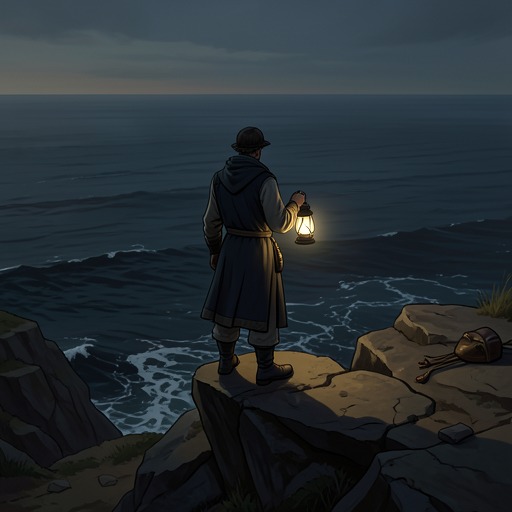
Nathan Oliver experiences Combe Island not as a place that must be made familiar, but as a home he can recover. On his first return seven years before the present events, he steps ashore from the launch with a sudden, almost triumphant exhilaration. Looking out from Peregrine Cottage toward the distant Cornish coast, he feels confirmed in his decision to return. The island’s sea-girt peace seems to promise that physical decline may slow and that his words, too, may come back. Place offers him both shelter and the hope of renewed creative power.
His claim on Atlantic Cottage is more deeply rooted than convenience. He was born there and believes he will die there; the stone cottage seems to grow from the dangerous cliff beneath it, while the sea’s rhythm answers something in his blood. His grandfather was a seaman who died at sea, and his father was once a boatman on Combe. Nathan Oliver lived with his father in the cottage until he was sixteen, then escaped the man’s alternating drunken rages and maudlin affection to try to make himself a writer. In the years of hardship, travel and loneliness that followed, Combe Island was not a comforting birthplace but a place bound up with violent feeling and forgotten trauma. His return therefore does not erase the past: the sense of coming home is powerful precisely because he once had to flee it.
The island’s boundary of belonging
The island’s social meaning is visible in Rupert Maycroft’s worries about Daniel Padgett and his mother. Maycroft had taken them on after Daniel wrote asking about work as a cook and handyman; the handyman vacancy and a suggestion that the household needed help made the appointment seem opportune. In practice, Daniel spent much of his time caring for his gravely ill mother, with Joanna Staveley and Mrs. Burbridge also helping. Neither complained, but Maycroft understands that they bore the cost of his decision. Daniel proved an excellent handyman, yet made it clear without words that he disliked living on the island.
After his mother’s death, Maycroft hears Mrs. Burbridge say that Daniel is not really an islander and may not stay. The phrase functions as a sharp social verdict: employment and residence have not made him feel at home, and others doubt that he belongs. His mother had wanted to spend her final months on Combe, which she had seen from shore visits to Pentworthy as a child and turned into a fantasy of refuge. Her imagined Shangri-La and Daniel’s quiet dislike of island life sit uneasily together. The same place can represent a longed-for sanctuary to one person and an unwanted posting to another.
Refuge, inheritance and exclusion
These experiences distinguish several meanings of home without making them interchangeable. Francis Benton-Smith seeks independence but cannot simply shed the family ties, cultural histories and uncertainty that shape his identity. Nathan Oliver finds a home in the very landscape from which he once escaped, joining childhood memory, ancestry and the hope of renewed writing to a claim on Atlantic Cottage. Daniel Padgett’s presence, meanwhile, shows that living and working on Combe Island does not by itself produce belonging. The island is refuge for some, but its community also has its own threshold of recognition.
The contrast turns home into both an inward attachment and a social condition. Nathan Oliver’s certainty is intensely personal, bound to a cottage, a coastline and a return; Francis Benton-Smith’s lack of secure footing persists across continents and into his professional life. For Daniel, the island’s promise of sanctuary belongs more to his mother’s longing than to his own experience. Together these strands make belonging less a matter of geography than of whether place, memory, identity and welcome can be brought into alignment.