Climbing: Overcoming Fear and Interdependence
The LighthouseClimbing in Combe Island becomes, for Francis Benton-Smith, both a test of nerve and a return to an old education in fear. As he descends a cliff to search for evidence and later climbs back up, the physical danger recalls his grandfather Hugh’s instruction and brings back an exhilaration Benton thought he had lost. The sequence also makes climbing a practical expression of trust: a climber commits to the rope, the belay, and another person’s attention, while remaining responsible for each move of his own.
An education in fear
Benton’s connection to climbing began with Hugh, whom he had always called by his first name. A twice-decorated fighter pilot in the Second World War, Hugh had struggled to adjust to civilian life after the deaths of his closest friends left him a reluctant, half-guilty survivor. His brittle, half-mocking manner concealed a loss that the adolescent Benton sensed even if he could not name it. Hugh’s obsessive amateur climbing offered the two a way to share an intensity that was more than sport.
What Hugh passed on was not simply technique. Benton understood that his grandfather was teaching him how to master fear: to acknowledge danger, find a hold, and continue deliberately rather than let panic dictate the next move. In Benton’s first year at university, Hugh fell to his death while climbing in Nepal. After that, Benton’s enthusiasm faded. His friends did not climb, and other interests took up his attention; more than a decade passed without the word karabiner coming readily to mind. The skill and its emotional meaning receded together.
The cliff as a return
The search below the cliff gives that past a present purpose. Jago Tamlyn prepares the rope and anchors it around a boulder with three joined slings and a karabiner. Benton watches the familiar equipment being assembled and recognizes how much of the vocabulary and routine he has forgotten. Jago’s control over the arrangements makes Benton suspect that the climb has been planned, but he is too proud to dispute the order. The risk is not abstract: the narrow strip of shore below is difficult to reach, the tide is advancing, and the search is for a hand-sized stone that might retain traces of blood.
As Jago explains that the climb is Very Severe, Benton’s memory briefly overlays the present with his first climbs beside Hugh. He recalls his grandfather asking if he was ready, and answers inwardly as the boy he once was. But it is Jago, not Hugh, who is actually speaking. Benton knows this is his last opportunity to withdraw. Adam Dalgliesh does not think Jago is the murderer, Benton reminds himself, and Dalgliesh has never yet been wrong. The thought offers reassurance, not certainty; Benton chooses to climb while knowing that the man above him may still be dangerous.
Before descending, Benton puts on a harness, helmet, and climbing gear. Kate Miskin gives him search gloves and a plastic exhibit bag to put in his pocket. The preparations take place largely in silence, which Benton recognizes as the familiar, purposeful ritual of a climb: a wordless gathering of courage and resolution. He compares it to a religious rite, with Hugh once occupying the role of priest and Benton that of acolyte. The comparison is undercut by Benton’s sardonic thought that he is more likely to become the sacrificial victim.
Descent, search, and renewed control
At the cliff edge, Benton braces his feet and leans backwards into space. The rope holds, and the initial terror gives way to the physical pleasure of moving down the rock. He controls the rope with both hands, feeling it slide through the karabiner and recognizing, in that moment, that he is in control of his descent. The remembered boyhood exhilaration returns after more than a decade away from climbing.
On the narrow shore, he puts on his gloves and searches carefully as the incoming tide reduces the ground available. The smooth stones are innumerable, and many are the right size and weight. Benton is looking for a heavy stone small enough to hold, potentially the weapon used in the killing, but every yard makes the search feel more fruitless while the climb back remains ahead. The physical setting presses time and uncertainty into the task: waves advance over the outcrop, water swirls through rock pools, and the polished stones make the evidence hard to distinguish from the terrain.
The ascent and shared dependence
The return climb is not a simple repetition of the descent. Benton takes the lead, ties the rope to his harness, and begins upwards while Jago belays him from a boulder below. For the first fifteen feet he moves cautiously, testing each handhold and foothold. He places nuts in cracks in the rock, attaches runners, and clips the rope in as he gains confidence. Then, about thirty feet above the ground, he freezes, stretched too far across the rock face. The granite feels wet and cold against his cheek; his shoulders are taut, and fear makes him afraid to search for another foothold.
Hugh’s remembered instruction returns at the moment Benton needs it: the climb is graded Very Severe, there will be a hold, and he should take it slowly. After what seems an eternity but lasts less than half a minute, he finds a higher hold and then footholds. The panic passes. At the overhanging roof, the climb reaches its crux. Benton locates a piton, clips in a runner, calls for a tight rope, and searches around the roof until his hand finds a hold above. He swings into the air, regains balance, places another runner, and secures himself. From there the rock is clean, with good holds to the top. He hauls himself over the edge exhausted, and Kate’s relieved face meets him there.
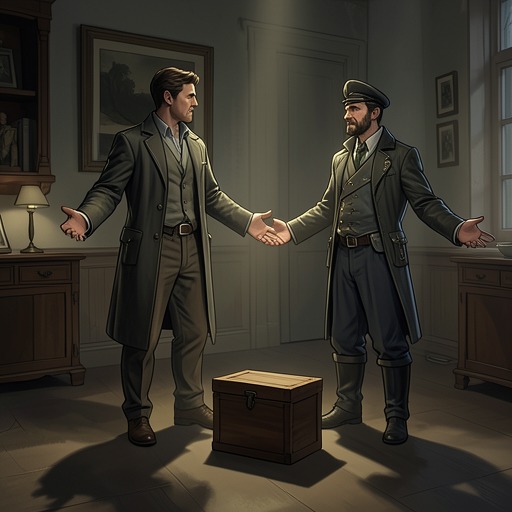
Benton then anchors himself to a large boulder and belays Jago’s ascent. The reversal matters: after relying on Jago to hold the rope, Benton now holds Jago’s life in his hands. He experiences this as the point of climbing—not solitary prowess but shared danger, mutual dependence, and fellowship. Jago climbs quickly, gathers the equipment, and briefly reaches out to shake Benton’s hand. Neither man speaks. Their silent exchange registers a connection made through the climb without resolving the danger or distrust that surrounded it.
A practice that continues
Climbing does not end with the search. During the days after the arrests, while the island remains under quarantine, Benton takes it up again with Jago. Kate sometimes sees one of them stretched against the granite crags during her solitary walks. The renewed practice is part of a broader period in which the investigation team, treated as guests on Combe Island, find room for solitude and companionship beyond their immediate police work.
The episode’s movement—from forgotten skill, through remembered fear, into renewed practice—shows that mastery is neither fearlessness nor escape from danger. Benton’s panic on the ascent is real, and he overcomes it by recalling an earlier lesson, moving carefully, and trusting the rope and belayer. Climbing reconnects him to Hugh without erasing the loss of his grandfather, and it gives him a present relationship with Jago founded, briefly and concretely, on reciprocal responsibility. Its exhilaration comes with risk; its fellowship depends on acknowledging that no climber is entirely self-sufficient.