Combe Island Chapel
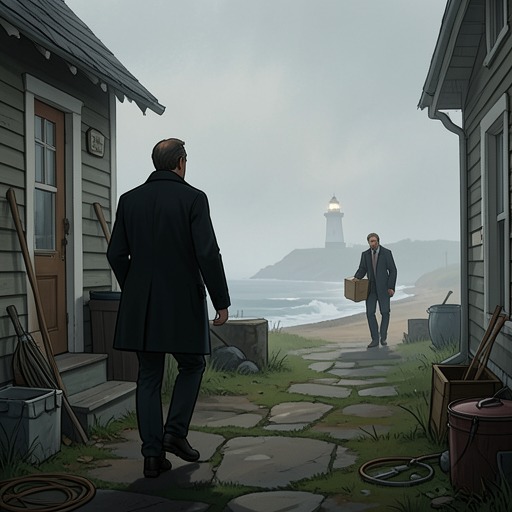
The LighthouseCombe Island Chapel is a small, plain building on Combe Island that serves both as a place of prayer and as the scene where Adrian Boyde is found murdered. Its uncertain origins and makeshift altar give it a spare, almost provisional character; after Boyde’s death, the blood on its stone floor turns that austerity into a lasting record of violence.
Setting and Appearance
The chapel stands about fifty yards beyond Chapel Cottage. It is more crudely built than the island’s cottages and measures no more than fifteen feet square. Its latched half-door resembles a stable door; inside, broken slabs pave the floor, and a single high window, its pane so grimy that little light passes through, affords only a blurred view of the sky. The enclosed, dim space contrasts with the bright room at Chapel Cottage, where Dalgliesh first finds Boyde at work.
A heavy, flat-topped boulder sits directly beneath the window and serves as an altar. It is bare except for two short silver candlesticks and a small wooden cross. When Dalgliesh enters, the candles are almost spent and he thinks he can detect the acrid trace of smoke. The boulder is so substantial that he wonders how it was brought there, estimating that half a dozen strong men might have been needed to move it.
There are no fixed benches. Two folding wooden chairs lean against a wall, and Dalgliesh supposes that one was put out for Mrs. Burbridge, apparently the only worshipper expected. The only outward sign that the building has been consecrated is a small stone cross set crookedly at the roof’s apex. Dalgliesh considers that it may originally have been built as an animal shelter and converted into a place of prayer only generations later; this is his conjecture, not an established account of the chapel’s history.
Prayer and the Past
Before entering the chapel, Dalgliesh sees Mrs. Burbridge in an old-fashioned tweed coat and felt trilby, carrying what appears to be a prayer book. Her presence suggests that she has attended a service and should now have returned to her cottage. Inside, the nearly burnt-out candles and the two chairs make the service seem intimate and sparsely attended, without establishing who conducted it or how regularly worship takes place there.
The building does not inspire in Dalgliesh the numinous awe he associates with ancient churches, where emptiness and the echo of plainsong can make a place feel sacred. Yet he closes the half-door more quietly than he otherwise would. He recognizes in that small gesture the persistence of his childhood as a priest’s son: the church calendar once organized the year for him through Advent, Christmas, Pentecost, and the Sundays after Trinity. The chapel therefore has a personal as well as a communal religious significance. Its modesty does not erase the habits of reverence that Dalgliesh carries into it.
Boyde’s Murder and the Investigation
On the morning Boyde is found dead, Dalgliesh first goes to Chapel Cottage. The door is open, but no one answers; upstairs, the bed has been made. He then crosses the roughly fifty yards to the chapel. The half-door is closed. When he opens it, he sees Boyde on the stone floor, about a foot from the improvised altar. A green embroidered cope covers most of the body, while Boyde’s stiff left hand protrudes from its edge. Dark blood shows through the green silk. A folding chair has been opened, and a long cardboard box rests on it with tissue paper spilling out.
Dalgliesh recognizes that Boyde is dead and immediately avoids touching the scene before putting on gloves. After summoning help, he returns in search gloves and examines the body. The lower face has been smashed, the nose broken, and both eyes obscured or destroyed by the injuries. The rigidity of the neck and hand indicates that Boyde died the previous night. Dalgliesh sees no identifiable footprints on the sandy turf and considers several possibilities: the killer might have waited in or near the chapel, watched from outside, or followed Boyde from Combe House. He bitterly reflects that, had he watched Seal Cottage’s door a little longer the night before, he might have seen another figure emerge from the darkness.
The chapel’s role in the investigation deepens when Dalgliesh considers Boyde’s knowledge as a confessor. He reasons that Boyde may have suspected Dan Padgett after Nathan Oliver’s murder, but could not disclose what he had heard in confession. Dalgliesh wonders whether Boyde went to Puffin Cottage to try to persuade Padgett to confess, and whether that attempt led to his own death. These are questions and inferences in Dalgliesh’s reconstruction, not events he witnesses inside the chapel. They connect its religious function—especially the obligation to keep a confession secret—to the silence surrounding the murder.
Bloodstains and Lasting Significance
Later, Kate enters the chapel alone and finds Dalgliesh looking down at the bloodstains. Mrs. Burbridge has wondered whether someone should scrub the floor, but decides instead to leave the door open and let time and the elements act on it. Dalgliesh questions whether the stain will ever disappear completely. The decision leaves the chapel exposed rather than restored to an untouched appearance: the marks of the killing remain visible, with their eventual fading uncertain.
As the helicopter takes the departing group away from Combe Island, Kate sees the square chapel among the familiar buildings below. Its bloodstain remains part of the view, alongside Seal Cottage and the lighthouse. The chapel has moved from an unobtrusive place of prayer to the site of a second killing and a physical reminder of the investigation’s failure to prevent Boyde’s death. Its plain architecture and sparse ritual objects do not explain the violence; instead, the contrast between the small altar, the discarded cope, and the blood on the floor makes the building a concentrated image of religious duty confronted by human harm.