Combe Island SARS quarantine
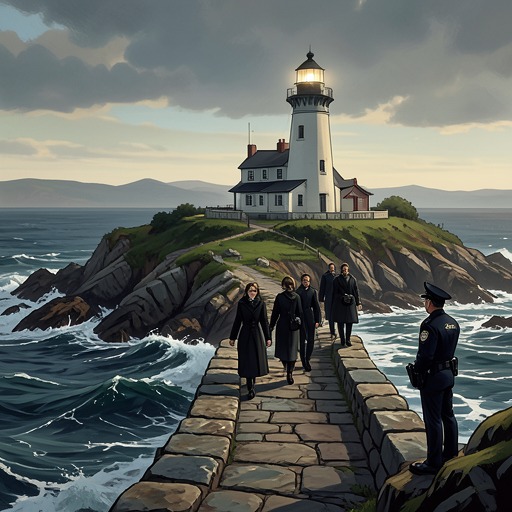
The LighthouseCombe Island SARS quarantine is the emergency response to Dr. Speidel’s confirmed infection, turning Combe Island’s distance from the mainland into a public-health boundary. The arrangement combined a request for residents to remain voluntarily with a practical restriction on departure: Rupert Maycroft controlled the launch and would not make it available until the incubation period had passed. The island’s residents therefore faced isolation amid a murder investigation, while the illness of Adam Dalgliesh made that isolation personal as well as administrative.
Trigger and Medical Basis
The decision followed a worsening sequence of events. After Dr. Speidel collapsed, Guy Staveley transferred him to Plymouth; Staveley had suspected SARS, and the diagnosis was subsequently confirmed. Dr. Speidel was placed in a special isolation unit there. His wife and some family members came from Germany, but could see him only under controlled conditions. He remained seriously ill.
Staveley explained that SARS spread primarily through close person-to-person contact, possibly through droplets from coughing or sneezing, or by touching a surface contaminated by infected droplets and then touching the nose, mouth, or eyes. Other forms of airborne transmission were possible but uncertain. Those who had been in close contact with Dr. Speidel or Dalgliesh were considered most at risk; nonetheless, Staveley recommended that everyone on Combe Island observe quarantine for about ten days.
The initial practical estimate came from Maycroft, who said the incubation period was believed to be ten days, pending further information from Staveley. If someone left, Maycroft expected they would be advised to stay at home and avoid other people until the period had passed. The time limit made the restriction finite, but did not make departure a realistic option: Maycroft said no visitors’ boats came to the island and none would be allowed to land now.
Authority and Operation
The quarantine was presented as voluntary rather than as an established compulsory order covering everyone on the island. Mark Yelland questioned the legal position, reasoning that the authorities could not impose compulsory measures unless people were infected. Staveley’s explanation qualified that assumption: the Public Health Authority had powers to enforce quarantine on an infected person and, in some cases, on people at risk. He did not claim that compulsory measures would necessarily apply to every resident, particularly those without close contact with Dr. Speidel or Dalgliesh. Instead, he asked the islanders to agree to stay until they were advised that it was safe to leave.
Maycroft supplied the immediate means of keeping people on the island. He described the restriction as little different from being unable to travel in thick fog or violent storms, and said that the launch was under his control and would remain unavailable through the incubation period. He asked whether anyone objected. The practical force of the policy lay in the combination of that control and the absence of visiting boats: even as the group was asked to consent, access to the mainland was constrained.
The response was not equally easy for everyone. Millie Tranter protested that she did not want to remain where people were being murdered and asked Jago Tamlyn to take her away in the launch. Yelland, though prepared to stay, raised the question of whether they were staying by choice. Daniel Padgett objected that the island was no longer home for him after his mother’s death and that he had a university-course interview in London; missing it, he feared, could cost him a place. Staveley nevertheless secured agreement to voluntary quarantine and undertook to inform the authorities.
Care, Exposure, and Daily Consequences
Staveley identified Dalgliesh and Jo Staveley, who had nursed Dr. Speidel, as the two people most at risk because of close exposure. Dalgliesh had helped Dr. Speidel after his collapse and accompanied him back to his cottage. When Staveley later addressed the residents, he reported that Dalgliesh had caught the infection and was in the island sickroom. Samples were to be taken to confirm the diagnosis, although Staveley said there could be little doubt. If Dalgliesh’s condition worsened, he too might be transferred by helicopter to Plymouth.
Staveley advised anyone who fell ill to report to the surgery. He described the usual early symptoms as fever and flu-like effects, including headache, general malaise, and body aches; some patients also began with a cough. His guidance converted the broad instruction to remain on the island into a basic procedure for monitoring illness and seeking care. Meanwhile, he and Jo cared for Dalgliesh. As his illness intensified, Dalgliesh was moved by medical staff into bed and received oxygen after severe coughing made breathing difficult. In disjointed recollection, he remembered insisting that he must remain on Combe Island.
Quarantine and the Murder Investigations
The restriction coincided with the murder inquiry rather than suspending it. Staveley told the residents that the killing of Adrian Boyde remained in the hands of Inspector Kate Miskin and Sergeant Francis Benton-Smith, and asked for cooperation as before. Maycroft warned that news of the crisis would end the island’s privacy: the story was expected on the one o’clock radio and television bulletins, and newspapers and supplies were to arrive by helicopter the next day. The island was isolated from ordinary visitors but not from public attention or the practical demands of the investigation.
Dalgliesh’s illness also complicated the search for proof. While confined to bed, he urgently wanted Kate to find the phial of blood and the lock of Martha Padgett’s hair. He regarded motive and opportunity as insufficient on their own: other people had reasons to hate Nathan Oliver and could have reached the lighthouse unseen. Without the samples, he feared, the case might not come to court. His anxiety shows how the quarantine’s medical consequences intersected with the demands of police work: he was seriously ill, but still focused on evidence that could make the murder case sustainable.
The arrangement thus held together a public-health appeal, Maycroft’s control of the launch, and the islanders’ practical acceptance of staying put. Its stated duration was about ten days, but its effects varied: some residents treated Combe as home, others experienced it as confinement, and Dalgliesh’s illness brought medical care and the unfinished inquiry into the same sickroom. The quarantine temporarily made remaining on the island both a collective responsibility and, for Dalgliesh, the condition under which he could continue to direct attention toward the case.