Combe Island lighthouse
The LighthouseThe Combe Island lighthouse is a restored, disused tower on a rocky spur west of Combe House, and one of the novel’s most consequential locations. It first appears as an elegant landmark against the sea; the mist then makes it the scene where Rupert Maycroft discovers Nathan Oliver’s hanging body. Its architecture and store of climbing ropes supply crucial evidence that the death was staged, while its wartime fire connects the present investigation to an older act of concealment. In the final crisis, the same tower becomes a perilous refuge and a place of arrest.
Setting and architecture
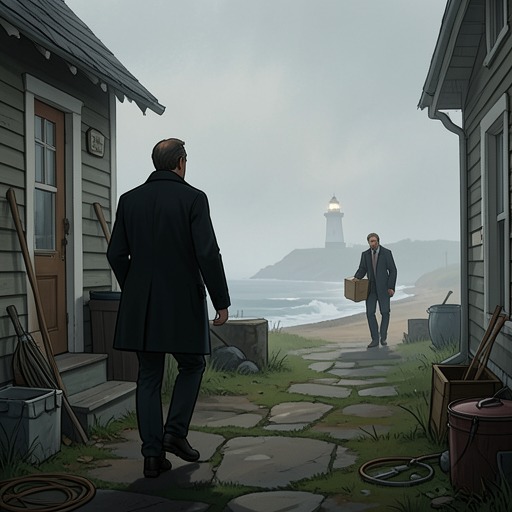
From Combe House, the tower stands against the sea with white-painted walls and a red lantern. Its height and isolated position make it visible as a distinct feature of the island, but its setting also cuts it off: a grassy mound encircles the approach, and the heavy oak door cannot be seen from beyond that rise. On the seaward side, a small paved area ends at a rough dry-stone wall; beyond it, sheer rock drops toward the water. The view offers both a dramatic prospect and a lethal fall, a contrast that later makes the staged hanging difficult to accept as suicide.
The lighthouse was modelled on the one designed by Smeaton, which was taken down in 1881 and rebuilt on Plymouth Hoe as a monument. The island tower is described as almost as high and similarly elegant. Its slightly concave, glistening shaft rises about fifty feet to a red upper structure and a railed platform around the lantern. The roof has the shape of a mandarin’s hat, with a bobble and weather vane; high above the entrance are four narrow-paned windows. Seen close, the unusual, almost childlike ornament contrasts with the exposed rock and the sheer drop nearby.
The lighthouse’s former working purpose has passed to a modern, automatic lighthouse on the island’s north-west tip, run by Trinity House and inspected periodically by its boat. The older tower is therefore not a functioning navigational station. Its restoration preserves the appearance of an earlier working lighthouse, while its current rooms serve more modest uses, including storage. This separation between a maintained monument and an active light leaves the old tower available as a private, secluded place—and as a setting in which activity can escape ordinary observation.
Abandonment, restoration, and access
After the modern lighthouse was built, the older tower was neglected. During the Second World War, when Combe Island was evacuated, a fire destroyed its upper three storeys; the building was then left derelict. A visitor who was an enthusiast for lighthouses later provided the money for its restoration. The work was carried out with close attention to detail, recreating, as far as possible, the lighthouse as it had last been used. The repaired exterior thus carries a concealed history of damage beneath its polished appearance.
The entrance arrangements reflect the island’s unusual approach to privacy. A key had once been provided after the restoration, but it had been missing for years and had not been replaced. Maycroft explains that the island had no children and did not admit casual visitors, so there seemed no reason to keep the door locked. There is, however, a bolt on the inside. The visitor who funded the restoration had used the platform beneath the lantern as a place where he could sit without being disturbed. The bolt was left in place, although Maycroft doubted that anyone used it. These details make access uncertain rather than simply open: the lighthouse is not routinely watched, yet its door can be secured from within.
That arrangement matters when Raimund Speidel reports that the door was locked on his arrival and open when he returned about twenty minutes later, by which time the climbing rope was missing. His account makes it possible that someone was inside, but does not establish whether that person was Oliver, his killer, or both. Speidel’s evidence is also treated cautiously because he could have lied about the locked door and about never meeting Oliver. The building’s unmonitored privacy allows the account to remain a genuine investigative possibility without making it proof.
Discovery and the staged hanging
At about ten in the morning, Maycroft goes to search for Oliver. With mist thickening, he decides that there is little point in searching farther and that they should try the lighthouse. The figures accompanying him disappear one by one into the fog, their voices fading. He finds the door ajar, enters, climbs past the fuel room, and calls Oliver’s name on the stairs. When the mist begins to lift, the white tower, red lantern, sea, and sky gradually return to view—and with them the body, suspended high against the lighthouse walls.
The body is held by the blue-and-red climbing rope, pulled taut to the railings. Oliver’s head hangs to one side, his hands turn outward, and his neck is visibly distorted. Maycroft’s discovery brings an apparently private search abruptly into public view: others arrive, Millie Tranter screams, and the body is eventually lowered and carried into one of the sickrooms at Combe House. The rope is left in the lighthouse. The decision to move Oliver is presented as a response to the indignity of leaving him alone at the foot of the tower, even under a sheet.
The physical examination overturns the appearance of suicide. The ligature mark is vivid, and the extensive bruise beneath Oliver’s right ear measures about five centimetres square. On the left side of the neck are two distinct circular bruises, probably made by fingers; a possible thumb mark on the right is obscured by the knot. The medical conclusion is that Oliver was strangled before he was hung. The bruise at the back of his neck is consistent with his head being forced against a hard surface, and there is no possibility that he produced the marks himself to make a suicide resemble murder.
The tower’s rope store provides another part of the reconstruction. In the ground-floor chamber, which is used for storage, six hooks hang above a chest. Five ropes are carefully coiled; the sixth hangs loose, its end twisted into a small loop. Its bowline and two half-hitches form an unusual combination, suggesting either inexperience with rope or an unusual reason for choosing that arrangement. The ligature also leaves a repeated surface pattern unlike what would be expected from an ordinary rope; it may have a strong nylon core and patterned outer cover, as in a climbing rope. Maycroft estimates that Oliver’s body had dangled twelve to fourteen feet below the platform, where the rope had been threaded through the railings and over the top. The tower is not just the place where the body is found: its ropes, height, door, and platform become evidence for how the apparent hanging was arranged.
The tower’s wartime secret
The lighthouse also holds a much older death scene. During the early months of the war, three German officers from the occupied Channel Islands landed on Combe Island. They went to the top of the disused tower, apparently to survey the island; one possibility was that they intended to plant a German flag there. Saul Oliver discovered their boat and inferred where they had gone. At the time, the lighthouse ground floor was packed with dry straw used as animal fodder. Saul set the straw alight, and smoke and flames rose into the upper chamber, trapping the men because the railings were unsafe and the entrance had long been nailed shut to prevent accidents.
All three officers died, probably from suffocation. After the fire had burnt out, Saul found their bodies halfway up the tower, carried them back to their boat, and took the boat out with a dinghy before scuttling it in deep water. Nathan Oliver was on the island and about four years old at the time. The revelation gives the ruined upper storeys a specific history: their wartime fire was not an unexplained accident but the result of Saul’s deliberate act, followed by the disposal of bodies and evidence. The tower’s decay and later careful restoration therefore cover a past that the investigation must bring back into view.
Later searches and the final crisis
The lighthouse continues to anchor the inquiry even when investigators move beyond it. Adam Dalgliesh, confined to a sickroom during the island’s SARS outbreak, remembers smoke rising from the lighthouse platform and connects the image with Adrian Boyde’s insistence that he had seen no one on a Saturday walk. Boyde had called at Puffin Cottage to speak to Daniel Padgett, but Padgett was not there. The remembered lighthouse image and the missing encounter help Dalgliesh return to the unresolved sequence of the crime while he is too ill to investigate in person.
The search for physical evidence also extends to the cliffs near the chapel. Kate Miskin says that the object may have been thrown over either the upper or lower cliff and asks Jago Tamlyn to help with an abseiling search. The party descends to the lower cliff and follows a narrow plateau above an incoming tide. There, close to the cliff edge, Benton finds an egg-shaped stone partly enclosed in the remnant of a surgical glove. One finger and part of the palm remain; the latex has otherwise been torn away, rolled by the waves, and blown off. A reddish stain on the stone appears to be blood. This discovery shifts attention from the conspicuous hanging to a concealed object that may preserve evidence of the killing.
At the climax, the lighthouse becomes the setting for Padgett’s attempt to escape and his seizure of Millie. As Benton gains on him, Jago appears around the house and collides with him; Padgett gets up and races toward the tower. Millie comes around its edge just as Padgett reaches the door, and he drags her inside. On the gallery, he holds her by one arm as she stands on an outside ledge only six inches wide, then edges her toward the seaward curve. Kate and Benton move quietly around the gallery. Kate approaches first, aware that Padgett’s fear, hatred, and determination make every word consequential for Millie’s survival. She speaks the words of arrest, bringing the lighthouse’s recurring role in the investigation to a final, immediate test: a place that concealed violence becomes the exposed stage on which the killer is stopped.