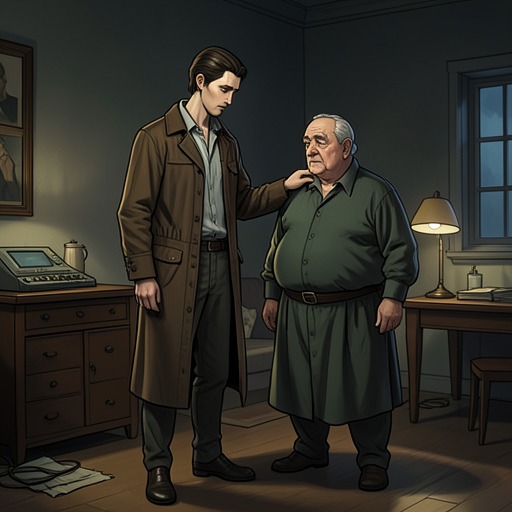
Dan Padgett—Adrian Boyde
The LighthouseDan Padgett and Adrian Boyde were connected by a secret that made Boyde both Dan’s potential guide and a threat to his silence. Boyde had learned that Dan was Nathan Oliver’s son while ministering to Dan’s dying mother, Martha Padgett. Bound by the seal of the confessional, he could not disclose her confidence; after the secret came to shape Dan’s actions, Boyde’s attempts to reach him culminated in Boyde’s death at the Combe Island Chapel.
A secret held in confidence
Martha confided Dan’s paternity to Boyde, the person she uniquely trusted with the revelation. Although he helped care for her, she and Mrs. Burbridge were the only people who regarded him as a priest to whom they could make a confession. That trust placed Boyde under a strict obligation: he could not simply tell the police what he had learned, even if the secret became relevant to a murder investigation.
The account reconstructs Boyde as having urged Martha to tell Dan herself. This left him caught between respect for her confidence and the possibility that Dan had a right to know who his father was. Martha eventually had to be the one to tell her son that the man he hated was his father; Boyde could encourage disclosure, but could not make the revelation in her place.
Boyde’s attempts to reach Dan
After Nathan Oliver’s murder, Boyde appears to have suspected Dan. On Saturday morning he called at Puffin Cottage to speak with him, but Dan was not there. Boyde could have reported that absence to the police, yet doing so would not have exposed the original confession; instead, the reconstruction suggests that he may have hoped to persuade Dan to confess and seek spiritual repair. That possibility fits Boyde’s continuing effort to act on what he knew without breaking the confidence entrusted to him.
Boyde’s later visit to the cottage on Monday night is presented as a possible last attempt to reach Dan. The precise intention is not established, nor is it certain whether Boyde understood the danger he faced. The possibility that he returned toward the chapel because he sensed someone following him remains conjectural. What is clear is the tragic narrowing of his choices: he could not reveal the secret, but his silence did not protect him from the violence it helped set in motion.
The killing and Dan’s account
Dan later claimed that killing Boyde was impulsive. In his account, he removed his jacket, picked up a stone, and followed Boyde into the chapel. The preparations complicate that explanation: gloves were among the nursing items left in Dan’s cottage, suggesting that he had come equipped rather than acting wholly on the spur of the moment.
Dan said Boyde was on his knees, then rose to confront him. According to Dan, Boyde neither tried to escape nor defended himself, and Dan believed that Boyde wanted to die. This is Dan’s interpretation of Boyde’s conduct, not an independently confirmed account of Boyde’s intention. The contrast between Dan’s claim of sudden impulse and the gloves, stone, and pursuit leaves the circumstances of the killing morally and psychologically unsettled.
A bond turned fatal
Boyde’s connection to Dan began through Martha’s confidence and became a conflict over what could be told, by whom, and at what cost. His pastoral role offered a possible path toward confession, but the obligation that defined that role also prevented him from using the secret as ordinary evidence. Dan, meanwhile, faced a revelation bound up with the father he hated; Boyde’s effort to bring him toward acknowledgment ended not in reconciliation but in violence.
Their relationship therefore joins care and danger without making them equivalent. Boyde tried to guide Dan while preserving Martha’s confidence; Dan killed the man who knew the secret and sought to reach him. The murder turns the confessional silence into a tragic constraint: it protected the confidence itself, but could not prevent the secret from becoming part of the chain of violence.