Emily Holcombe
The LighthouseEmily Holcombe is the last surviving member of the family that once owned Combe Island, a former Oxford academic with a right to live out her life in Atlantic Cottage. Her claim to the house makes her a direct opponent of Nathan Oliver, but her significance reaches beyond that dispute: her recollections of the island’s wartime past connect its present inhabitants to concealed deaths and unresolved suspicions. She is neither a passive relic nor a simple guardian of tradition. She can be fiercely protective, candid about her own selfishness, and willing to resist both Oliver’s demands and the assumptions of those around her.
Identity and Background
More than eighty years old and a historian by training, Emily has returned to the island of her childhood intending to remain in its cliff-edge cottage for the rest of her life. She had visited Combe Island every year as a child and later as an adolescent; her grandfather built the family house there. Her connection to the place is therefore at once legal, familial, and personal. Though she resigned as a Trustee years earlier, the Trust deed gives her a lifetime right to live on the island, while its admission provisions also prevent the Trust from refusing Nathan Oliver, the only living person born there.
Emily’s account of her appearance and habits resists the idea that age has made her indifferent to herself. For five years, since turning seventy-five, she has followed a daily routine of applying moisturising cream after her shower. She doubts that it can do more than briefly soften age’s effects and wonders whether the effort is pointless, yet continues. In youth and middle age she had taken little care with her looks; she was strong-featured and handsome, with high cheekbones, hazel eyes, and a face some found intimidating. The routine is less a bid to please others than a private act of self-regard: she asks herself whom she has ever wished to gratify but herself.
Her independence coexists with durable affection and a capacity to make practical attachments. Arthur Roughtwood, once her father’s driver, asked to become her butler when she was arranging the final affairs of the family home on the edge of Exmoor. She believes hiring him was a good decision for them both. He lives in the smaller, semi-detached portion of Atlantic Cottage, and their daily arrangements show a settled household built around mutual familiarity. When Kate Miskin and Francis Benton-Smith visit, Emily remains seated over her Saturday Scrabble game while Roughtwood sits opposite her; she even keeps an eye on him, as if reassuring herself that he will not move away.
Atlantic Cottage and Nathan Oliver
Emily’s residence becomes a point of conflict when Nathan Oliver wants Atlantic Cottage. It is the largest cottage, close to the cliff, and prized for its views. Emily has no intention of surrendering it, and Rupert Maycroft, the Trust’s administrator, says he will not ask her to leave. Oliver’s status as an internationally celebrated novelist does not, in her view, excuse selfishness or self-indulgence. Her position is not a general rejection of artistic talent: she respects his writing, while refusing the claim that genius should entitle him to behave worse than other people.
The quarrel also reflects her understanding of Oliver’s place in the island community. He arrived every three months, usually with his daughter Miranda Oliver and his copy-editor and secretary Dennis Tremlett, and stayed for two weeks. His visits, as Emily describes them, disturbed the residents and reminded them that Oliver regarded their life as irrelevant to the world beyond the island. Yet she grants that he served a purpose: by puncturing their complacency, he unsettled the retreat they had built for themselves. She calls him a necessary evil, a judgment that combines resentment with recognition rather than reducing him to a mere intruder.
Emily is alert to the damage she thinks Oliver does to other people. She sees his treatment of Millie Tranter as typical: he watched people, made use of them, and sought proximity to their suffering, an impulse she recognizes in his novels. In her speculation about his death, she imagines that he might have staged a dangerous encounter with hanging in order to experience it for his writing. Perhaps, she suggests, he put a rope around his neck and stepped over the lighthouse rail while believing he remained in control. She even imagines the perilous mixture of terror and exhilaration such an experiment might offer. Her theory is wrong: Adam Dalgliesh knows Oliver’s neck marks were made before he was hanged and that Oliver was already dead. The episode nonetheless reveals how firmly Emily’s reading of Oliver’s life and art is shaped by her belief that he turned human experience into material.
The Island’s Buried History
Emily’s most consequential testimony concerns the island’s past. She explains that her family acquired Combe Island in the sixteenth century, after it had already become feared for piracy and the capture and enslavement of young people. Mediterranean pirates used it as a place of imprisonment, rape, and torture; the island’s reputation persisted among local people long after the family took possession. Emily grew up largely untroubled by that folk history, as did her family, but her later recollections show that the island’s reputation for hidden violence was not merely legend.
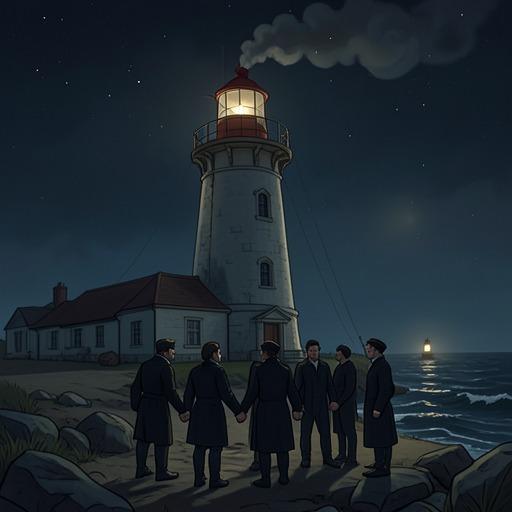
Her memories reach back to the Second World War. The island was evacuated after the fall of France and the death of Emily’s brother at Dunkirk; the family left in 1940, while Saul Oliver, the boatman, and his son Nathan stayed behind for an additional night. Emily knew Saul as a fine sailor and as a difficult, sometimes violent man, and remembered the boy Nathan as self-contained, uncommunicative, and strong-willed. In the account she gives Dalgliesh, she says that she threw the dead men into the sea and regarded the act that led to their deaths as murder. She saw no reason to contact the German authorities: the men had died horribly and, she believed, to no purpose.
When Dalgliesh presses her on how Saul could have carried three young men down the lighthouse stairs, scuttled a boat, and returned alone, Emily supplies a crucial missing detail: Saul had taken Nathan and Tom Tamlyn with him. After the boat was scuttled, the three returned to Combe and later set out for the mainland. Tom did not reach shore. Saul said he fell overboard in a storm, but his body was found six weeks later with the back of the skull smashed, and the coroner returned an open verdict. Emily reports that the Tamlyn family always believed Tom was murdered by Nathan to conceal what had happened. She does not present that suspicion as proven fact; its force lies in the way one unclosed wartime secret shadows the island’s later deaths.
Witness to the Investigation and Its Aftermath
Emily is an important witness partly because she is willing to say what others might soften. When Dalgliesh visits her late, she admits that the timing is partly for her convenience and acknowledges that islanders might call her selfish. She compares herself to Oliver, then explains why she disliked him: he could not tolerate being liked, and she has never accepted genius as an excuse for bad behaviour. Her frankness gives the investigation not only facts but a distinctive interpretation of the island’s relationships and the novelist’s effect on them.
After Adrian Boyde’s murder, the island’s assumption of safety gives way to fear. Rupert Maycroft recommends that residents gather in Combe House, where vacant guest suites and stable accommodation are available, and that they bring what they need while police search the cottages. Emily refuses to leave Atlantic Cottage. She believes its locks offer protection, and says Roughtwood can protect her if necessary; staying, she argues, is preferable to the inconvenience of confining everyone together. Her decision expresses the same independence that governs her claim to the cottage: danger does not automatically cancel her right to choose where she lives.
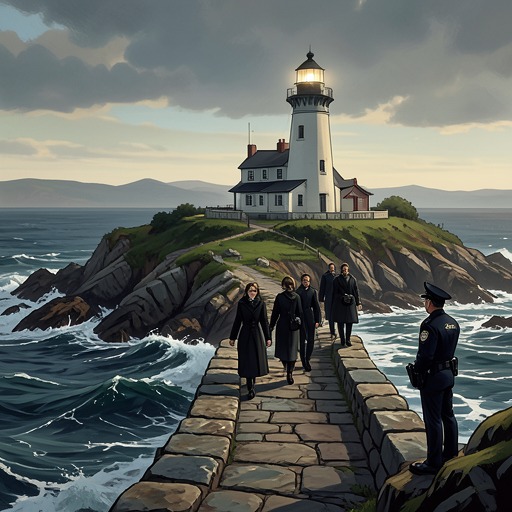
During the lighthouse hostage crisis, Emily appears with Roughtwood, Mrs. Burbridge, and Mrs. Plunkett after the chase is noticed from the house. She asks what has happened and where Dan Padgett is, then learns that he is in the lighthouse with Millie. Kate Miskin decides against bringing in a rescue helicopter immediately, fearing that a larger audience could provoke Padgett to throw Millie from the tower. She sends the women back to the house. Emily walks away very upright and a little alone, a brief image of composure that does not erase her isolation.
Change, Continuity, and Narrative Role
Emily’s clearest change is not a conversion but a widening of the past she must carry. She begins as the formidable defender of her home and a critic of Oliver’s conduct; her wartime testimony reveals that her attachment to Combe Island also involves knowledge of violence that the island’s present order has never fully resolved. Her account cannot settle every question surrounding the deaths, but it complicates the distinction between the island as refuge and the island as a place where people and evidence could disappear.
After the murders, Emily is also implicated in the question of what the Trust should become. Some Trustees propose a holiday home for deprived children, an idea she rejects; another proposal, to accommodate overworked city clergy as a memorial to Adrian Boyde, also meets her disapproval. She favours the Book of Common Prayer over newer forms of worship, though she does not attend church. The alternatives reported by Mrs. Plunkett show Emily resisting attempts to remake the island according to other people’s ideals, just as she resisted Oliver’s attempt to take her cottage. Her conservatism is specific and active: she defends a chosen form of life, not simply the past for its own sake.
Through Emily, Combe Island’s privacy and apparent security are shown to have limits. Her lifetime residence right protects her place there, but it cannot make the island immune to intrusion, murder, or the return of buried history. She remains a survivor and a witness rather than a detective: the investigation challenges her belief that Oliver may have experimented with death, while her own recollections expose how much the island’s present depends on uncertain accounts of its past.