Green embroidered cope
The LighthouseThe Green embroidered cope is a handmade silk vestment whose passage from a retirement gift to the covering on Adrian Boyde’s murdered body binds the island’s quiet creative work to its violence. Made by Mrs. Burbridge and given to Boyde to admire and wear, it was meant eventually to leave Combe Island for a bishop. Instead, its green silk was found spread over Boyde in the chapel, turning an act of kindness into a source of shock and painful uncertainty for its maker.
Design and Making
Mrs. Burbridge’s sewing room reveals the work behind the cope. In a light room at the end of a passage, boxes of coloured silk thread, rolls of silk cloth, and a notice-board of samples, photographs, and designs surround the tables. The cope is displayed on a tailor’s dummy: rich green silk embroidered with matching panels of delicate foliage and spring flowers. The design is Mrs. Burbridge’s as well as the embroidery, and it reflects the care she brings to both stages of the craft.
Her work grew from a practical request. When the altar frontal in her husband’s church began to come apart at the seams, the vicar’s warden suggested that she make a replacement. Mrs. Burbridge had been taking her City & Guilds examination during the 1950s, when church embroidery was moving beyond conventional bands of braid and standard central motifs towards more imaginative designs shaped by mid-century aesthetics. She describes herself as an amateur who works only in silk, while recognizing that others make more elaborate and original pieces. The cope belongs to this personal, skilled practice: a designed garment made by someone whose experience connects contemporary needlework with the needs of a church community.
The garment also represents a network of assistance rather than a purely private hobby. Mrs. Burbridge mostly embroiders for friends; they pay for materials and contribute towards the money she gives Millie Tranter. During Dalgliesh and Kate’s visit, Millie is at work on a cream stole, dressed in a clean white overall and concentrating on a fine needle as she stitches an appliquéd silk design. The finished cope and the small piece Millie is making place the craft within a shared routine of instruction, paid help, and careful labor.
Gift and Intended Use
The cope is a retirement present for a bishop. Mrs. Burbridge chooses green because it is the liturgical colour for Epiphany and Trinity, but favors spring flowers for the embroidery, imagining that the recipient would prefer them. Its intended destination gives the garment both a religious function and a personal character: its color follows the church calendar, while its floral design reflects the maker’s considered choice.
Boyde had previously carried Mrs. Burbridge’s vestments to their recipients, a task that gave him a rare and, she thought, welcome opportunity to leave the island. She expected him to deliver the cope to the bishop the following week. After Nathan Oliver’s murder, however, taking it off Combe Island was not yet possible. Mrs. Burbridge had packed it in a long cardboard box, but the immediate purpose was not transport: she wanted Boyde to have the pleasure of trying it on, perhaps while saying Evensong. She thought it would help to know whether it sat comfortably. He would not wear it to celebrate Mass, she explained, because that would not be suitable.
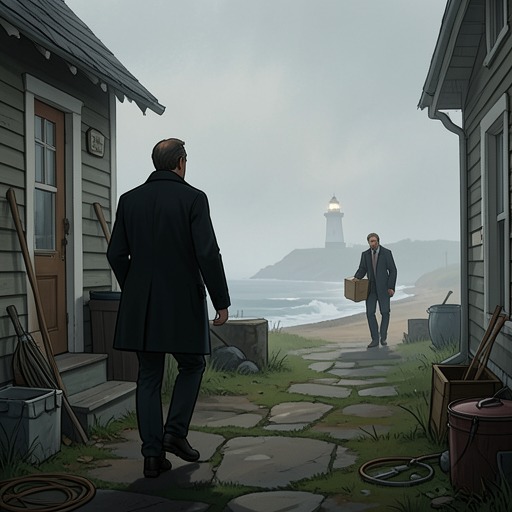
Boyde visited Mrs. Burbridge after dinner to see the finished garment. He stayed for about twenty-five minutes and left carrying the box at roughly five to nine. Later that night Dalgliesh saw him return to Chapel Cottage with the long, narrow box on his shoulder. Boyde put it down, opened the cottage door, hesitated, then picked it up again and walked towards the chapel. The sight of the box, which Dalgliesh recognized from the sewing room, supplies a concrete link between the gift’s ordinary journey and the events that followed; it does not, by itself, explain why Boyde took it to the chapel.
Discovery and Aftermath
The next morning Dalgliesh found Boyde dead on the chapel’s stone floor, a foot from the improvised altar. The cope covered nearly all of the body, leaving Boyde’s left hand protruding from its edge. Dark bloodstains showed through the green silk. Nearby, the folding chair had been opened and the cardboard box rested on it, its tissue paper spilling out. The garment’s vivid presence in that arrangement makes it inseparable from the discovery, although the evidence distinguishes its placement from the cause of death: it had been laid over Boyde, not used to suffocate him.
When Kate spoke with Mrs. Burbridge after the discovery, the seamstress looked around her sewing room as though seeing it anew. The colored silk, design samples, and folded cloth Millie had worked on had become, in Kate’s perception, innocent creativity permanently marked by horror. Mrs. Burbridge herself quickly connected the death to her gift, asking whether it was the cope and acknowledging that she had given it to Boyde. Kate explained that it had been placed over the body but had not killed him. Mrs. Burbridge then asked whether it was stained with his blood. Her distress shows how the garment’s meaning has changed: what she made as a beautiful, carefully considered present has become material evidence in a murder and a burden of association for the person who gave it.
Narrative Significance
The cope moves through several distinct roles without losing its material identity: an object of skilled labor, a church vestment, a retirement gift, a possible source of pleasure for Boyde, and finally the covering over his corpse. Its green silk and spring-flower panels carry the intentions invested in its making into the chapel, where blood darkens the fabric. The contrast does not make the craft itself culpable; rather, it shows how violence can seize an object created for care and redirect its meaning.
Its physical details also help the investigation remain grounded in observed circumstances. Dalgliesh recognizes the box because he has seen the cope in Mrs. Burbridge’s sewing room; he later sees Boyde carry it towards the chapel, and the body is found beneath it. Mrs. Burbridge’s account supplies the timing and explains why Boyde had the boxed garment, while the placement on the body establishes a troubling association without making the cope the murder weapon. The object therefore connects testimony, observation, and discovery, while its transformation from gift to bloodstained covering gives the case one of its most affecting images.